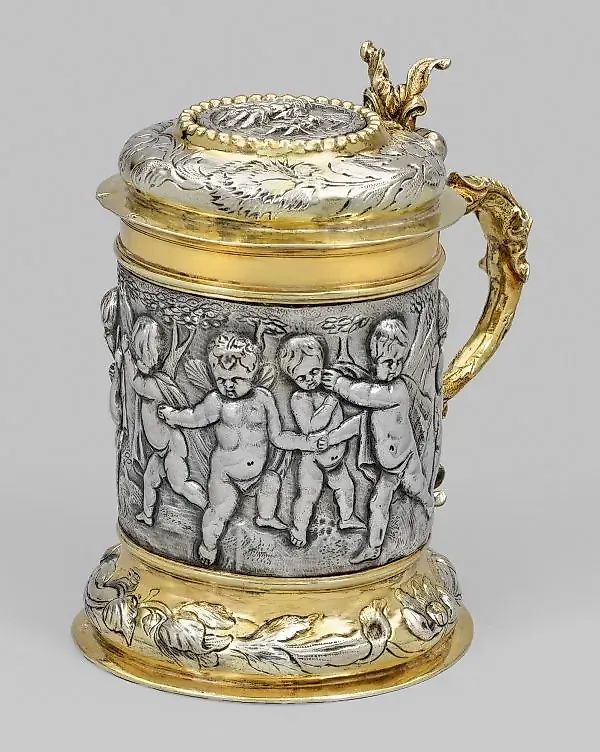
Hamburg Baroque humpen
Description
Silver, partially gilded. A curved base framed by a relief plastic band made of large, finely chased flowers and leaves, as well as a smooth ring of the base. The cylindrical body, bounded by narrow profiled rings, with a multiple profiled smooth edge. The paneled walls are decorated with a highly relief plastic and finely engraved row of dancing and music-playing putti in front of a wooded landscape. The lid with a convex rim, with corresponding floral and leaf decorations and a smooth edge. The central round plate, bordered by a wreath of laurel and a beaded pearl, with a relief depiction of David and Goliath. The handle in the shape of an "S", relief-worked and plastically executed, ends with two or three jointed cartilaginous ornaments. On the underside of the ring, an ancient Greek inscription is engraved. On the edge and underside of the ring, "75" is repeatedly stamped. Gilded inside. Marked, several trembling lines, assay mark, master Hans Lambrecht III (master since 1630), Moscow re-assay mark from 1778. Weight about 905 g. Height 19.5 cm. Hamburg silverware entered Russia in the 18th century thanks to the expansion of trade relations, including this luxurious lidded jug. Other jugs by Hans Lambrecht III can be found, among others, in the Hamburg Museum of History in Hamburg, in the Metropolitan Museum in New York, and in the Royal Collection in England. See Schliemann, Vol. II, p. 33, No. 168, pp. 102-107; for another lidded jug by the master see here Vol. III, fig. 264, as well as a comparable Hamburg jug circa 1660 in the catalog Schöner Trinken, Basel 2022, cat. no. 110. Rare German Baroque gilded silver jug with figural scenes and an ancient Greek inscription by master Hans Lambrecht III (master since 1630). Gilded inside.
Similar lots
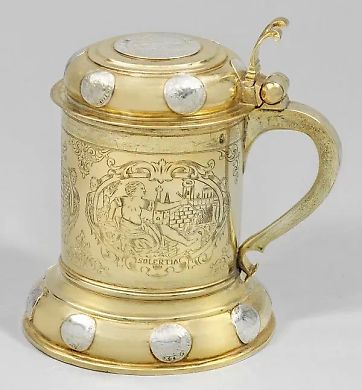
Lot No. 13161 Baroque hampen
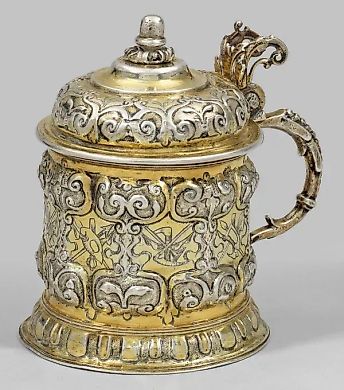
Lot No. 13140 Silver mug
Lot No. 14501 Little cream cake
Goldsmiths & Silversmiths
Lot No. 13164 Silver Cup
Lot No. 10027 LUXURIOUS SILVER DECANTER IN HISTORICISM STYLE
Lot No. 13155 Baroque pouf
Lot No. 13144 Cup
Lot No. 13158 Silver Cup
Lot No. 13147 Silver Cup
Lot No. 14470 Meissen coffee pot with a house in pictorial pu…
Meissen (Meissen)