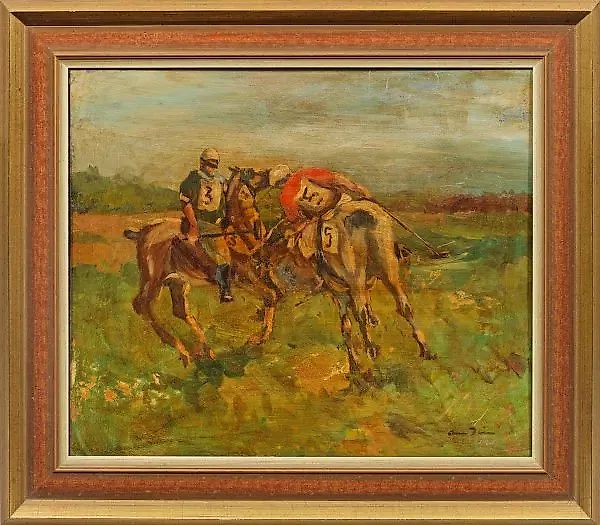
Polo Virtuoso: A Bright Work of a Late Impressionist
Description
(1884 Neustadt an der Hardt – 1957 Bad Dürkheim) A virtuoso polo player who painted in a swift style, partially executed in an impasto manner – a vibrant work of the late Impressionist, likely created around 1950–1955. Works dedicated to hunting and equestrian sports, such as gallops and trottings, as well as polo games and carriage races, occupy a significant place in Dill's oeuvre from the 1920s onward. Here, he could express his mastery of depicting dynamic, rapid movements. Dill frequently attended horse races and polo games, including those in Munich and Iffezheim near Baden-Baden, which he captured with great liveliness and a captivating eye for horses, riders, and the glamorous atmosphere. From 1908 to 1914, he studied at the Munich Academy, as a master student of Heinrich von Zügel. As early as 1917, Dill presented a large collection of paintings and drawings at the Crystal Palace. From 1922 to 1930, he was a member of the Munich Secession. In 1924, he was awarded the title of professor, and in 1949, he was appointed an honorary member of the Munich Academy of Fine Arts. In 1930, the artist moved from Munich to the town of Neustadt an der Weinstraße, and in 1941, he relocated to Bad Dürkheim. Alongside Max Slevogt, Otto Dill is considered one of the most important painters of Palatine classical modernism. Oil on plywood. Signed. 50 cm x 59.5 cm. Framed. Provenance: German private collection, Rhineland-Palatinate.
Otto Dill
Additional lots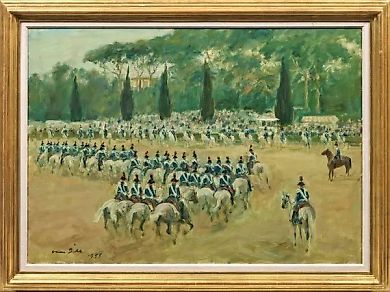
Lot No. 14612 Carousel of the Carabinieri
Otto Dill
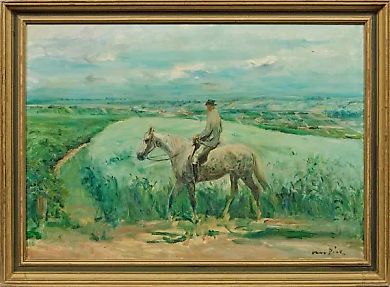
Lot No. 14611 "The landowner riding across his field"
Otto Dill
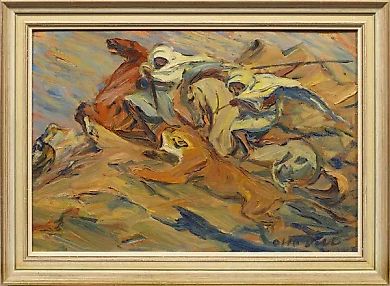
Lot No. 14617 "Lion hunting" is a great skill.
Otto Dill
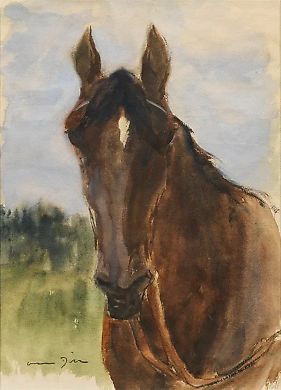
Lot No. 14608 "Horse Head: Art and Sport"
Otto Dill
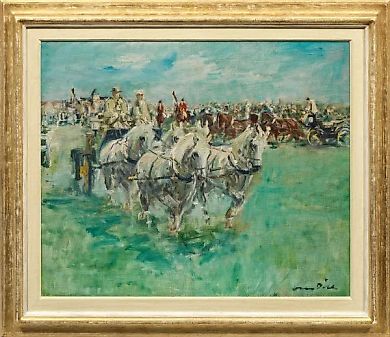
Lot No. 14607 An exquisite perspective on art
Otto Dill
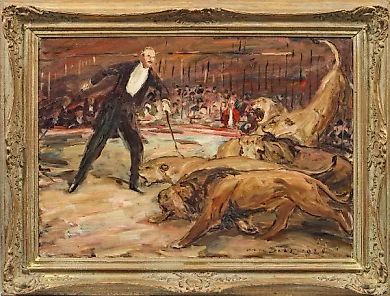
Lot No. 14614 Lion Tamer
Otto Dill
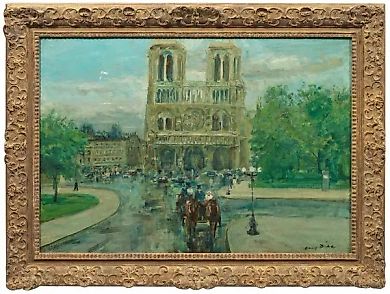
Lot No. 14613 "Otto Dill's Impressionistic Cityscape"
Otto Dill
Similar lots
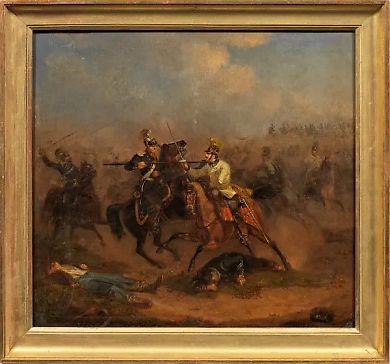
Lot No. 14757 The Battle of Novara: a dramatic scene of milit…
Ludwig Beringer
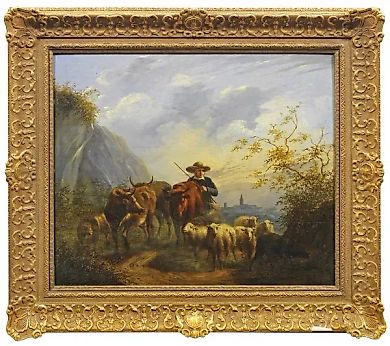
Lot No. 14172 A Belgian artist painted animals.
Unknown Author
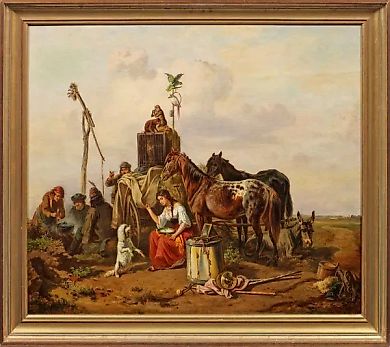
Lot No. 14151 "Wandering Gypsies with a Menagerie: A Pictures…
Unknown Author
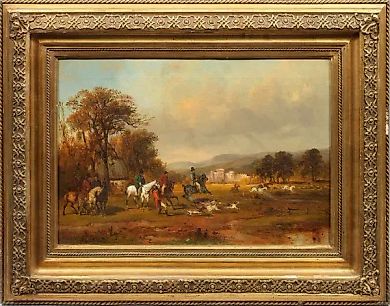
Lot No. 14735 Magnificent Landscape with a Parforce: A Rare M…
Josef Karl Berthold Pyuttner