Baroque hampen
Description
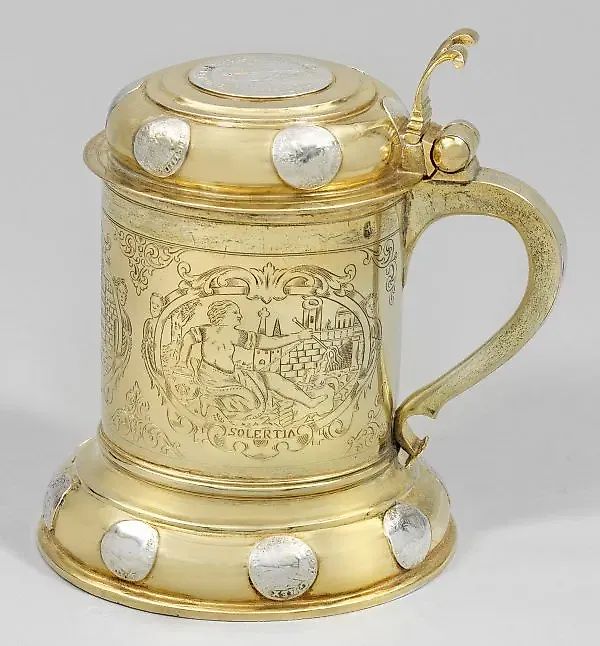
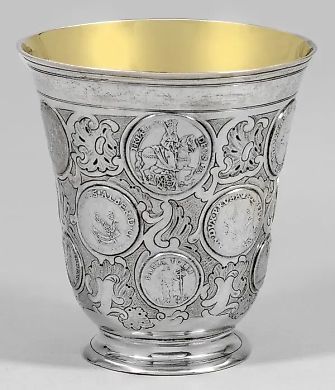
Silver, partially gilded. On a profiled, highly convex round base, a cylindrical body with a hinged, correspondingly convex lid and a two-part, rolled finger loop. The smooth wall features a wide border distinguished by delicate profile lines and rings. Around it are three oval, engraved cartouches, decorated with volutes, acanthus leaves, and flanked by cherub heads, with allegorical depictions of figures in architectural landscapes, respectively labeled "NONVI", "PATIENTIA", and "SOLERTIA". The base, lower part, and lid contain a total of 16 inserted coins, including a 1630 thaler depicting Archduke Leopold V of Austria-Tyrol, as well as the so-called specie thaler depicting Christian IV of Norway and Denmark, Copenhagen, 1628. Side loop for the ear. Gilded inside. Made by, marks, master Georg Conrad Kressel (became a master around 1699). Weight approximately 490 g. Height 16 cm. Pewter jug, the so-called Briotkrug, by Isaac Faust (Strasbourg, 1623) with comparable allegorical depictions and inscriptions is illustrated in Boucaud / Frégnac, Zinn, p. 102, fig. 129, as well as in the Württemberg State Museum, Stuttgart. Inv. - No. [G 9, 485]. See Scheffler, Berlin, BZ 4 d, No. 253. Exceptional German Baroque silver jug with gilding and coins by Georg Conrad Kressel (master since about 1699). Gilded inside. Mark and workshop stamp. German. Berlin. Circa 1727.
Similar lots
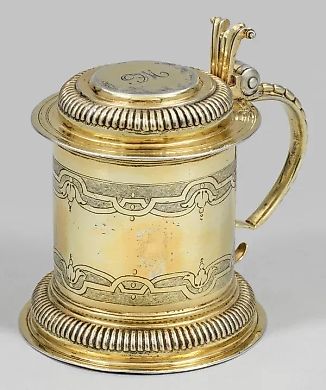
Lot No. 13155 Baroque pouf
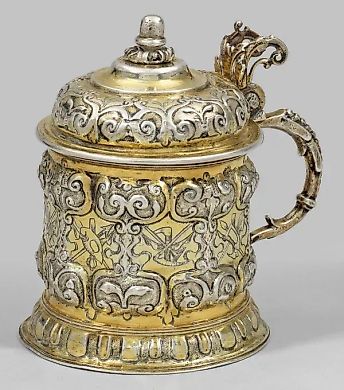
Lot No. 13140 Silver mug
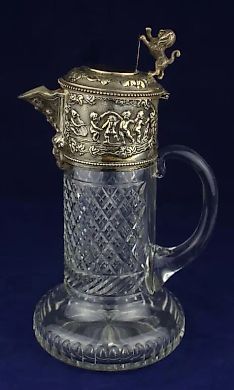
Lot No. 10027 LUXURIOUS SILVER DECANTER IN HISTORICISM STYLE
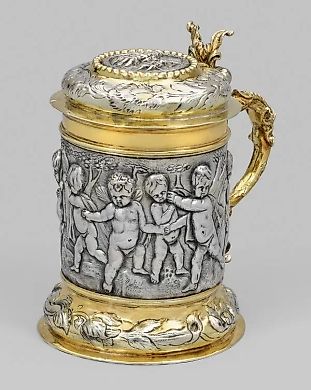
Lot No. 13143 Hamburg Baroque humpen
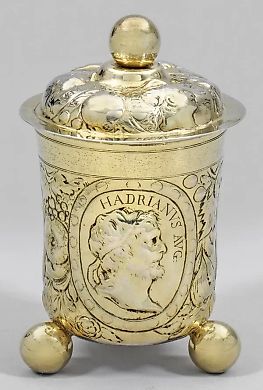
Lot No. 13144 Cup
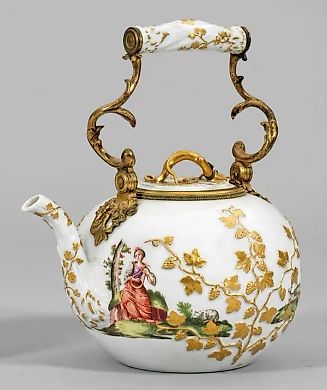
Lot No. 14430 Large Meissen porcelain teapot with a painted h…
Meissen (Meissen)
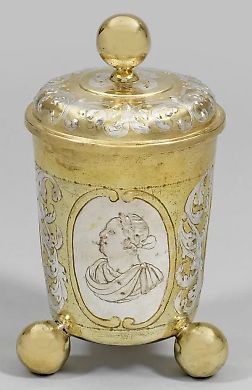
Lot No. 13158 Silver Cup
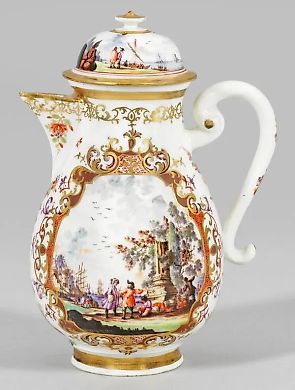
Lot No. 14456 Magnificent Meissen coffee pot with trading sce…
Meissen (Meissen)
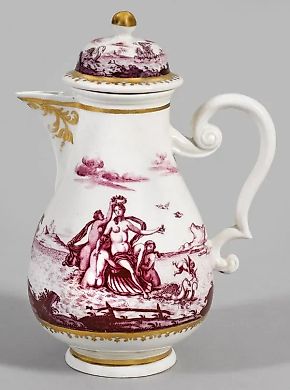
Lot No. 14470 Meissen coffee pot with a house in pictorial pu…
Meissen (Meissen)
Lot No. 13164 Silver Cup