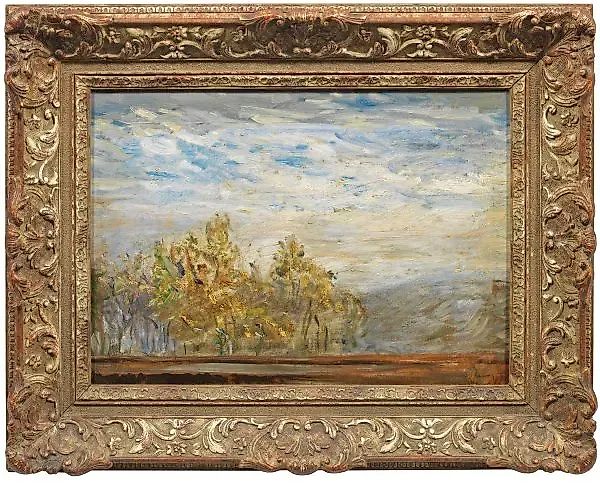
"Impulsive Style and Abstraction: The Landscape of Neukastel"
Description
(1868 Landshut – 1932 Neukastel) Group of Trees near Neukastel. The landscape, painted in 1931, with its lively and free, impulsive style and partially impasto application of paint, belongs to the last works of the most important German Impressionists alongside Lovis Corinth and Max Liebermann. It is entirely focused on the overall atmosphere, and the brushstrokes intertwine, resulting in a high degree of abstraction in the details. In Slevogt’s diverse oeuvre, landscapes occupy a prominent place. Already in his youth, Slevogt visited Landau in der Pfalz and the Finkler family in Neukastel near Leinsweiler, where in 1890 he met their daughter Antonie (Nini) Finkler (1864–1932), whom he married in 1898. In 1914, he finally acquired the Neukastel estate belonging to his in-laws, Hofgut Neukastel (now Slevogthof Neukastel). This allowed him to find numerous motifs for his Impressionist plein air painting in the Palatinate landscape. From the terrace, the artist saw a wide view of the Rhine plain and captured this landscape at different times of the year. Among his close artistic colleagues who achieved a similar level of mature landscape depiction was Lovis Corinth (1858–1925) with his expressive paintings of Walchensee from 1919. Slevogt studied at the Munich Academy from 1884 to 1889, and it was during this time that he created his first landscapes in Neukastel. In 1889/90, he entered the Académie Julian in Paris before settling in Munich in 1890. In 1892, Slevogt was one of the founders of the Free Association XXIV in the Munich section of the Vienna Secession. In 1901, he moved to Berlin together with Lovis Corinth and became a member of the Berlin Secession. In 1914, he was admitted to the Prussian Academy of Arts in Berlin, and from 1917 to 1932 he was head of the painting workshop at the Academy of Arts in Berlin. Oil/plywood. Signed. On the reverse, collector’s mark of Theodor Kiefer, Kaiserslautern. 38 cm x 54.5 cm. In frame. We thank Dr. Karoline Feulner from the Max Slevogt Research Center at the Landesmuseum Mainz for her friendly support in the scholarly processing. Literature/exhibitions: Hans-Jürgen Imiela: “Max Slevogt. Monograph,” Karlsruhe 1968, p. 261, fig. 96, p. 439, note 2; exhibition and catalog “Max Slevogt for the 100th Anniversary,” edited by Wilhelm Weber, Pfalzgalerie Kaiserslautern 1968 (subsequently at Kunsthalle Basel and Kunst- und Museumsverein Wuppertal in 1968), No. 176; exhibition and catalog “Palatinate Landscapes: Max Slevogt 1868–1932,” Max Slevogt Gallery at the ‘Villa Ludwigshöhe’ Castle (Edenkoben), 1982, edited by Berthold Roland, pp. 104–105; Berthold Roland: “Max Slevogt – Palatinate Landscapes,” with texts by W. von Alten, J. Gutmann, et al., edited by the Max Slevogt Gallery, ‘Villa Ludwigshöhe’ Castle, Munich 1991, pp. 218–219. Provenance: From the collection of medical advisor Dr. Theodor Kiefer (1889–1985), Kaiserslautern.
Similar lots
Lot No. 14742 "Field of Harvest: Atmospheric Harvest Scenes b…
William Shirer
Lot No. 14769 "Frozen River: Picturesque 19th Century Landsca…
Andreas Schelfhout
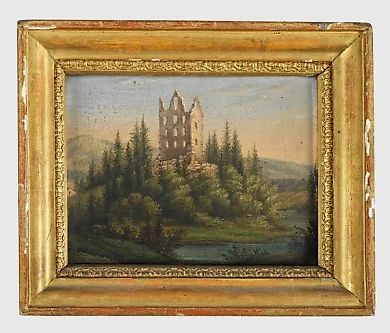
Lot No. 14880 "Active 19th-century artist: landscape with a r…
Unknown Author
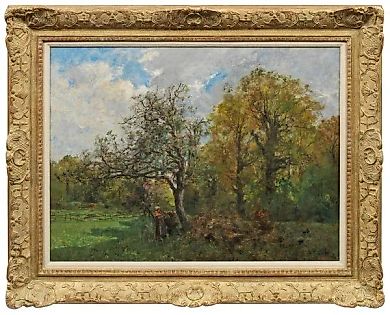
Lot No. 14663 Impressive landscape with a girl: the art of Pi…
Léon Germain Pelouse
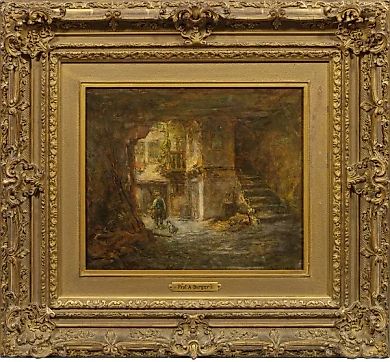
Lot No. 14743 "Frankfurt am Main 1905: Kronberg im Taunus – a…
Anton Burger
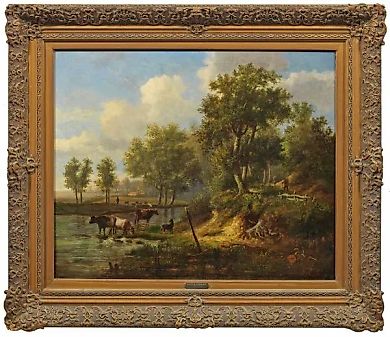
Lot No. 14771 "Romantic landscape by a Dutch artist: water, s…
Josephus Augustus Knip
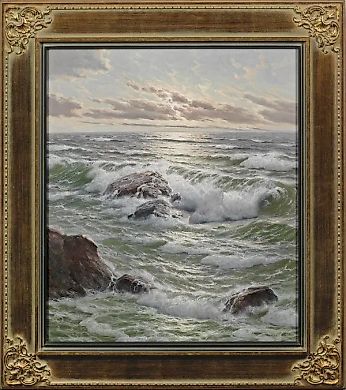
Lot No. 14115 "Evening Light of Dettmann's Brandsturms: Marit…
Walter Dettmann
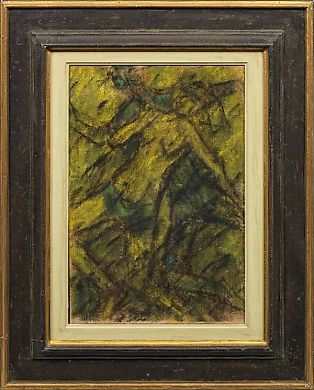
Lot No. 14594 "Expressionist couple in yellow-green tones: a …
Christian Rolfs
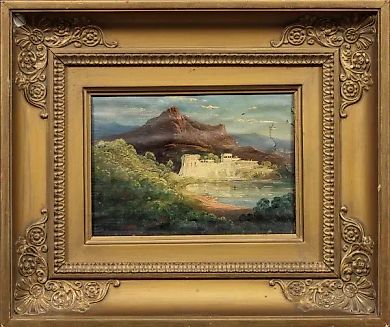
Lot No. 14773 Italian landscape with a palace: a study by the…
August Wilhelm Ferdinand Schirmer