
Klara Lidén
Exploring Klara Lidén's radical urban interventions at Berlin's KW Institute, from Unheimlich Manöver to her architectural disappearances.

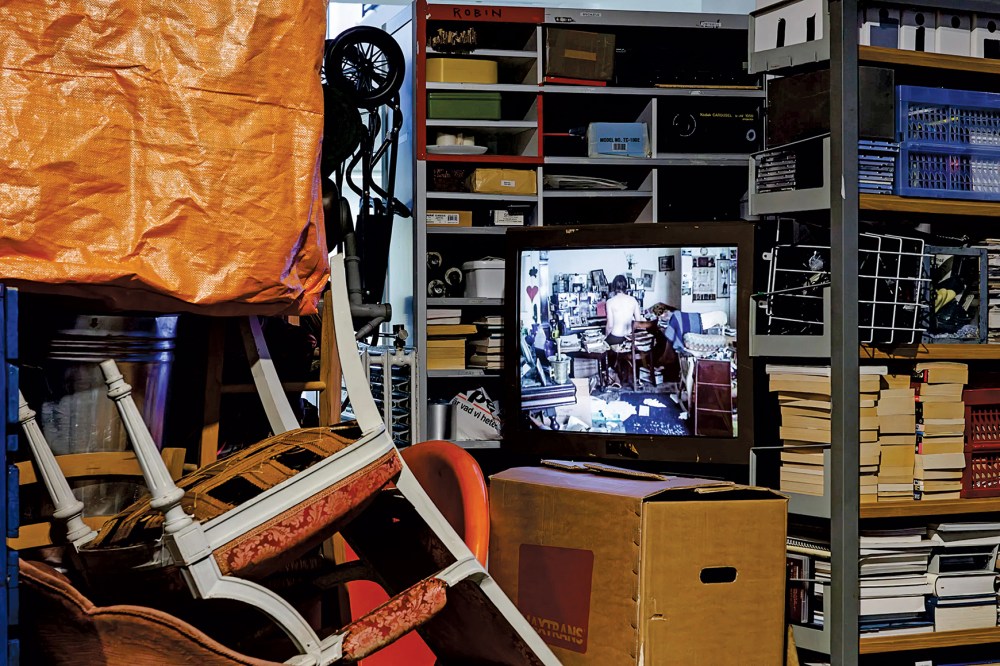
In the halls of Berlin's KW Institute for Contemporary Art, an exhibition by Swedish artist Klara Lidén, known for her radical interventions in urban environments, is on display. The entrance is blocked by a massive wall of objects: furniture, books, clothing, a dismantled kitchen, spray paint cans, tools, and a disassembled bicycle. This is the installation Unheimlich Manöver (2007), assembled from the contents of the artist's former three-hundred-square-foot apartment in Stockholm. The objects are packed into a dense rectangular mass reminiscent of warehouse storage. For Lidén, who trained as an architect, this work is unexpectedly domestic. The title alludes to the first-aid maneuver for choking and to Freud's concept of the "uncanny" (unheimlich), yet there is nothing frightening about this composition. The question is what lies hidden behind this domestic chaos—beyond the mere sight.
Inside the installation, atop boxes and furniture, two televisions and a projector loop videos shot in that very Stockholm apartment. In one, Lidén smashes a bicycle with a steel pipe. In another, she moves erratically around the kitchen, hits herself in the face, and drinks milk straight from the carton. The apartment, shown in the videos as a lived-in space, appears far less orderly than in its current configuration. The uncanny arises between objects—in those acts of normalcy required to sustain domestic life, which Lidén postpones. Not washing dishes, not paying rent, not getting up in the morning—how much more pleasant. Yet Protestant ethics are not violated without pangs of guilt or the pleasure of self-destruction: never good enough, never bad enough. A third video documents Lidén breaking into the apartment of an unknown hoarder. Perhaps mimicking the former occupant, known only through photographs, books, textiles, and knick-knacks covering the walls and floor, Lidén sits topless at a piano. She pounds the keys, humming an unintelligible phrase in a made-up language, a mix of German, Spanish, and English: "Ich brauche más space"—"I need more space."
Home as Artwork: From Darboven to Lidén
The lineage of artists turning their homes into art is long. Recently I visited the house of German artist Hanne Darboven on the outskirts of Hamburg. After the death of her mother, with whom she lived, Darboven entered a period of feverish collecting and constant rearrangement of their shared dwelling. Nothing has been touched since the artist's death in 2009, except for the dust removed by a neighbor. What struck me most was not the fantastic utensils from around the world, nor the correspondence with other artists (including letters from Carl Andre with an attached seed), but an unsealed bottle of sparkling water on the bedside table.
The displacement and depersonalization of private property in Unheimlich Manöver can be seen as an inversion of Darboven's cocooning, yet both artists share an interest in the silent speech of objects and in language as a spatial entity. Darboven's most famous cycle, Schreibzeit ("Writing Time," 1975–1999), is the physical result of daily filling pages with scribbles resembling handwriting. In a wall installation, the pages become an object signifying only the imitation of writing by a depersonalized other. Lidén does not create meaningless writing, but she speaks through impersonal texts found on objects from public space. Language is nothing more than a set of ready-made forms available to everyone. If signification is understood as an activity of engaging with common material, then the "authorial self" eludes grammatical person. Lidén's incorporative impulses carry a childish desire to remain preverbal, but they also achieve the post-verbal—an encounter with death through speech bordering on memorialization.
Tunnels and Billboards: Architecture of Disappearance
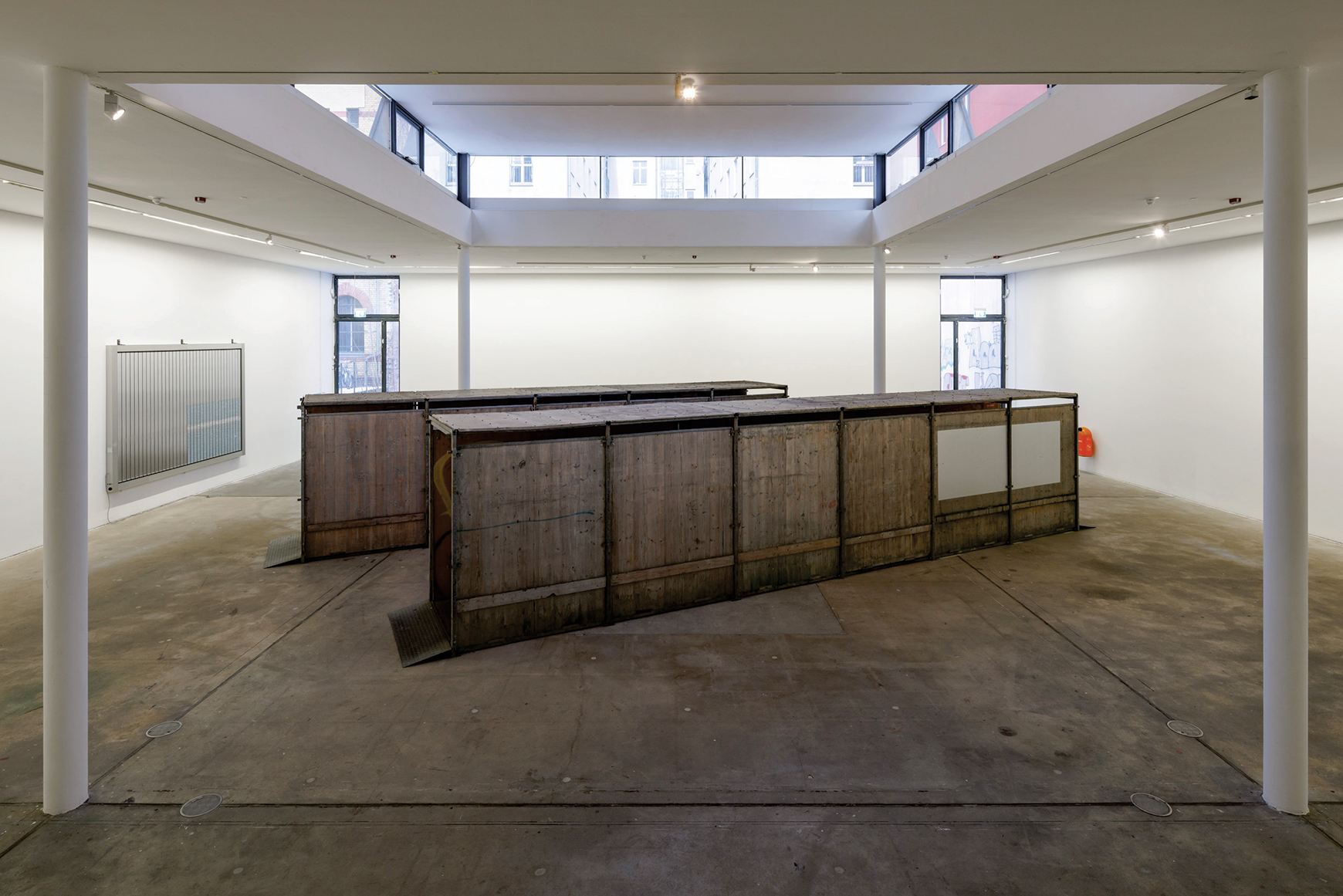
Descending into the large hall on the ground floor, I see in the center two fenced-off passageways, typically used at construction sites to protect pedestrians from falling objects. Graffiti on the inner walls, where unknown individuals have marked their presence, suggests these tunnels have been in various locations around Berlin. Passing through them, I hear the echo of my footsteps on the wooden floor. In the enclosed space, I recall the feeling of freedom that arises when moving through the city unnoticed. Or conversely: freedom as spatial ubiquity through the amplification of my stomping? Exiting, I perceive the passages as sculptural objects rather than immersive space. The sudden shift in perspective gives me a sense of observing myself from outside.
Temporary immersion is restored by three large-format billboards with tri-vision mechanisms, which surround me in a triangle in the hall. No images or text on them: the posters have been removed, turned, cut, and reinserted, revealing the gray-blue monochrome backside. As the boards switch, the silver rotating panels emit a sound like mechanical ocean waves or the crushing of metal. How did Lidén acquire objects of such scale? Darboven was a wealthy woman who never left home and used agents for acquisitions. Lidén's tunnels, judging by the contact information of a Berlin scaffolding rental company stuck to the wall inside one of them, were most likely rented. Nevertheless, one wants to think of her as a burglar of external space.
Trash Bins and Urban Anonymity
Stolen, borrowed, or bought, street trash bins from various cities—New York, Berlin, Rome, and Bolzano—are sparsely placed around the hall. Their intermittent placement suggests a realistic staging of public space, while their common function and different origins expose the sense of repetition experienced in urban public architectures: an uncanny blindness to difference. I examine a bin I recognize from Berlin's streets. To encourage environmental consciousness, the sanitation department designed bright orange bins with white inscriptions inspired by the city's nightlife. On this one is written: FÜR DIE ZIGARETTE DANACH ("For the cigarette after"). In the context of urban alienation, the post-communicative subtext seems to voice the unspoken: you are alone.
In the smaller galleries upstairs, more objects from public space—electric panels, a modified pharmacy sign, posters turned into paintings—are installed as individual objects. The uncanny disappears, the white cube returns. Two videos are projected inside a two-chamber cardboard shed: in one, Lidén does the moonwalk on the streets of Manhattan; in another, she joins rehearsals of professional ballerinas at the Hermitage Theatre in St. Petersburg. Much has been written about the artist's interest in the connection between architecture and dance, but I am more struck by the videos where she embodies a spy in the vein of Jason Bourne. In You're all places that leave me breathless (2020), shown on a screen leaning against a temporary wall, there is a sense of real risk: she climbs scaffolding—an excess of sexual energy and aggression that can only find outlet in transgressive action in public.
Language, Death, and the Politics of Red Lines
As if spoken language died along with privacy in Lidén's memorialization of her own home, all videos after Unheimlich Manöver are either silent or have an instrumental track. Appearance comes to the fore, and Lidén's look—a quiet mask of androgynous anonymity—grants her a particular freedom of movement that extends to the viewer. She could be an indie rocker of the early 2000s, an anarcho-feminist activist, a butch sound engineer, or a terrorist: I can enter her body as any of these figures, confident that my individual fantasies will remain undisclosed. Anonymity works both ways. I recall that the books on the shelf in Unheimlich Manöver were carefully arranged to hide covers and spines. Only one escaped anonymization: Albert Camus, The Myth of Sisyphus. I too am guilty of editing my bookshelf, but this must be a message about greater absurdity than concern for appearances.
In a corner on the second floor, I stumble upon a cubic sign on a street pole. Devoid of any individualizing images or text, the sign remains recognizable as originating from Berlin's streets by its shape. The artist left untouched a sticker on the back of the pole: FREIHEIT FÜR PALÄSTINA, MERA25 (Freedom for Palestine, MERA25). If this were not a simulation of public space, the sticker would quickly be torn off or covered: in 2024, Yanis Varoufakis, the Greek leader of the pan-European left movement MERA25, was banned from entering Germany and speaking at a pro-Palestinian event in Berlin. Here the sticker remains, protected by its status as an artwork and by the German institution whose physical enclosure legitimizes it as such. Pointing both to the immediate context and beyond, the sticker acts as a narrow passage through which the outside can enter and the inside can slip out.
In two slideshows on the same floor, Lidén continues to circulate between viewpoints, using a tactic of distorting enlargement. The slides, made from enlarged video frames printed on transparent acetate film, resemble pointillist stop-motion animation. In one, shot from above, Lidén moves toward a hatch into which she disappears. In another, shot from the artist's point of view, she rides a bicycle into the Seine. The splash of water captured by the camera is abstracted into a misty cloud dissolving the profile of a Parisian bridge in the background. Bas Jan Ader replaces Jason Bourne. Doesn't Lidén resemble Rimbaud a bit? In his "Letters of the Seer," the young poet outlined his method of poetic vision as a "rational derangement of all the senses," wandering the streets of Paris.
I am not a flâneur. I remember this as soon as I step out of KW. I think about where I'm going, what I'm leaving, how I can overtake the tourists gathered on the sidewalk. I am also impatient with art. I tell myself I know immediately whether I like a work or not, whether I have access, whether it makes sense. Perhaps my attention span has shortened, as they say, but I still know how to read. In Lidén's works there is a brevity and directness that ease entry. Few artists possess her command of the spatial dimensions of narrative needed to guide the addressee between points of divergence and contradiction. It's a trick. Yet Lidén's most poignant messages concerning the ongoing "withdrawals" of public speech in Germany are indirect. To perceive them, one must move through the Kunstwerke with the same attention to detail with which the artist moves through the city.
What a Collector Should Consider
- Lidén's works are often made from found objects and ephemeral materials (cardboard, household appliances, street signs). When purchasing, check whether instructions for reinstallation and replacement of elements are included—some parts may be consumable.
- Videos and slideshows require special equipment (projectors, monitors, acetate films). Verify the presence of a certificate of authenticity and edition limits: many videos exist in multiple copies, which affects price.
- Installations like Unheimlich Manöver are often sold as a single entity. Be prepared for complex logistics of storage and transport: objects may be fragile or have non-standard sizes.
- Pay attention to provenance: works from prestigious institutions (KW Berlin, MMK) are valued higher. Request exhibition history and proof of origin.
- Examine the condition of objects: signs of use (scratches, wear) may be part of the concept, but damage not intended by the artist reduces value.
- Monitor the market: Lidén is represented by galleries (e.g., Reena Spaulings Fine Art), and her works appear at major contemporary art auctions. Look at comparable sales and consult specialists.