
Motherhood in Art: From Raphael to Cassatt
Explore how motherhood in art evolved from Raphael's idealized Madonnas to Mary Cassatt's intimate portrayals, with insights on collecting and caring for artworks.

Motherhood is one of the oldest themes in art, but its interpretation has changed radically. Raphael created the image of the ideal mother, devoid of physicality, while Mary Cassatt, four centuries later, showed the flip side—an all-consuming intimacy in which the mother risks dissolving. Two exhibitions, at the Metropolitan Museum of Art and the National Gallery of Art, offer a retrospective of this evolution.
Raphael: A Revolution of Tenderness
When Raphael painted his Madonnas, he brought about a revolution. Before him, the Virgin and Child were depicted hierarchically: their size depended on theological importance rather than the laws of perspective. Raphael was the first to place them in real space, surround them with landscape, and give their poses naturalness. He learned from Leonardo how to convey the movements of the soul—moti mentali—and his Madonnas were the first to acquire an inner life.
At the exhibition "Raphael: Sublime Poetry" at the Met, curator Carmen Bambach devoted a separate gallery to the Madonnas painted for private patrons. These were small paintings for domestic altars, and in them Raphael achieved unprecedented naturalness. In the "Niccolini-Cowper Madonna" (1508), the infant reaches for the neckline of his mother's dress, while she turns away, lost in thought. This disconnect between gesture and gaze is key to understanding Raphael's Madonnas: they are not just mothers but individuals.
The Iconography of Tenderness
A special place in Raphael's oeuvre belongs to the type of the Virgin of Eleusa—the Virgin of Tenderness—where mother and child touch cheeks. In the preparatory cartoon for the "Tempi Madonna" (c. 1507), this gesture is executed with almost painful intensity: Mary presses her son's face to hers, and the movement conveys a premonition of his suffering. In the finished painting, the emotion is muted, but the Virgin's gaze remains turned inward.
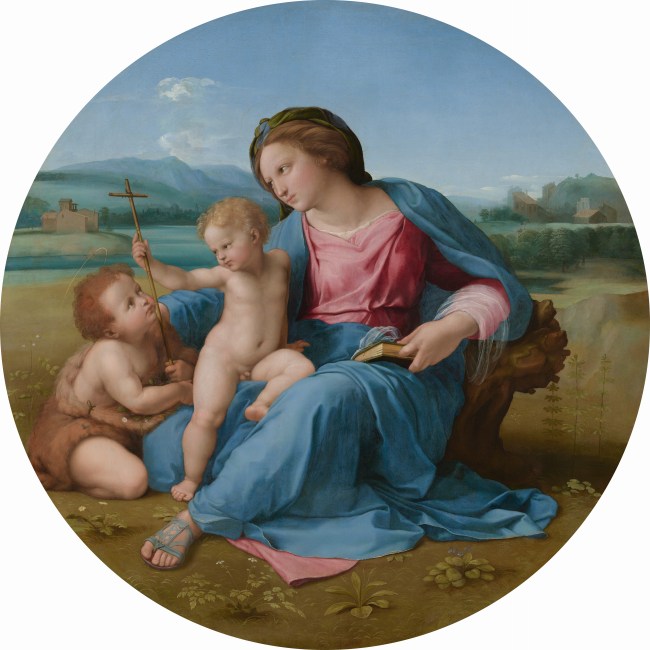
The "Alba Madonna" (c. 1510) is a tondo, a form that derives from the desco da parto, a tray for new mothers. Mary and the infant lean toward the young John the Baptist, who raises a cross—a symbol of future Passion. Outwardly, it is a scene of tenderness, but Mary's face reveals a melancholy that makes the painting deeper than a simple iconographic cliché.
Motherhood Without a Body
Raphael created an image of motherhood cleansed of all physicality. His Madonnas are flawless: their skin glows, and their faces show no traces of fatigue or pain. Catholic doctrine held that Mary was spared the pains of childbirth, and Raphael follows this dogma. Moreover, a preparatory drawing for the "Alba Madonna" shows that he used a male model for the Virgin. His naturalism did not extend to the female body—he removed from the frame anything that recalled the real, dangerous experience of motherhood.
In the adjacent gallery at the Met, Bambach showed the flip side: a relief from Verrocchio's workshop dedicated to Francesca Pitti Tornabuoni, who died in childbirth, and a record of the funeral of Raphael's mother, who died when he was eight. Medieval medical treatises on display demonstrate how little was known about female anatomy in the 15th century. This contrast—between the ideal Madonnas and the harsh reality—makes the exhibition especially poignant.
Cassatt: The Price of Intimacy
Mary Cassatt, the American Impressionist working in Paris, made motherhood a central theme of her art. But her approach was the opposite of Raphael's. In the etching "Gardner (Cassatt) Held in Her Mother's Arms" (c. 1887), she depicts her sister-in-law with a baby. The bodies of mother and child merge into a single contour—reminiscent of the physical inseparability of pregnancy that persists after birth. But their gazes are directed in opposite directions: the mother is pensive, the child looks away. Cassatt shows not an idyll but a tension between the need for closeness and the desire for autonomy.
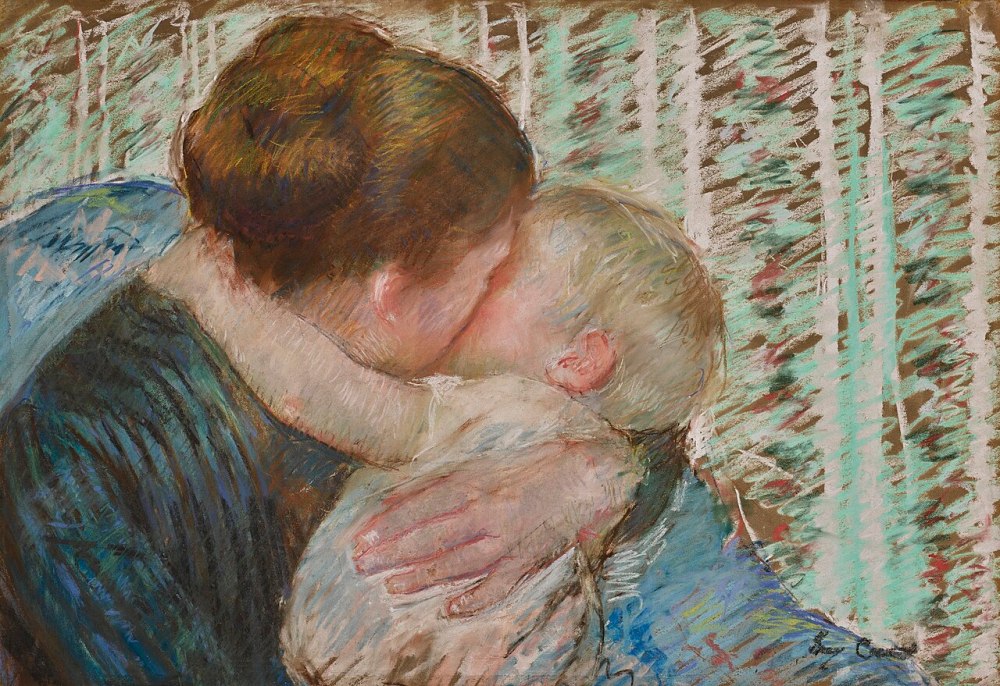
In the pastel "Goodnight Embrace" (1880), this tension reaches its limit: the faces of mother and child merge, the boundaries of bodies blur. The mother's face, the center of her identity, disappears, absorbed by the child's body. Cassatt inverts the Eleusa iconography: if in Raphael the mother dissolves in her son's suffering, in Cassatt she dissolves in the very act of care.
Cassatt's Children: Unruly and Alive
The exhibition "Mary Cassatt: An American in Paris" at the National Gallery of Art includes about forty works from the museum's collection. Curators Mary Morton, Kimberly Jones, and Rina Hoisington selected paintings where Cassatt's children behave anything but angelically. In "Children Playing on the Beach" (1884), two girls dig in the sand, their bodies painted with dense strokes, while the world around dissolves in light touches of the brush. They are self-contained and indifferent to the viewer.
"Little Girl in a Blue Armchair" (1878) is a portrait of a child who refuses to be a model. The girl slouches in the chair with a defiant air, and the composition is shifted to the right, leaving the center empty. Cassatt breaks all the rules of child portraiture, showing the child as a person, not an object of tenderness.
How to Attribute: Marks, Signatures, Material, and Signs of Work
Attribution is the first step toward an informed purchase. Even if you don't plan to become an expert, basic skills will help you filter out obvious mistakes and ask the right questions of a dealer or auction house. Start with the material. In painting, wood panel and canvas have different natures: a panel may have been transferred to canvas, which affects the behavior of the paint layer. Copper and stone are rare supports, easy to check by touch and weight. For works on paper, the paper type matters: laid or wove, watermarks, and edge cuts. Signs of work—brushstrokes, texture, retouching—reveal technique and period. Signature and marks are only part of the story: they may have been added later, and marks on frames and the reverse of panels often preserve information about the workshop or collection. Look for traces of old restorations—canvas lining, inserts, varnishing. All these are clues that need to be compared with the claimed age and provenance. If in doubt, consult a specialist: independent examination answers questions, but even self-study with a magnifying glass and ultraviolet light yields much.
Fakes, Replicas, and Typical Buyer Mistakes
The market is flooded with copies, and it's important to distinguish types. A replica is an authorial or workshop repetition of a composition, often with variations; it can be valuable if created in the same workshop or era. A fake is an imitation made to deceive. Typical mistakes: trusting provenance that isn't documented; ignoring condition—overpainted backgrounds or added details may be hidden under a layer of varnish; buying "on emotion" without checking against the catalogue raisonné. Check dimensions: discrepancy with the catalogue is a red flag. Compare handwriting: signatures on known works are easy to verify against a database. Beware of "family legends"—the story that the painting "always hung at grandma's" doesn't replace expert examination. Remember: if the price is suspiciously low for the stated name, that's already a reason to be cautious. Always request full documentation and, if possible, conduct technical analysis—X-ray, infrared reflectography, pigment analysis.
Storage, Care, and Restoration: What Not to Do
Proper storage is key to preservation. Ideal conditions are stable: temperature 18–22°C, humidity 45–55%, without sharp fluctuations. Don't hang paintings over radiators, fireplaces, or in direct sunlight. Ultraviolet fades pigments, so use UV-filter glass for works on paper and pastels. Never wipe paintings with a damp cloth or use household chemicals. Remove dust with a soft brush or dry microfiber, without pressure. Don't attempt to "refresh" varnish or remove darkening yourself—that's a restorer's job. The most common mistake is turning to non-professionals: a "handyman" can ruin the original paint layer. Trust only restorers with specialized education and experience with museum objects. Don't store works in damp basements or attics: temperature and humidity fluctuations lead to panel warping and cracking of the paint layer. Remember that restoration should be minimal and reversible—any intervention reduces the object's museum value.
How to Start a Collection and What Budget to Allocate
Start by defining a focus. For the theme of motherhood in art, this could be engravings of Madonnas, drawings, small paintings, or even postcards and photographs. Study the market: browse auction catalogs, prices for comparable works. Budget depends on the segment: original prints by known masters can range from a few hundred to thousands of dollars; Old Master paintings from tens of thousands. For a start, editioned works—etchings, lithographs—are suitable, as they are more accessible while retaining artistic value. Allocate not only the purchase price but also costs for authentication, restoration, framing, and insurance. Begin with small acquisitions from reputable dealers or auctions. Don't chase big names—better to buy a quality work by an unknown artist than a dubious attribution. Build your collection gradually, documenting provenance and condition for each piece. Remember: a collection is not just an investment but also a pleasure, so choose what resonates with you personally.