
Russian Silver: Masterpieces Ahead of Europe
Введите подпись The art of working with silver in Russia reached a level that in many ways surpassed the capabilities of European masters. The finest chasing, exquisite engravings, the most complex en

Введите подпись
The art of working with silver in Russia reached a level that in many ways surpassed the capabilities of European masters. The finest chasing, exquisite engravings, the most complex enamel overlays—all of this became the hallmark of Russian silversmiths.
Their works not only met the aesthetic demands of the era but also embodied a unique combination of technical skill and artistic vision, becoming a reflection of Russian culture and national spirit. Russian silver art, like musical masterpieces or architectural monuments, became one of the symbols of cultural superiority that inspired and amazed the entire world.
Введите подпись
Russian silver masters, working in Moscow, St. Petersburg, and other centers, gained fame far beyond the country's borders. Their works were valued in the courts of Europe, became part of private collections, and adorned luxurious interiors. Alexei Ratkov is just one name in a long line of talented masters.
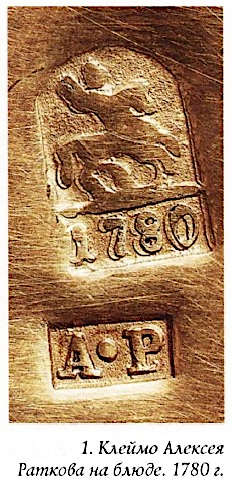
The small rectangular hallmark with the letters "A﮲R" belongs to the outstanding Moscow silversmith of the late 18th to early 19th century, Alexei Ivanov Ratkov. Every item with this hallmark is distinguished by remarkable quality of execution, be it a miniature charka (cup) or a majestic floor candlestick.
Little is known about the master himself, although the surname Ratkov or Rat'kov is mentioned quite often in archives from the first quarter of the 18th century. These people were quit-rent peasants who found their place in Moscow and were engaged in trade. Some researchers suggest that Alexei Ratkov could have been the butler of Count Vladimir Grigorievich Orlov, the youngest of the five brothers from the famous estate. Count V.G. Orlov, one of the most educated men of his time, had an extensive library and a home theater. He also held the post of Director of the Academy of Sciences for a long time. Among his close associates, there may have been architects and artists who received professional education with the Count's help. Alexei Ratkov was likely one of them. It is known that he fulfilled important commissions and worked not only with silver but also with gold, and was a member of the Moscow silversmiths' guild. He showed himself not only as a master of chasing but also as an engraver, adorning his works with niello and enamel overlays, and actively using casting.
There is always hope that in the future, documents will be discovered that will at least partially clarify the biography of this talented silversmith.
While no documents have been found yet, there are many of his works. They are diverse in their purpose—from everyday tableware to representative covers for Gospels, which are held in museums and private collections and occasionally appear on the antique market.
The earliest of them date back to the 1770s, and the last known work is a Gospel cover with a hallmark from 1807. The surviving items indicate that he had his own workshop, possibly with journeymen and apprentices. It is unlikely that one person could create two large, labor-intensive dishes, three floor candlesticks, and a bowl, or three different complex chalices in a single year. These are only the works that have survived and were made to order. Undoubtedly, the master also created a multitude of simpler items for sale: glasses, cups, spoons, salt cellars.
The most significant collection of works by Alexey Ratkov is in the Moscow Kremlin Museums.
It is not necessary to mention each of the thirty-four pieces, although they are all unique and each item is interesting in its own way.
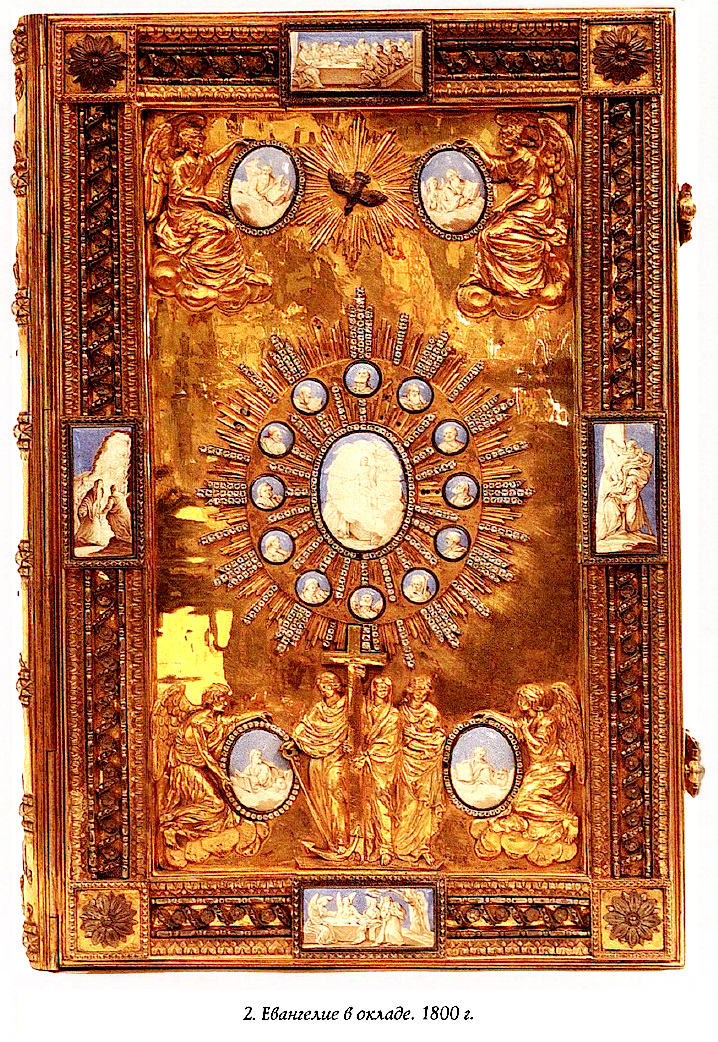
Anyone who has ever visited the Armory Chamber has surely noticed the display case where, under glass, two magnificent Gospels are presented, adorned with massive covers in the style of Russian classicism. These works of art captivate with their aesthetic perfection—strict compositional lines, clear geometry of forms, and elegant gilding combined with calm enamel shades create a harmonious visual perception. The cover created in 1800 stands out especially, with its expressive enamels in gray and blue tones (ill. 2).
Введите подпись
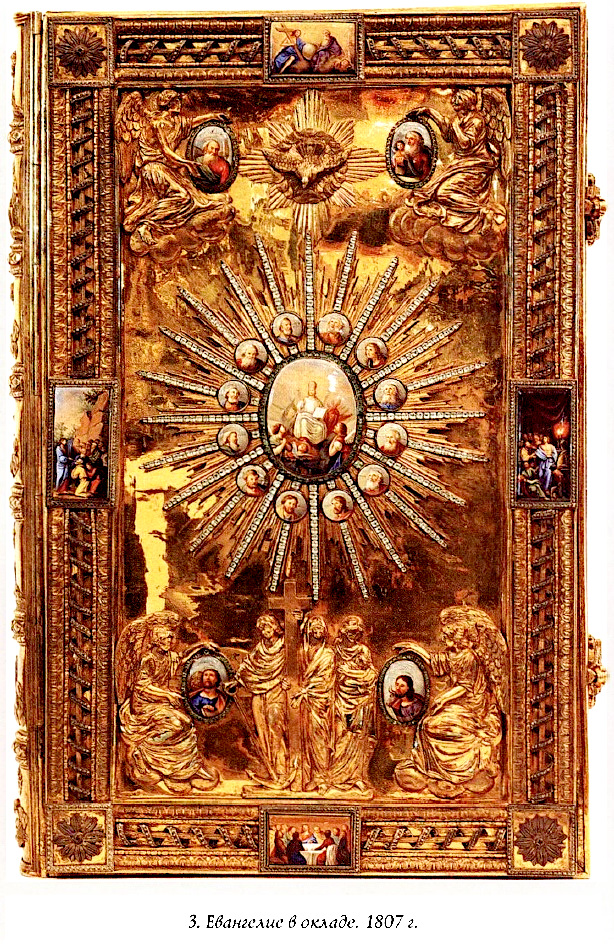
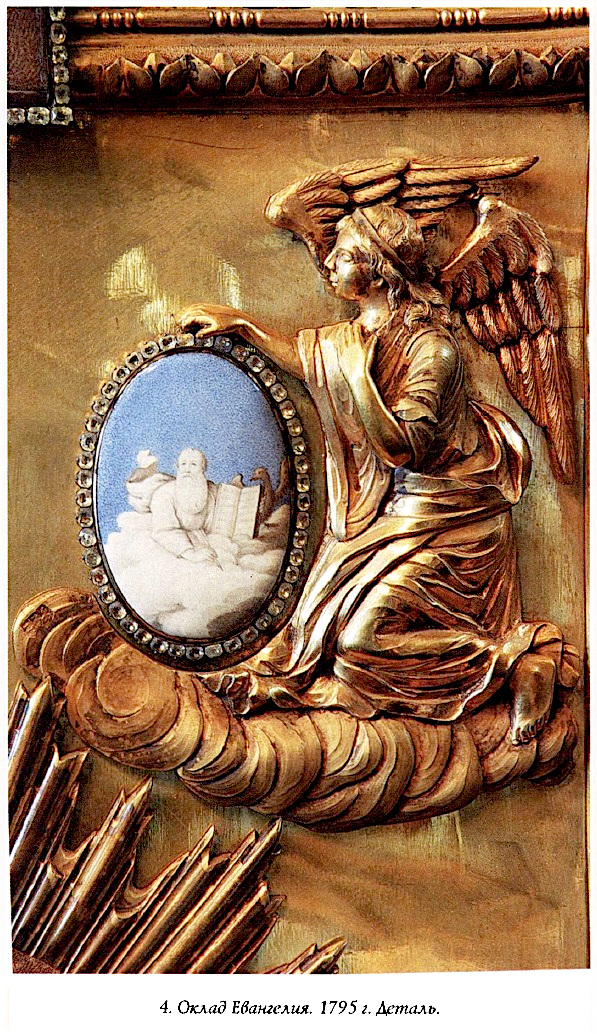
This technique for creating an image, known as grisaille, gained popularity in the late 18th century, although some patrons found it too cold for their items. A vivid example of this opinion is the Gospel cover from 1807, displayed nearby (ill. 3). Its decoration, while retaining the same composition, nevertheless delights the eye with the brightness and saturation of its color palette. The Kremlin Museums' collection also includes another cover with a similar structure (ill. 4), made by Ratkov in 1795 for the cathedral in Tula.
Введите подпись
The choice of materials is admirable: the patron, likely the Bishop of Tula, spared no expense on the book, printed on Alexandrian paper (80x45 cm), nor on the cover itself, which weighed 20 kilograms of precious metal. This makes it the heaviest book in the museum's collection, with a total mass reaching 37 kilograms.
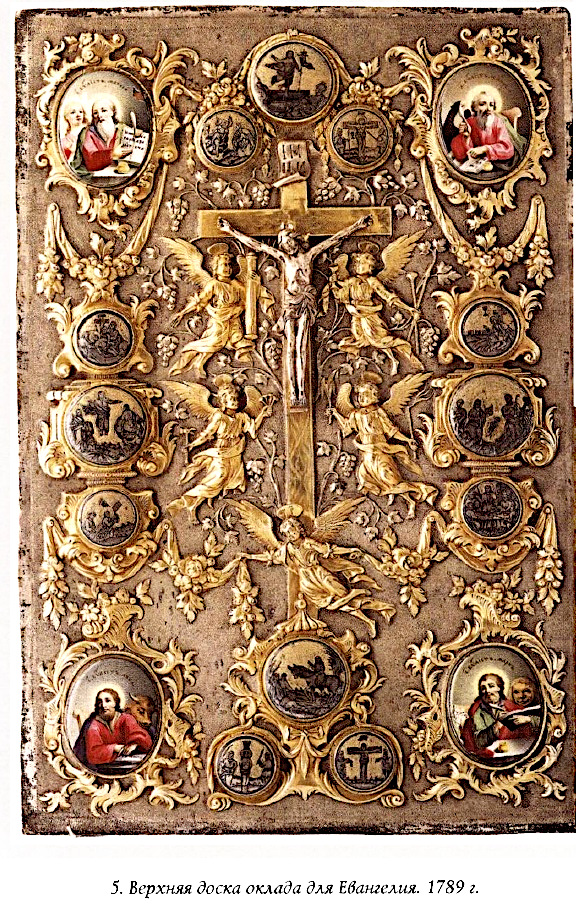
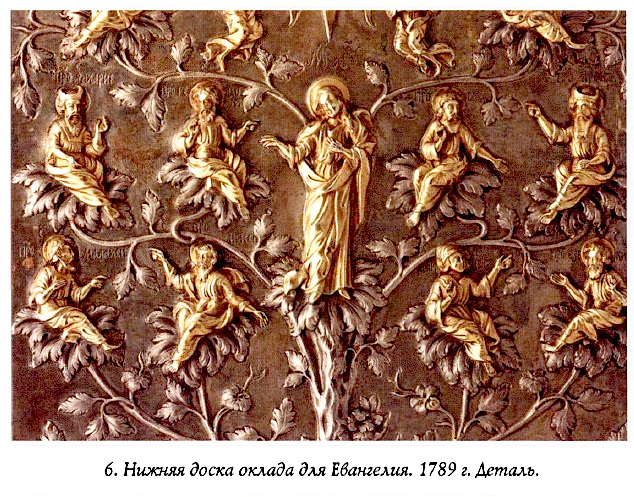
It is not surprising that an opinion might arise that, having once created a successful composition, the master began imposing it on all his patrons. However, this does not correspond to reality. An example is the upper and lower silver boards of the 1789 cover (ill. 5, 6), which are fundamentally different from the previously mentioned works.
Введите подпись
In this icon cover, Ratkov emotionally embodies all his skill: a free drawing of chasing, complemented by high-relief images of saints and niello compositions on a gilded background, incredibly eye-pleasing bright enamel plaques that create a festive atmosphere. Ratkov's talent is manifested not only in the skill of drawing but also in skillful modeling, which is especially noticeable in the composition "Tree of Jesse" on the lower board, where the faces of the saints are worked out with amazing meticulousness.
Введите подпись
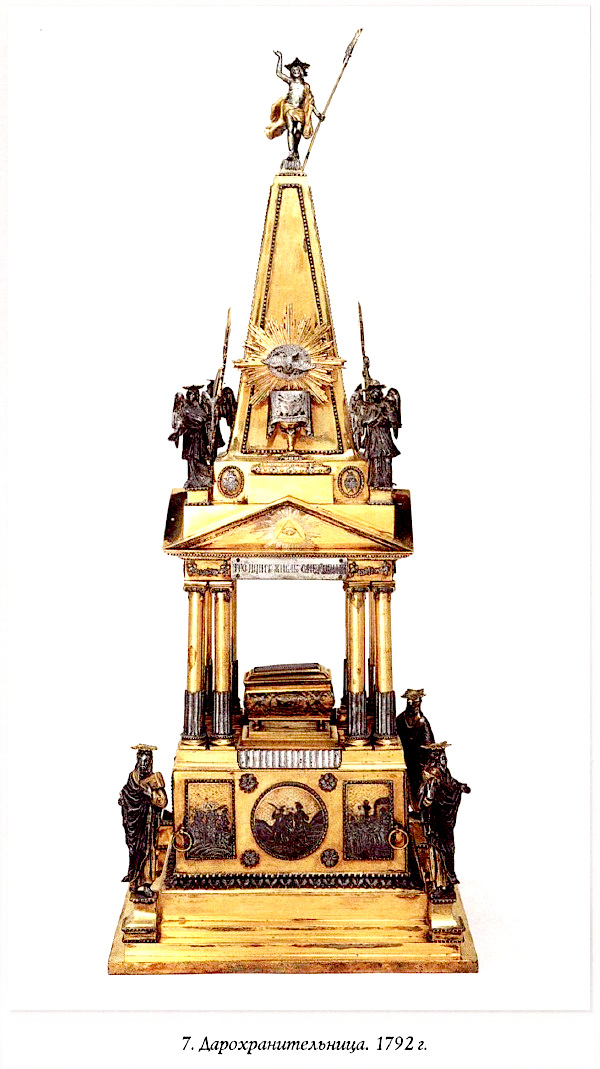
One of Ratkov's most impressive works is a pompous silver tabernacle, transformed into a stylized classical temple (ill. 7). It bears the Moscow hallmark with the year "1792". It is unclear whether the master himself developed the design of this item; perhaps his ideas were suggested by a professional architect working with the Higher Spiritual Authority, presumably with the Vyatka Bishop.
Введите подпись
The tabernacle came to the Armory Chamber from Vyatka in the 1930s, and it is unlikely that any monastery could easily afford to order such a luxurious item from a famous silversmith, which contains more than twelve kilograms of silver. Nevertheless, even if Ratkov executed someone else's design, he did so at the highest level. The style of this work successfully combines all the characteristics of the time, and the cast figures of the evangelists, angels, and Christ are executed with a high level of skill. Clear drawing is evident in the niello overlays, which are compositions of the Passion and images of cherubs, indicating the hand of a true master. The tabernacle undoubtedly occupies one of the central places in the exposition of the Armory Chamber and is a vivid example of the art of silversmithing at the beginning of the 19th century.
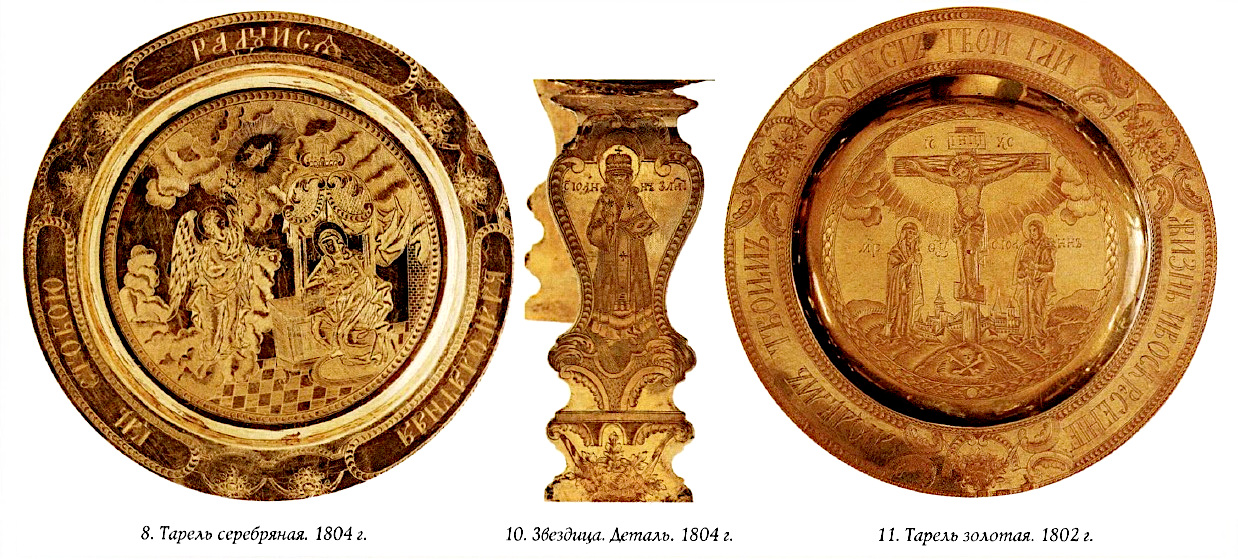
Among the creative legacy of Alexey Ratkov, church items occupy a noticeable place. This is not limited only to covers for Gospels and tabernacles but also includes candlesticks (ill. 8), chalices, patens, liturgical plates (ill. 9), asterisks (ill. 10), as well as covers for icons.
Введите подпись
Liturgical utensils dazzle with their decoration, executed in the exquisite technique of engraving. The images applied to these items were characterized by shallow but fine lines, giving them refinement and delightful charm.
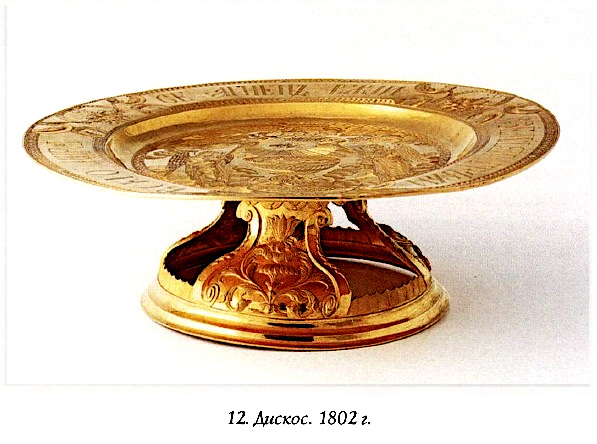
Particularly notable is the golden liturgical set, dated 1802, which includes two miniature plates with the compositions "The Crucifixion" (fig. 11) and "The Virgin of the Sign," as well as a paten placed on a filigree stand (fig. 12). On the reverse side of the paten, there is an engraved inscription indicating that it was "remade" from an old item donated by deacon Ivan Tarasievich Gramotin to the Trinity Monastery, and it weighs 82 zolotniks, with the work costing 1 ruble 25 kopecks per zolotnik. The term "remade" implies that metal from a lost artifact was used.
Введите подпись
Ratkov was not driven by a desire to create a new paten stylized to look "antique." His work organically fits into the aesthetics of its time, with ornamentation along the rim characteristic of Classicism. Presumably, the old metal was insufficient, so the master had to seek alternatives. He combined the paten with a uniquely designed filigree stand for its time, adorned with a chased pattern. As a result, the paten looks incredibly elegant and festive.
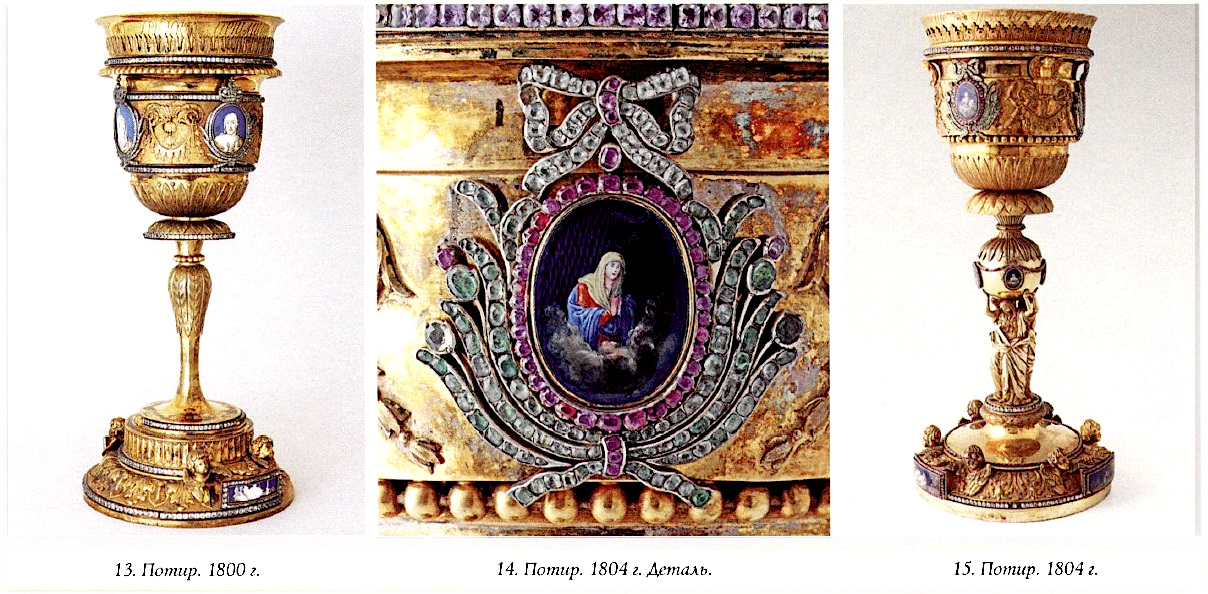
Two chalices by Ratkov are also remarkable for their originality. One of them, dated 1800 (fig. 13), features a deep bowl set on a slender and graceful stem with high bases, crowned with cast angel figures. A chased Classical ornament adorns the low relief, effectively highlighting the applied plaques with gray enamel on a blue background. Colorless rhinestones, imitating diamonds, were used to complement the decoration. The second chalice, dated 1804 (fig. 14), appears even more spectacular due to the multitude of colored stones—over a thousand, including emeralds, rubies, almandines, and amethysts. The use of grisaille would clearly have been inappropriate with such a diverse palette, so Ratkov commissioned enamel medallions in an excellent color scheme for this chalice (fig. 15). Miniature drawings, enhanced with accents of red, white, light blue, and yellow, stand out vividly against the background of transparent dark blue enamel.
Введите подпись
The second chalice differs in the design of its stem from the 1800 model. Here, three female figures supporting a sphere personify Faith, Hope, and Love. Their attributes—a cross, an anchor, and an infant—stylishly accentuate the individuality of each figure. This motif became especially popular in the late 18th and early 19th centuries; the master gladly used it when designing the upper covers for Gospels.
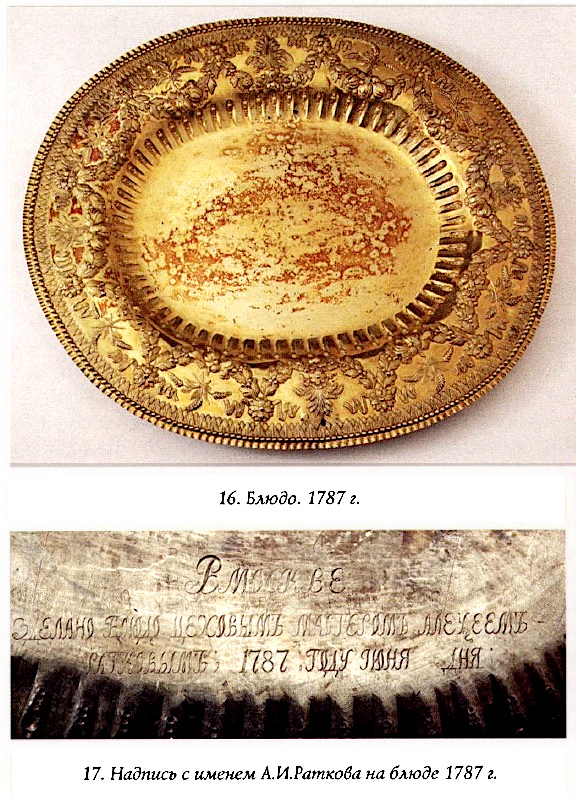
Ratkov's talent as a chaser was fully demonstrated in 1787 with the creation of two oval presentation dishes for Catherine II (fig. 16, 17).
Введите подпись
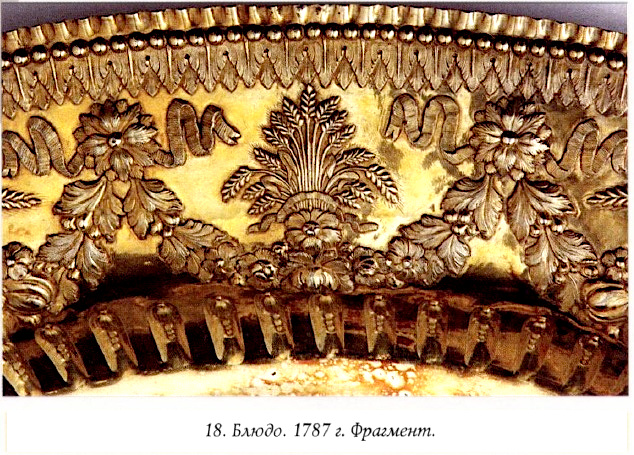
Both dishes are executed with high quality and decorated with beautiful ornaments, accentuated by high-relief chasing. The compositional structure of each is similar, and some ornamental motifs are repeated, yet each piece is an original work. On one of the dishes, clusters of ears of grain stand out among elegantly draped floral garlands (ill. 18).
Введите подпись
This decorative element became particularly popular in the late 18th and first quarter of the 19th century, possibly due to Ratkov's skill. The reverse side of this dish bears an inscription: "In Moscow, this dish was made by the guild master Alexey Ratkov on a day in June of the year 1787" (ill. 19). Clearly taking pride in his work, the master decided to leave not only his personal hallmark but also his name on the piece, which became the most convincing proof of his authorship. Unlike many 18th-century hallmarks, there is no doubt here.
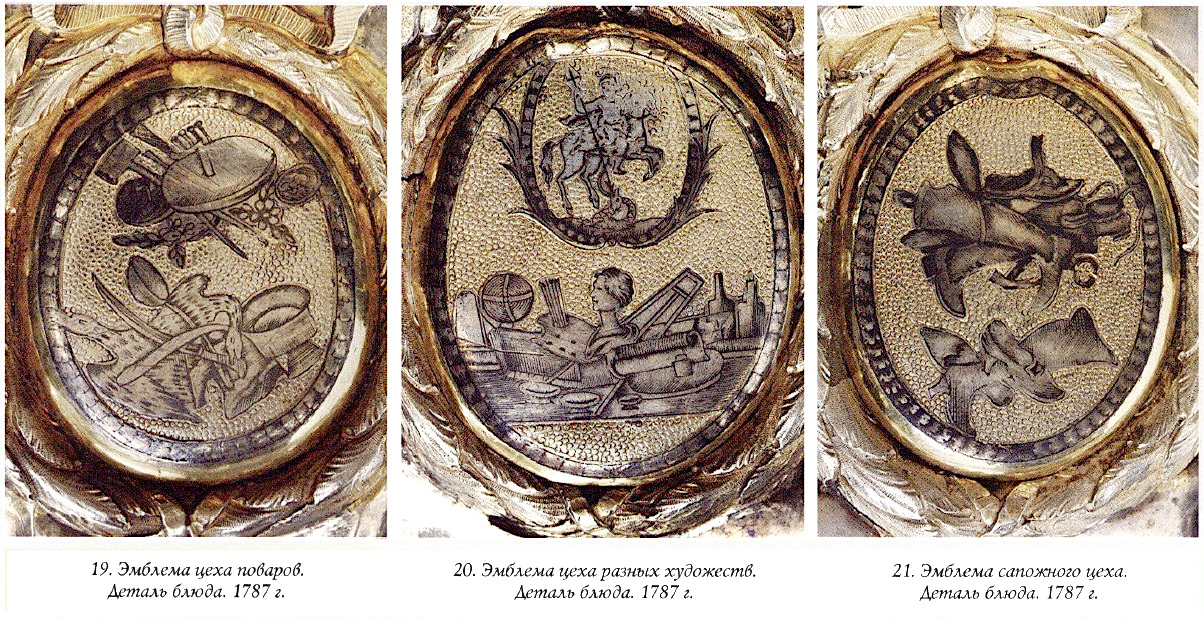
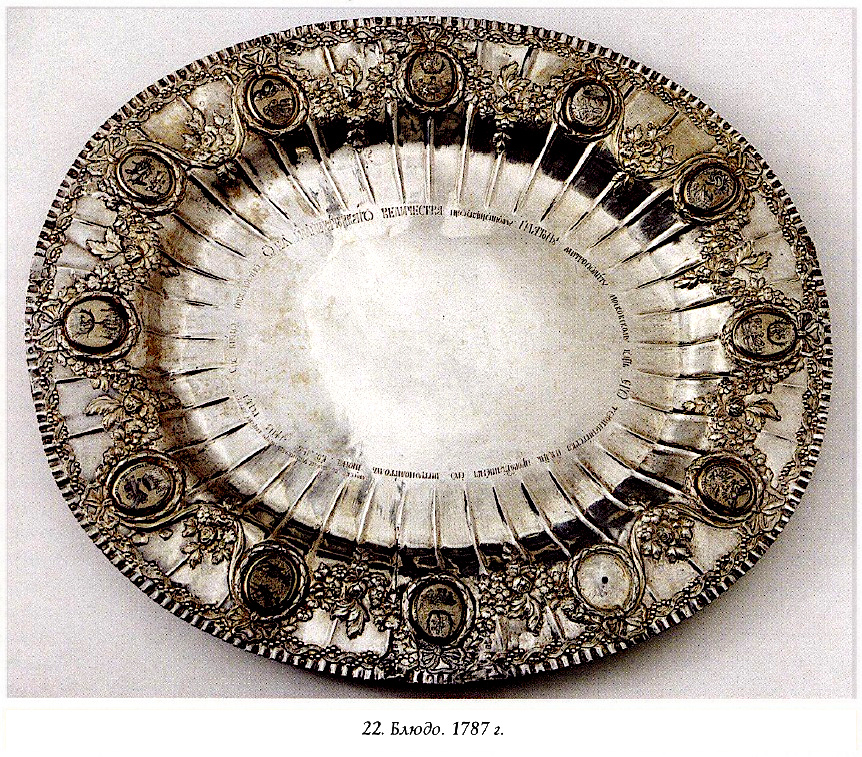
On the second dish, relief garlands and laurel wreaths frame twelve medallions with niello depictions of the emblems of craft guilds (ill. 20, 21). The reverse side also contains an inscription: "From the Moscow guilds of the Craft Administration on a day in June of the year 1787." However, the obverse mentions that this dish was granted by the Empress to Metropolitan Platon of Moscow on his name day, June 29, 1787. Presumably, the Moscow Palace Office did not have time for a special order, so it was decided to use an already existing dish and simply engrave the required inscription. This is especially relevant given the significance of the occasion, as the gift was presented during the liturgy at the Dormition Cathedral in the Kremlin. How Metropolitan Platon reacted to such circumstances remains beyond what is known.
Введите подпись
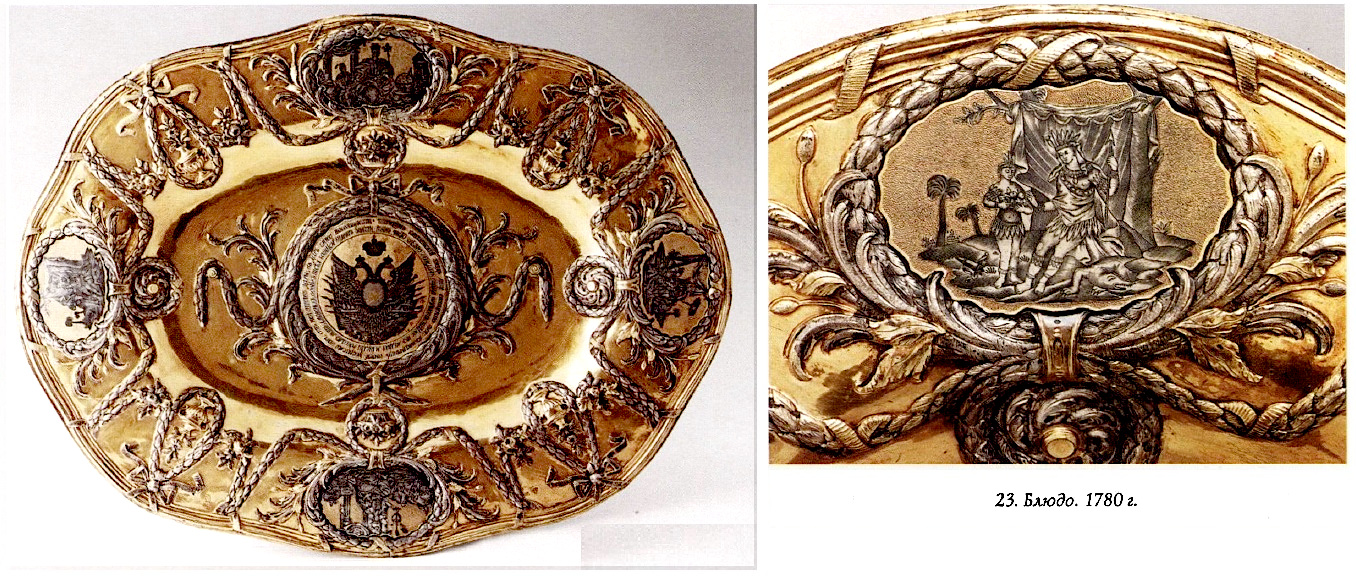
Another dish by Ratkov is kept in the storerooms of the Kremlin Museums (ill. 22). It was presented to Catherine II by a delegation of residents of Smolensk in 1780. This piece depicts the city's coat of arms—a cannon with a bird perched on it, placed within an oval on the chest of a double-headed eagle. Surrounding the Russian coat of arms is a poetic dedicatory inscription praising the Empress, her wisdom, and her generosity: "Blessed is the city of Smolensk, seeing the sacred countenance, burning with zeal for its sovereign, having received gifts from her, dedicates them to her in return, as pure silver entrusts the hearts of its citizens. Accept them, wise and bountiful mother of the Russians, Smolensk will forever call you a goddess."
Введите подпись
The medallions arranged along the rim of the dish skillfully depict allegorical images. At the center of the composition, in the upper part, Catherine is depicted, surrounded by attributes of science and art; her image personifies the idea of a European enlightened ruler, concerned with the prosperity and glory of the state. The other medallions abound with allegories of unenlightened rulers, immersed in idleness and leisure (ill. 23). The clothing of the characters in these scenes and the overall setting are stylized with Eastern and African motifs, reflecting the master's striving for originality and expressiveness in each of his creations.
Введите подпись
The unique style and artistic mastery of Alexey Ratkov continue to attract the attention of art connoisseurs, underscoring his significant place among the outstanding masters of his time. It is no wonder that his works are valued as significant cultural artifacts, preserving the spirit of the era and the high ideals inherent in 18th-century art.
The history of the creation of Alexey Ratkov's prize cups is a fascinating story about the cultural and sporting traditions of 18th-century Russia.
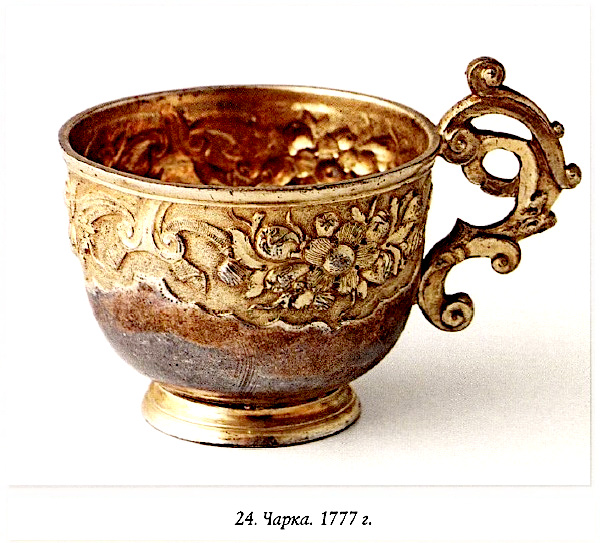
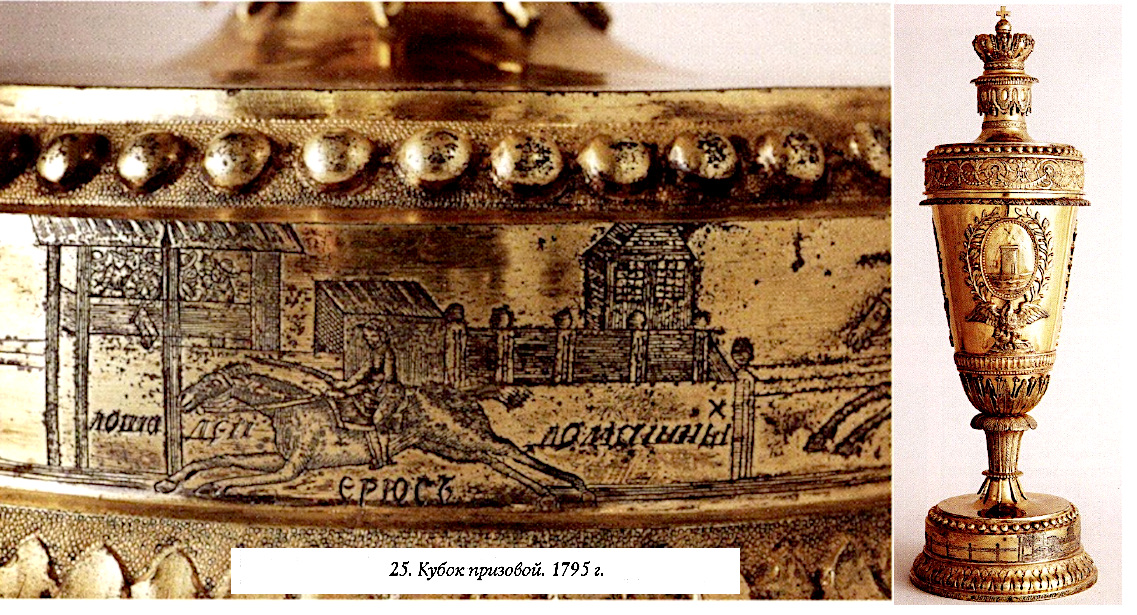
These cups are a very rare type of artifact for their era, and to date, two specimens made using Ratkov's master mark are known. One of these cups is housed in the Armory Chamber (ill. 24), while the other is in the United States and from 1941 to 1953 served as a perpetual trophy for the winner of the steeplechase race, the "Virginia Gold Cup". Subsequently, this cup was transferred to the National Museum of Racing, located in Saratoga Springs, New York. The cup was purchased by the race organizers from the famous entrepreneur Armand Hammer.
Введите подпись
Both cups, despite their different inscriptions, are executed in a unified style. According to information, the cup in the USA is inscribed stating that it was won by a dark bay mare named Ruler on April 27, 1795. In turn, the cup presented in the Armory Chamber was won by Brigadier Pavel Alekseevich Chemodanov, whose animal was a bay stallion named Yerus. The racecourse in Moscow where these competitions took place was located on Donskoye Field and was established on the initiative of Count Alexey Orlov-Chesmensky. This man, who was not only a successful military and statesman but also a talented horse breeder, played an important role in the development of equestrian sports in Russia. The races were held in summer, two to three times a month, and in 1795 their purpose was to encourage the breeding of thoroughbred horses.
The patroness of these events was the Empress herself, who, according to information from the journal "Notes for Horse Enthusiasts," "deigned to award a silver cup to those owners whose horses, by their swiftness, outran other horses." From April to July of that year, eight races were held, each concluding with the awarding of prizes to the winners. The cups created by Ratkov became a symbol of these competitions, emphasizing the high status and significance of the event, while also showcasing the skill of the silversmith himself, who masterfully combined artistic value with practical function.
No less interesting is the fate of the cups themselves. They became a vivid testament not only to the sporting culture of the time but also to Ratkov's mastery in the field of silverwork. Such items, possessing both aesthetic and historical significance, perfectly illustrate the high standards that were established in the production of art objects within the Russian tradition of the 18th century. The quality of execution and original design of these cups evoke thoughts of the undying interest in sports and art that flourished at the time, leaving behind numerous cultural artifacts capable of conveying the spirit of their era.
Alongside the cups, Ratkov also created various decorative objects that were in great demand among the nobility of the time. Among them stand out deeply pierced trays, exquisite candlesticks, and other items executed with a high level of craftsmanship. Thus, his works were distinguished not only by their functions in church rituals but also by the application of new techniques and materials, which gave the items a special charm and impressive originality. Ratkov's silver pieces were created with deep respect for traditions, yet at the same time, they were not afraid to express individuality.
These works not only served practical purposes but also acted as status symbols, emphasizing the position of their owners. As a result, Ratkov became not only a favored master but also a symbol of the prosperity and art characteristic of his time. His works, possessing unique characteristics, left a significant mark on the history of Russian art, continuing to attract the attention of collectors and researchers to this day. Every item that came from Ratkov's hands carried something more than just a physical form—it preserved the spirit of the time and was part of a cultural heritage that must be valued and preserved for future generations.
Based on a cup from the Armory, Master Ratkov skillfully engraved a racing scene, depicting seven galloping horses with jockeys, a taut rope along the track, a judge's tower at the finish line, and a stand filled with spectators. The name of each horse—among them Yerus, Sannik, Nadezhnoy, Zaletnoy, Lentyay, Gazar, and Donkarlus—can be read next to its figure.
The main decoration of the cup is concentrated on the bowl, which features embossed images reflecting the programmatic ideas: the empress welcomes the breeding of thoroughbred horses and values the efforts of breeders striving to see their work through to the end, despite difficulties and possible sacrifices. One medallion depicts Catherine's monogram, another bears the inscription: "To encourage enthusiasts to breed good horses," confirming the attention given to the significance of such breeding. Below, as a symbol of resilience, a rocky cliff is depicted, and in the third medallion, a hive with swarming bees, symbolizing diligence and industriousness. Beneath it, the action of a pelican, sacrificing its own blood to feed its chicks, reflects the idea of self-sacrifice. The cup, located in the USA, is similar to the specimen from the Armory Chamber, except for some images on the base. Since there were eight races, there were also eight awards. It is unknown whether all the cups are the creations of Ratkov or if among them there are works executed by other masters.
Other silversmiths of his time could not possibly sustain themselves solely through commissioned work. Therefore, each of them also produced items for the general public, which were more popular. These were icon covers of standard sizes with traditional images, such as the Vladimir Mother of God, the Kazan Mother of God, St. Nicholas the Wonderworker, and Christ Pantocrator. Alexey Ratkov did not stand aside and also engaged in making these items. Periodically, his icon covers can be found in antique shops. The master also produced various types of tableware, such as beakers and charkas (small drinking cups). For example, two small gilded charka-cups from 1777, adorned with elegant embossed ornamentation depicting fruits (ill. 25), demonstrate his skill in working with the material.
Введите подпись
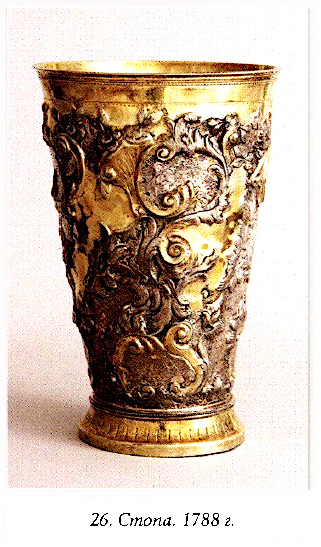
Although such a form of drinking vessel was already considered outdated by the end of the 18th century, Ratkov's charkas were in demand, and in 1783 they were precisely reproduced by a Tobolsk silversmith with the monogram "DES." The Armory Chamber also displays a magnificent tall beaker from 1788, entirely covered with a relief pattern in the Rococo style (ill. 26). This piece highlights the skill of its creator and astonishes with its high level of execution. Master Ratkov was able to combine elements of Classicism and the preceding style, which is evidence of his broad professional range and impeccable craftsmanship.
Such success could not help but attract the attention of highly professional craftsmen and clients, as Ratkov's works have always been distinguished by their high quality and original design. His creations, beyond their functional purpose, also carry cultural value and serve as living witnesses of their era. They remain relevant not only within the context of art history but also as symbols of the rich cultural tradition from which they originate. Each item created by Ratkov encapsulates the uniqueness of its time and the level of craftsmanship, highly valued both by contemporaries and later generations.
Введите подпись
Equally important are the tangible testimonies of his skill, for even the most inconspicuous objects made by Ratkov speak of the era in which they were created. His works stand out not only due to their techniques but also through a profound understanding of content and forms of education. Ratkov established a highly professional standard, the level of which continues to spark interest and admiration among researchers and collectors. His creations continue to live on and serve as a resource for studying the methods and techniques of his time, allowing us to better understand the artistic standards of the 18th century and their evolution.
The treasures created by Alexey Ratkov continue to amaze with their craftsmanship and decorative diversity, highlighting the high status and social significance of silver craftsmanship in 18th-century Russia. The love for exquisite art was manifested not only among the nobility but also among common people, which contributed to the development of this craft and increased interest in new forms and techniques. Ratkov's products became a symbol of this passion, and his works still evoke admiration among both collectors and art historians. The significance of Ratkov's works extends to both the cultural and social benchmarks of that time. Their aesthetic value reflects the ideals and societal notions of beauty, grandeur, and functionality. The items he created not only brought satisfaction to their owners but also served as expressions of status and prosperity, becoming objects of pride passed down from generation to generation.
Collectors and art historians emphasize that Ratkov's works help to better understand the philosophy and aesthetics of Russian silver craftsmanship of his time. Each item created under his guidance represents a document of its era, vividly speaking of its cultural significance. The diversity of forms and styles, along with the high level of finishing, make these works true masterpieces that deserve special attention and study.
Currently, interest in Ratkov's legacy is growing, leading to the emergence of new exhibitions and publications dedicated to his art. In recent years, his earlier works have been especially highly valued, and this is no coincidence, as, despite the centuries that have passed, his works continue to inspire young masters and collectors worldwide.
The importance and cultural significance of Ratkov's works become evident at every stage of their study and collection. They demonstrate how powerfully art can connect people and eras and how, at various historical moments, accumulated experience became unified into a single idea, embodied in objects of antique silver.
When studying his works, alongside technical aspects, one cannot help but notice how distinctly they reflect the changes in the society and culture of that era, showing his craft journey through the prism of the master's personal experience. Considering all these facts, one can confidently speak of Alexei Ratkov's undeniable contribution to the heritage of 18th-century Russian art, which remains relevant today.
Thus, the works of Alexei Ratkov continue to evoke interest and admiration, providing rich material for analysis and inspiration. Each of his works reveals the depth of discoveries in copper work and artistic expression, which remain in demand even centuries later, offering modern art connoisseurs the opportunity to touch the atmosphere of the past.
Because of this, the discourse about Ratkov is more than just about a master—he has become a symbol of an era in which art and craft intertwined, creating a living history full of significance, emotion, and aesthetic enrichment.