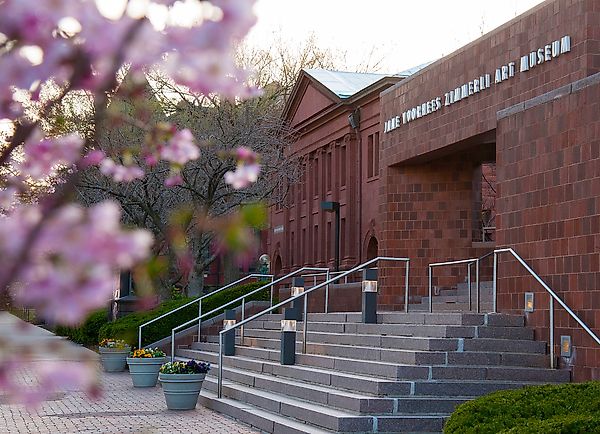
The Zimmerli Art Museum at Rutgers University in New Jersey is now richer by more than 70 artworks after a donation from the collectors Anne and Arthur Goldstein that includes pieces by established figures such as Tauba Auerbach, Darren Bader, Mark Bradford, Nicole Eisenman, Kunié Sugiura, and John Waters, as well as emerging artists like Ever Baldwin, Troy Lamarr Chew II, and Lamar Peterson. “Anne and Arthur are visionary collectors who have long championed artists of color, women artists, and members of the LGBTQ+ community,” director Maura Reilly said in a statement. “This gift represents their enduring relationship with the museum and a remarkable synchronicity with the values that are at the heart of our mission to reflect the nation’s most diverse public university.” The gift will be featured in the upcoming exhibition “Mashup: New Acquisitions from the Zimmerli,” opening in February 2027. Arthur Goldstein had studied law at Rutgers and first visited the Zimmerli in the early 1990s. He and Anne began collecting two years later, first focusing on photography. They were committed to supporting living artists, many before they were widely recognized, says the museum. They previously donated more than 160 works to the institution, including examples by Vito Acconci, Annie Leibovitz, Robert Rauschenberg, Cindy Sherman, and others. They have also donated to larger institutions, including the Museum of Modern Art and the Whitney Museum in New York, the San Francisco Museum of Modern Art, the Art Institute of Chicago, and the Institute of Contemporary Art, Boston. Founded in 1966 as the Rutgers University Art Gallery and renamed the Jane Voorhees Zimmerli Art Museum in 1983, the museum boasts a collection of more than 75,000 works of art. It notably houses an extensive collection of work by nonconformist artists from Moscow, Leningrad, and the former Soviet republics, donated by Norton and Nancy Ruyle Dodge in 1991, and also has strengths in American, European, and Eurasian art as well as original illustrations for children’s literature. Below are some highlights from the gift. There’s a tradition stretching back at least a quarter century of artists creating designs for skateboard decks; streetwear brand Supreme launched it by commissioning artists in 2000, and examples bearing imagery by artists from Raymond Pettibon to Judy Chicago have become highly collectible. Where artist-designed decks are typically visually bold and colorful, this contribution to the genre by artist Darren Bader includes references to a range of Japanese pop-cultural phenomena, but, hilariously, strips away their visual pyrotechnics and reduces them to black text on a white background. Mark Bradford famously spent parts of his youth at his mother’s South Los Angeles beauty shop, where he was in charge of painting signs. Materials from that environment were often integrated into his early collage-paintings, and at the first Art Basel Miami Beach, in 2002, he set up an installation, Foxyé Hair, a beauty-shop-cum-artwork. Miss China Silk is one image in a four-part photographic series features Asian models with African-inspired hairstyles, posed before African-inspired textiles, as a commentary on identity in an age of globalization. The year after creating this work, Bradford would win the $100,000 Bucksbaum Award at the 2006 Whitney Biennial. Troy Lamarr Chew II transforms the classic Campbell’s Soup can, which Andy Warhol famously depicted in one of Pop art’s most famous images, into “the can,” a slang term for jail. The title refers to CorrLinks and JPay, systems for electronically communicating with incarcerated people, and echoes a call for liberation of those behind bars by various musicians. Several dogs are chained in an outdoor enclosure, while aloft in the sky are numerous kites; “kite” is a slang term for secret notes among prison inmates. This mixed-media drawing, recalling scenes of the Crucifixion and images of lynchings, shows a central figure tied to a post, surrounded by more than a dozen figures, some armed, one seemingly grinning and brandishing a knife. Two seem to cradle a third figure, reclining, as if in a scene showing the Deposition from the Cross. Per the museum, it “explores power dynamics, persecution, and mob mentality.” American photographer Lee Friedlander is renowned for his scenes of urban streets incorporating candid images of people in their everyday activities. He took up residence in New York in 1956, and won a Guggenheim Fellowship in 1960, two years before he shot this photo. As in this image, his works often include signage and reflections in windows. Here, a stout man and a young boy look out from behind the window of an ice cream shop, in which the street outside is reflected, thus interweaving inside and out. Hancock’s bright-hued works explore a personal mythology, an absurdist parable of good and evil that includes a battle between the evil Vegans and the meat-eating Mounds (half-human, half-plant mutants). Sesom, a Vegan, discovers the liberating power of color in a dream, and begins to craft miracle machines that create life-affirming color blasts. Hancock’s work wraps up his own life experience with references to art history, superhero comics, pulp fiction, and an array of other pop-cultural inspirations. Alice Mackler, who died in 2024 at 92 years of age, garnered the attention of New York critics, including the New York Times’s Roberta Smith, only starting in her 80s. She created lumpy female figures in ceramic, then painted features onto them, achieving highly individualized personalities, as ARTnews’s Alex Greenberger wrote. Mackler was discovered in 2013, when a partner at New York gallery James Fuentes met her at a class at Greenwich House Pottery. She would go on to be featured in a Jewish Museum group show and see her work enter the Whitney Museum of American Art’s collection.