A.I. Deciphers Ancient, Carbonized Herculaneum Scroll, Which Could Be a Stoic Text
58July 3, 2026
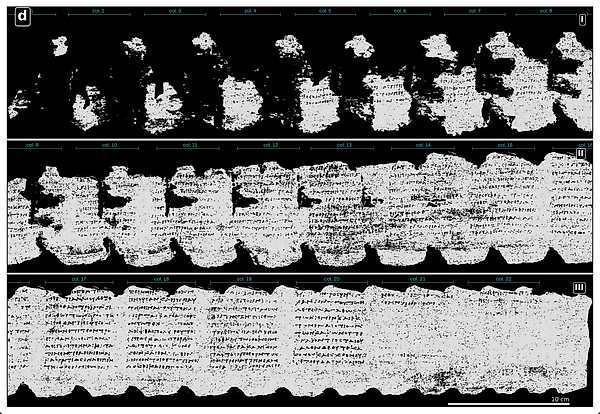
Herculaneum, an ancient Roman town that was buried in an avalanche of volcanic refuse following the eruption of Mount Vesuvius in 79 AD, is also the site of a long-preserved library called the Villa of the Papyri. For hundreds of years, researchers have puzzled over the question of how to decipher the carbonized scrolls entombed within the library’s walls without destroying the fragile documents. Now, however, a great leap forward has been achieved: an international research team of engineers and scientists associated with the University of Kentucky has managed to read all surviving text from a single scroll calledPHerc. 1667. The researchers achieved the result, which represents a complete virtual unwrapping of the scroll, using a combination of A.I. and advanced imaging, including a particle accelerator and a synchrotron.
It has now been determined that the object dates back to either the second century B.C. or the late third century B.C. The contents of the writing on PHerc. 1667, researchers said, have to do with ethics, the arts and human behavior, making it possible that it contains a Stoic philosophical treatise. The scroll’s authorship is unclear, but researcher Alessia Lavorante said that the possibilities include the Stoic philosopher Chrysippus or Epicurus.
“This scroll was deemed completely unreadable when part of it was opened in the 1980s,” Federica Nicolardi, assistant professor in papyrology at the Università degli Studi di Napoli Federico II, said in a statement. “While a few isolated letters were visible, overlapping layers obscured the writing, and the scroll was assigned a readability score of zero. But now, with virtual unwrapping, we can follow sustained arguments across multiple columns. That’s a transformational shift.”
Brent Seales, a Professor of Computer Science at the University of Kentucky, is the co-founder of the Vesuvius Challenge, launched in 2023, which offers large financial prizes to researchers and computer scientists who manage to find new ways to read the scrolls without opening them. The first word in an unopened Herculaneum scroll, for example, was uncovered by 21-year-old Luke Farritor in October of 2023; he was awarded $40,000. Seales has been working on unwrapping the scrolls with new technology since the early 2000s.
In a press conference held at Naples’ Biblioteca Nazionale di Napoli Vittorio Emanuele III, Seales said that “we’re taking an historic leap toward a digital reunification of the collection” of the Herculaneum papyri. “We’ve developed a systematic and repeatable approach for all the scrolls,” Seales said. “So, I’m gonna say it: now, it’s only a matter of time until we read all the scrolls.”