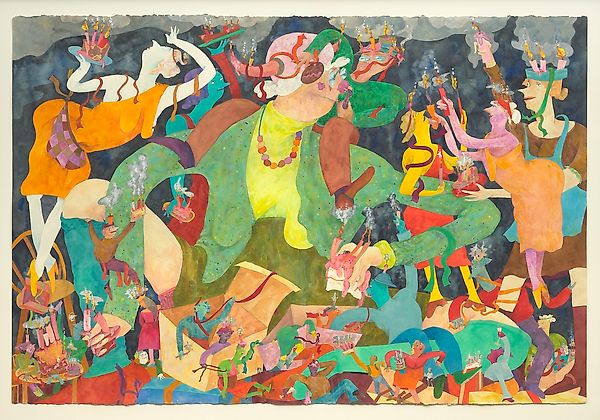
Spectacle in all its many forms is the big theme of the summer season, when big, glitzy projects will take over museums across the globe. Laure Prouvost has been given a wide playing field for a show about quantum physics at Paris’s Grand Palais, while Carsten Höller is planning a vast exhibition for Beijing’s UCCA Center for Contemporary Art, the details of which he has largely kept secret. Meanwhile, Tomás Saraceno will bring his monumental sculptures to Munich’s Haus der Kunst; a permanent land artwork by him is also going on view in his native Argentina. He is hardly the only artist considering the land and all the histories embedded within it. Carolina Caycedo is having a show at the Museu de Arte de São Paulo, while the National Gallery of Canada is surveying contemporary Indigenous artists from Inuit Nunaat, Sápmi, and Denendeh. This is not exactly a new theme, of course, and Ana Mendieta was considering it before many others. Tate Modern is giving her a proper retrospective, in one of the season’s most anticipated art events. This period of relative quiet will also leave collectors, curators, critics, and artists with plenty of time to travel—perhaps to the Venice Biennale, which remains on view through November. It’s not the biennial happening this season, however. Manifesta, a roving European biennial, this time touches down in Germany’s Ruhr region, while two new biennial-style shows will launch in the Northeastern US. If you can’t beat biennial fatigue, join it. Below is a look at 46 museum exhibitions and biennials to see this summer. Before Akinsanya Kambon appeared in the 2023 edition of the Hammer Museum’s “Made in L.A.” biennial, he was not so well known. Now, this California artist who once helped lead the Sacramento chapter of the Black Panther Party seems poised to become a star of the New York scene this summer. In a survey split across SculptureCenter in Queens and the Center for Art, Research and Alliance in Manhattan, Kambon will exhibit the full range of his art, with an emphasis at the Queens venue on his ceramic sculptures, which reconfigure symbols from the African diaspora. Made using the Japanese raku firing technique, these ceramics will be on view at the same time as CARA’s show of paintings, drawings, and archival matter. May 28–August 16 For her current show at the Fondazione Prada in Milan, Cao Fei filled the museum’s main exhibition space with a diverse set of works, from documentaries about drone technology in China to a faux rice paddy. The Beijing-based artist described the show as a “contemporary agricultural archaeological site,” a phrase that emblematizes how Cao’s art scrambles past, present, and future, often to suggest that China is constantly remaking its history to imagine itself in the years to come. Similar themes will bind the bodies of work featured in this show. Billed as her largest European survey to date, the exhibition will include classics such as Whose Utopia, her famed 2006 video in which Chinese factory workers break into dance, briefly refusing the demand that they contribute to the project of propelling China forward. May 30–October 11 This intriguing group show takes its name from structures introduced by socialist governments—including ones in China—to give children access to extracurricular activities. Children’s palaces, the show’s description notes, create “the fantasy that a better society can be engineered by training bodies, attention, and aspirations”; curator X Zhu-Nowell has convened a range of artists who rebut that notion. Among them is Jeamin Cha, a rising artist whose past works include a video about Korean women who never received a proper diagnosis for their mysterious ailments. June 1–September 20 Few young artists are making work with as significant a creep-out factor as Diego Marcon, who has gained a reputation for unsettling videos that enlist digital technology to warp peaceful visions of domesticity. Krapfen (2025), this show’s centerpiece, could very well have been a musical for kids, except that the child at the film’s center is dancing to tunes that are threatening, not delightful. (The songs are about the necessity of eating a krapfen, or German doughnut, which is something this kid is not wont to do.) Krapfen appears in this show alongside other works by the Italian artist, whose star has steadily risen since an appearance in the 2022 Venice Biennale. June 6–October 4 One of the stars of the Met’s Rockefeller Wing is a 14-foot-tall slit gong by the Vanuatuan sculptor Tin Mweleun. The slit gong transforms an elongated body with big googly eyes into a playable instrument, and as this exhibition demonstrates, it’s hardly the only object in the Met’s holdings to do something along those lines. Across 130 items spanning ancient Egypt to the present, the exhibition suggests that artists have always made connections between music and the body, as is apparent from works such as Nam June Paik’s TV Cello (1971), in which a string instrument is outfitted with television screens stacked to vaguely resemble a person’s torso. June 7–September 27 Long before Indigenous artists in Latin America made their way into biennials worldwide, Chico da Silva found fame in Brazil, where his glorious paintings of birds and sharp-toothed fish gained widespread recognition during the 1960s (as well as the label primitive from non-Indigenous critics). Born to an Indigenous Peruvian mother and a Brazilian father, he was raised in the Amazon rainforest and would go on to form the Pirambu Workshop, whose participants, from the Fortaleza favela, helped Da Silva produce his paintings. Billed as the artist’s first survey in Europe, this show presents the workshop’s collaborative model as an inspiration to Indigenous artists working today. June 6–September 6 The nimble artist Maren Hassinger has spent a career considering humanity’s indifference to nature, a problem she has tried to remedy through graceful sculptures and reparative performances. One such performance, from 1982, involved picking up rubbish from New York parks, painting it pink, and then returning the refuse back to the sites where she found it. Pink Trash, as that work is known, may be the defining work by Hassinger, who once noted that “there’s an absence of nature yet a proliferation of human-made products which reflect nature or imitate nature.” The piece will be restaged during the run of this retrospective, her biggest to date, which includes sculptures, performances, videos, and more from the 1970s to today. June 6–November 29 While Keith Haring is fondly remembered for painting his graphic figures across canvases, T-shirts, gallery walls, and even subway cars, this exhibition proposes that he was equally significant as a sculptor. Rebutting the notion that his two-dimensional work was his best, this show features such objects as a mask lined with dancing people, an elephant-like sculpture whose trunk is covered in stripes, and a 1963 Buick whose surface Haring covered with such fabulous creatures as a giant snake that makes its way across nearly the entire length of the car. The show is part of a summer of celebrations at Crystal Bridges, whose galleries will expand by 65 percent through the inauguration of a new space designed by Safdie Architects. June 6–January 25, 2027 Even though it may be a crowded year for biennials and other recurring art exhibitions, two newcomers are hoping to make a splash in the northeastern United States. The first of them, the Medina Triennial, is betting that it can lure the international art elite to western New York State, which is not necessarily a destination for collectors and dealers from abroad. Under the theme “All That Sustains Us,” organizers Kari Conte and Karin Laansoo have assembled 39 participants ranging from Nigerian-born photographer Abraham O. Oghobase to Lina Lapelytė, who contributed to the Golden Lion–winning Lithuanian Pavilion at the 2019 Venice Biennale. Many of the artists featured in this show are invested in sustainability and rebuilding the natural environment. June 6–September 7 Imagine a Connecticut-focused response to the Hammer Museum’s “Made in L.A.” biennial and MoMA PS1’s “Greater New York” quinquennial, and you’d have the Aldrich Decennial, the second high-profile recurring art exhibition to launch its inaugural edition this summer. Set to take place once every decade, this show features artists who work in Connecticut or lived there at some point. First up is an edition called “I Am What Is Around Me,” which features well-known names such as Em Rooney, Aki Sasamoto, Philip Taaffe, and Tammy Nguyen, the latter of whom is also showing paintings about the intertwined legacies of the Cold War and the American War in Vietnam at the Venice Biennale. June 7–January 10, 2027 You can always count on the ceaselessly creative French artist Laure Prouvost to deliver a good spectacle, and she looks to deliver once more with this show, the result of research into quantum physics aided by philosopher Tobias Rees and scientist Hartmut Neven. Given carte blanche at one of Paris’s most storied exhibition spaces, Prouvost will show such works as The Beginning, a large-scale kinetic sculpture resembling a flower, its petals extending around the Grand Palais’s glassed-in main room. Across a video and other sculptures exhibited around it, Prouvost will contend with notions of ephemerality and infinitude—heavy topics taken up with the artist’s signature mix of curiosity and humor. June 10–July 26 Most people would say that Picasso’s greatest contribution to the arts came in the form of paintings and sculptures. Few would suggest that he made a significant impact through fashion, though indeed he did, for as a GQ editor once put it: “Just as Picasso made his name through the prism of cubism, he also manufactured a unique identity through the prism of his wardrobe.” (And the other wardrobes of others, too—the dresses worn by his female sitters in his paintings are quite memorable.) Maybe that’s why Tokyo’s National Art Center thought to bring on Paul Smith, a fashion designer, to aid in the production of this show. Works on loan from Paris’s Musée Picasso will be exhibited in a setting that the center suggests is evocative of Smith’s clothes—a gimmick, perhaps, but one that’s certainly in keeping with Picasso’s and Smith’s shared love of stripes. June 10–September 21 The artist Rufino Tamayo, the namesake of this museum, at one point led the ethnographic drawing department of Mexico City’s National Museum of Archaeology, History, and Ethnography, furthering an interest in his nation’s past that guided his entire practice. And he was hardly the only Mexican artist fascinated with the exhumation of history, as this exhibition proves. Focused predominantly on the 1980s, the 100-work show is in part dedicated to reframing the way Mexican art is typically discussed, moving the narrative away from Duchampian aesthetics and toward archaeological revisitation. Featured here are a range of the era’s top artists, from Francis Alÿs to Maria Thereza Alves. June 10–October 18 As he nears his 100th birthday, Julio Le Parc is getting a survey at Tate Modern, which plans to return this Argentinean sculptor to his experimental roots. Though his colorful sculptures now appear eminently Instagrammable, Le Parc came out of the European avant-garde of the 1960s—he became famous through his work with the Groupe de Recherche d’Art Visuel and initially made work using Plexiglas, a type of plastic then associated less with art than with industry. He has continued using the stuff to make grand sculptures that throw their vibrant hues around the rooms they occupy, in the process questioning how the eye perceives color and movement. Some 60 works will be featured here. June 11–May 3, 2027 This heady group show is centered on the notion of debt. One might associate that concept with economics, but this show’s description notes that it also “encompasses social, spatial, historical and emotional dimensions.” One participant in the exhibition is Sung Tieu, a Vietnamese–German artist whose recent pieces include one in which she sold art to gain the curator Mi You a position on the board of Berlin’s KW Institute for Contemporary Art. Tieu said at the time that this was an effort to diversify the board and contend with “legacies of exclusion and economic gatekeeping [that] persist within cultural institutions and beyond,” something that others in this show will also address. June 11–September 20 This museum has a reputation for rescuing female artists of the postwar era from obscurity and reviving interest in them. The latest artist to receive the treatment is the nonagenarian Italian artist and activist Mariuccia Secol, who at one point in her fascinating career, in the 1960s, led a painting workshop at a psychiatric hospital. Following the feminist calls for liberation during the late ’60s, Secol stopped painting altogether and instead began making textiles. Often these textiles depict bodies, whether figuratively or abstractly, their dangling threads and woundlike forms reflecting “the experience of women,” as she once said of a series about pregnancy and stretch marks. June 11–November 1 Continuing an emphasis on Indigenous art that has defined the National Gallery of Canada’s programming for the past decade and a half, “Qillaniq” includes dozens of artists from Inuit Nunaat, Sápmi, and Denendeh. (The title is borrowed from the Inuktitut word for the shimmer of sunlight or moonlight on water.) Though broadly billed as “a celebration of those that share love as an answer to difficulty,” the exhibition is less notable for any binding theme than for convening so many of these artists in North America, whose biggest museums rarely mount shows like this one. Included among the artists are Hans Ragnar Mathisen, the artist who composed the Sámi anthem and a recent star of the Carnegie International; Inuuteq Storch, who in 2024 became the first Greelandic artist to represent Denmark at the Venice Biennale; and Tanya Lukin Linklater, an artist and choreographer of Alutiiq descent whose works consider how acts of violence shape what can and can’t be said. June 12–September 20 “MY WORK is MANNERED, is HOMOSEXUAL, is EFFETE, is BASE, is SNOBISH,” begins the text included in one Arch Connelly work, acting as “a kind of manifesto,” as critic David Frankel wrote in Artforum. All those adjectives are apt descriptors for Connelly’s art, which frequently featured photographic material—including images taken from gay porn—that he studded with rhinestones and other materials. These works, which Connelly exhibited at the storied Fun Gallery in New York’s East Village, celebrated excess and defied the prevailing standards of good taste, which may be one reason he failed to achieve widespread fame in his lifetime. Now comes an attempt to canonize him in the form of a full-fledged survey, the biggest since his death of AIDS-related complications in 1993. June 12–October 11 Frank Gehry, the starchitect who died last year, reshaped the museum world with his designs for spaces ranging from the Vitra Design Museum to the Guggenheim Bilbao, whose sloping titanium exterior defined an entire era. (At the time of his passing, he had yet one more museum building to come: the Guggenheim Abu Dhabi, which is not yet open.) What does it mean to museumify Gehry, an architect whose designs often bristled against the strictures of institutional practices? Find out with this retrospective, which is centered around 19 of his projects. June 12–December 30 Cyprian Gaillard works best at a monumental scale, which is probably why the Kunsthaus Bregenz made the wise decision to give this artist three of its floors to fill. One will feature the debut of DETERRENT, a new video that starts with a 7Eleven in Los Angeles before tackling the world of museums and the urban environments of cities across Europe. Another floor will feature sculptures—flutes that have rolled-up euros planted in their holes—that relate to the show’s eccentric title. Running across both the video and the sculptures, as well as in some photographs included in the show, is an interest in what happens when an object or a space is made to function in ways beyond its original use. June 13–October 4 Melted into the Sun, the 2024 film from which this survey takes its name, considers the eighth-century prophet Al-Muqanna, who was known for wearing a veil and leading an uprising against the Abbasid Caliphate. Rather than directly representing Al-Muqanna in the film, Saodat Ismailova focuses on the landscape of Central Asia that he is thought to have graced—particularly her native Uzbekistan, whose deserts she films in long, dreamy takes. This work, like many others by Ismailova, a star artist of the biennial circuit, is about the history contained within the region, whose cultural memory was upended during the Soviet era. Alongside several of her hypnotic films, this museum is showing ikat textiles produced in Uzbekistan during the 19th century. June 13–November 29 Willem de Kooning’s name typically conjures thick, chaotic strokes of paint slathered together to form images of nude women. And indeed, one such work from that series by the famed Abstract Expressionist—his beloved Woman I (1950), long held by the Museum of Modern Art in New York—is making its way to Chicago for this survey. But the show is less focused on De Kooning’s paintings than it is on his drawings, which form the bulk of the 200 works assembled here. These works on paper suggest that De Kooning mastered figuration before he turned to abstraction: One early work depicts a bowl and two jugs, rendered with a crisp precision attributable to his academic training in the Netherlands. June 14–September 20 There have been plenty of shows mounted this year to mark the 250th anniversary of the founding of the United States, but most thus far have been disappointing, either failing to critically address the nation’s history or flaccidly attempting to do so using an anodyne theme. This show looks like the rare one to thread a very difficult needle. Teased with a Johannes Adam Simon Oertel painting from the mid-19th century that shows early Americans pulling down a George III monument, the exhibition suggests that democracy has always been a contentious notion—and that debate and dissent are integral to this country’s culture. The show inaugurates a fresh wing devoted to democracy, a topic that has taken on an unfortunate degree of importance as high-ranking politicians continue devising new ways to strip voters of their rights. June 18–November 1 Perhaps more than any other U.S. president in recent history, Barack Obama demonstrated a passion for the art of his time: He chose Kehinde Wiley to paint his official portrait, he commissioned Shepard Fairey to create the iconic “HOPE” poster, and he hung an Alma Thomas painting in the White House well before she had mainstream recognition. Now he’s preparing to open his Presidential Center, and thought not exactly an art museum, it abounds with more commissions than most spaces recognizing former presidents. The star of those commissions is arguably an 83-foot-tall glass painting by Julie Mehretu that looms high above the 19.3-acre complex, but the ones around it, by artists ranging from Aliza Nisenbaum to Rashid Johnson, are no less notable. Opens June 19 “I’m not a journalist, an objective reporter,” said the photographer Ed van der Elsken, whose black-and-white pictures taken on the streets of Paris and Amsterdam are raw and highly stylized, with areas left blurry. Indeed, these are not the kind of crisp shots one might find in a newspaper to accompany reporting on the events of the day. Having come into possession of the Dutch photographer’s archive in 2019, the Rijksmuseum will now stage a survey of his work, which bore witness to changing social mores across Europe in the postwar era and beyond. June 19–September 13 In 1976, the artist Gabriele Stötzer signed a petition in support of Wolf Biermann, an East German dissident. In response, Stötzer was kicked out of school in East Germany and thrown in prison. While incarcerated, she realized that “my body was the only medium I had left,” as she told ARTnews last year. After a year behind bars, Stötzer devoted an entire career to exploring the body as a site of political resistance, occasionally courting controversy for doing so: She once photographed a model in drag in her studio, only to learn that this person was actually a Stasi informant who was monitoring her. With one retrospective in Switzerland in 2025, Stötzer is now receiving another in Berlin, a city where East Germans remain underrepresented in most museums. June 19–December 6 Vishnu, the Hindu deity that protects the universe, and all the many forms he takes are the main subjects of this mega-show, which brings together 200 works, many of them on loan from countries ranging from Cambodia to Switzerland. On hand will be the classic images one might expect—for example, a 16th-century illuminated manuscript of the Mahabharata, the ancient epic in which Vishnu descends to earth as Krishna. But there will also be contemporary artworks, courtesy of Indian artists such as Pushpamala N, who has periodically posed as Hindu deities for her own photographs, suggesting the way in which tradition remains mutable in the present. June 20–October 5 In 2024, Deutsche Welle reported on an epidemic of church closures in Germany, where the number of Protestant and Catholic church members had declined markedly in the prior three decades. Many of these decommissioned religious sites are now being remade anew as libraries, bookstores, and even residential housing. This edition of Manifesta, a roving biennial that takes place in a different European location with each edition, acknowledges the trend by siting works by 100 artists in a dozen churches spread across Essen, Bochum, Gelsenkirchen, and Duisburg, all of which are located in the Ruhr region, sometimes referred to as Germany’s “Rust Belt.” Answering pressing questions about religion will be artists ranging from Mona Hatoum to Judith Hopf. June 21–October 4 This is the most significant retrospective for Carmen Laffón in her home country of Spain since 1992, and the first since her death in 2021. Laffón was known for sticking to figuration while others took up abstraction and conceptualism. In painting still lifes with fruit and landscapes of the Spanish coast, she revisited subject matter that has recurred throughout art history, albeit in ways that diverged slightly from how things actually looked; Laffón was more interested in getting at the essence of life than in depicting its realistic details. Some 80 of her works have been assembled for this show. June 23–September 27 Borrowing its title from a 19th-century painting by Albert Pinkham Ryder that features people traversing a darkened landscape, this exhibition is not your average solo show. As one might expect from a show for a contemporary artist, there will be a gallery of new works by the Iranian-born Ali Banisadr on hand—dense abstractions hinting at worlds beyond our own. But rather than siloing Banisadr’s work in one designated section of the museum, the AKG will also feature the painter’s art in its permanent collection galleries, where his latest canvases will mingle with famed works by William Blake, Hiroshige, and many more. June 26–November 8 The name of this show transposes two words in the title of a 1948 painting by Marian Bogusz: Ways of the White Spread Over the Black Land, in which motifs derived from sub-Saharan African cultures are reformulated to create an abstraction that tracks with the aesthetics of European modernism. In inverting Bogusz’s title, the exhibition aspires to critique the way Polish artists saw Africa as a source of artistic inspiration while also demonstrating that artists from post-independence Ethiopia, Sudan, and Nigeria really did find a home in Poland. Fittingly, Bogusz is included in this show alongside artists such as Worku Goshu, an Ethiopian painter whose earned a master’s degree in Krakow and then went on to found a gallery in Addis Ababa. June 26–January 10, 2027 For most with a passing knowledge of postwar American art history, Betty Parsons’s name calls to mind her adventurous New York gallery, which gave artists such as Robert Rauschenberg, Barnett Newman, and Jackson Pollock some of their first significant exposure. In fact, Parsons was a consummate painter in her own right, regularly showing her abstractions at the same time as her Abstract Expressionist peers—though she has not entirely gotten her due until now. Curated by Kelly Taxter and Amy Sillman, the latter of whom is herself a painter of lush abstractions, this retrospective aspires to canonize Parsons as a figure who moved as fluidly between her studio and the nascent New York art market as she did between painting and sculpture. June 27–October 18 While painters have used grids for decades to impose a sharp sense of order on abstraction, Tony Bechara once said he reveled in the format’s ability to surprise him. To make his innovative abstractions, the New York artist, who died last year, created grids of tape and filled in the blank areas between his strips, gradually pulling them away to find squares of color that he had forgotten lay underneath. His paintings, which consider what happens when rigid structures break down into chaos, form the bulk of this survey for an artist who may be better known for his patronage—he chaired the board of New York’s El Museo del Barrio for nearly two decades. June 27–November 1 Born in Brazil to Japanese parents, Kenzi Shiokava didn’t receive mainstream recognition until a few years before his death in 2021. It wasn’t until the Hammer Museum’s 2016 “Made in L.A.” biennial, where he showed 66 of his towering yet graceful wood totems, that his name became recognized beyond his Los Angeles base. Similar totems will appear in this survey, which will also feature his intimate assemblages of unlike objects—toys and faux leaves, for example—that combine to reference a cross-continental array of thought systems, from Zen Buddhism to Candomblé. June 27–January 31, 2027 At the current Venice Biennale, Carolina Caycedo is showing weavings that pay homage to an array of dispossessed individuals, including two Japanese-American women who were interned by the U.S. government, and a jute sculpture that contains seeds carved from wood. Both in Venice and in this show, the artist, who was raised in Colombia and is now based in the United States, brings together underrecognized histories and organic matter to uphold the value of the land around us, often by emphasizing the role that women play in tending it. It’s fitting, then, that MASP’s Caycedo survey is part of its ongoing “Latin American Histories” program, which showcases figures who have shaped the region’s canon. July 3–October 4 Carsten Höller is typically associated with giant sculptures of mushrooms and corkscrewing slides installed in gallery spaces. They’re oddball works that are meant to surprise. What’s he got up his sleeve this time? A description for this show notes that the German artist, an unlikely participant in the current Venice Biennale, has conceived the show as a “Laboratory of Doubt,” without much explanation for what that might mean. Still, one can assume that this show will continue Höller’s reputation for mind-bending art that overwhelms the senses and alters the viewer’s sense of space and time. July 4–January 31, 2027 If you feel that Georges Seurat gets too much attention when it comes to 19th-century French art history, try this exhibition on for size. His French colleague Paul Signac is the central figure of a show focused on Neo-Impressionism, which critic Félix Fénéon theorized as a response to the Impressionist movement. During the late 19th century, Neo-Impressionism—in Fénéon’s view, at least—moved even farther from reality, with artists like Signac and Seurat taking up styles like Pointillism, in which dots of color come together to form people and landscapes. Signac, along with artists such as Camille Pissarro, Curt Herrmann, and Jan Toorop, deployed these styles to question how and why we see the world as we do. These artists are all represented in this survey. July 4–October 11 At a time when so many younger artists are divining unexpected connections between the body and the earth, often with an eye toward feminist histories and anticolonial struggles, Ana Mendieta’s art of the 1970s and ’80s looks only more prescient. For her legendary “Siluetas” series, for example, she visited sites in Iowa and Mexico and created images of the human form in the earth, occasionally lying on the ground to make an impression of her own body. Those performances, which the Cuban-born artist preserved through photographs, showed that one’s body is intimately related to the landscape around it and blazed a trail for many artists who came after her. This 150-work retrospective will feature that series, as well as works dealing with rape—a topic that was not widely discussed during Mendieta’s day—and a sculpture made from a tree. July 15–January 17, 2027 The more famous Tomás Saraceno has become, the more extravagant and grandly scaled his installations contending with ecological change have gotten. He has come a long way from the 2019 Venice Biennale, where he scored a hit with his weblike sculptures that were tended by spiders throughout the show’s run. With this exhibition, the Argentinean artist returns to his spider-oriented sculptures, which will be shown alongside a group of “air sculptures,” as the museum calls them, produced through Saraceno’s Aerocene initiative. The show coincides with the completion of El Santuario del Agua (The Sanctuary of Water), a new Land artwork by Saraceno, who made it with Indigenous communities in northern Argentina. The piece is on permanent view in Salinas Grandes. July 17–February 7, 2027 Famed for her contributions to the Chicago-based Hairy Who group of the 1960s, Gladys Nilsson has gained a cult following for her raucous paintings dense with people twisting around and through each other as they fly through space. These figurations have almost always been out of step with critical tastes, but she has continued producing them anyway, undaunted. It’s an attitude she attributed to her working-class upbringing. “There’s a lot to be said about that, the ability to continue on,” she told Frieze in 2020, just days before she turned 80. Class identity forms one focus of her biggest retrospective to date, which includes approximately 115 works. July 19–November 29 There are some artists’ biographies you simply could not make up, even if you tried, and Richard Dadd’s is one of them. This British artist was trained at the Royal Academy of Arts during the early 19th century, then went on to travel the world, drawing sights seen in Egypt, Turkey, and elsewhere. Then he began to experience delusions; he would eventually murder his father and spend much of his career in asylums, from which he produced fabulous landscapes dense with figures engaged in mysterious rituals. Though not exactly popular during the Victorian era, Dadd’s work has enjoyed an afterlife in England—the British band Queen once did a song inspired by one of his paintings. Now, his art may inspire a new generation of Brits with this 100-work survey. July 25–October 25 If the Welsh painter Gwen John appears in art history books, it is typically as a footnote in sections about Auguste Rodin—she was the sculptor’s mentee and romantic partner. No longer will she be remembered only that way. This summer, John is getting a significant retrospective that will make its way to the United States following a run in Scotland. The show places an emphasis on John’s canny ability to take styles that grew out of both England and France during the 19th century (she received her training in both countries at that time) and merge them to create pallidly colored portraits that are prized for their quietude and psychological intensity. August 1–January 4, 2027 Olalekan Jeyifous took the Silver Lion award at the 2023 Venice Architecture Biennale for an installation about the All-Africa Protoport, an initiative to create zero-emissions complexes in cities across the continent. (The initiative wasn’t real; the artist described it as a “retrofuturist African ecofiction.”) The piece is one of many to imagine an alternative future version of Africa—one seeded with references to the continent’s past—by the Nigerian-born artist, architect, and designer, whose work has been steadily gaining a following in the art world. His first-ever museum show will present a new set of works about rivers, in particular the Mississippi River, which runs through Minneapolis. August 6–January 3, 2027 In Uganda, the queer community is sometimes called abasiyazi, or “sugarcane husk”—a label cruelly suggesting that its members are no better than trash. Babirye comes from that country and is intimately familiar with the lowly status conferred upon queer people there, which is why she turns the word abasiyazi literal, creating sculptural portraits made of tossed-off objects. Now based in New York, Babirye will continue her practice of turning rubbish into treasured art with this show, where she will display new wood and ceramic sculptures meant to resemble family members attending a matrimonial rite. This wedding is a queer one, a description of the show notes. August 27–January 18, 2027 In 2013, at Seoul’s MMCA, Do Ho Suh unveiled a monumental installation called Home Within Home Within Home Within Home Within Home, which was almost exactly what the title suggested: two houses constructed from translucent material, one set inside the other. Both houses were full-size replicas of ones where Suh had personally resided—the first was a copy his childhood home in Seoul, and the second was a simulacrum of his house in Providence, Rhode Island. The installation turned the phrase “memory house” literal, furthering themes related to the loss of history that Suh has spent a career exploring. He now returns to the MMCA for this show, which surveys the artist’s entire oeuvre, from its beginnings in the 1990s to the present. August 27–February 9, 2027 Permanently installed on the grounds of the Museum of Contemporary Art Tokyo is Tada Minami’s Chiaroscuro (1979), a stainless-steel sculpture that reflects—and warps—its surroundings. Like most other works by Tada, this sculpture uses materials associated with industry to shift how people perceive the world. Born in Taiwan, raised in Korea, and based for much of her career in Japan, Tada continued her exploration of that theme across multiple mediums—first in painting, then in sculpture, and finally in large-scale installation. Each of these areas of her oeuvre will be explored in this 70-work survey. August 29–December 6