Carl Andre (1935–2024)
243Jan. 26, 2024The names
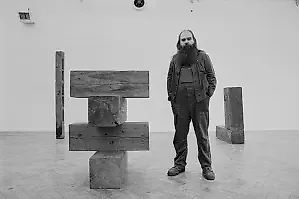
Carl Andre, a towering figure in Minimalist sculpture renowned for his austere linear and grid-format works and for facing a murder charge in the death of his third wife, Ana Mendieta, died in hospice in Manhattan on January 24 at the age of eighty-eight. No cause of death was given. Working with everyday materials of the type found at construction sites, including bricks, wood, granite, and metal, Andre created works whose stark simplicity evoked deeply primal emotions, and whose modest makeup frequently sparked controversy, as detractors carped that his piled, strewn, or carefully laid-out groupings of humble objects could not possibly comprise artworks.RelatedROBERT WHITMAN (1935–2024)MARIE-ANNE MCQUAY TO CURATE 2025 LIVERPOOL BIENNIAL Carl Andre was born on September 16, 1935, in Quincy, Massachusetts, the youngest of three children and the only son of his Swedish father, a naval draftsman and accomplished amateur woodworker, and his American mother, an office manager. From 1951 to 1953, he studied at the prestigious Phillips Academy in Andover, Massachusetts, where he met Hollis Frampton. The two would become lifelong friends and Frampton’s experimental work as a maker of structural films would influence Andre’s practice. On graduating from Phillips, Andre joined the army before moving to New York upon his discharge in 1956.
There, he was introduced by Frampton to Romanian sculptor Constantin Brâncusi, a pioneer of modernism whose work Andre would later cite as important in shaping his own practice, particularly his first works in wood, made in the late 1950s. Reconnecting with Phillips classmate Frank Stella in 1958, Andre shared a studio with the painter until 1960. That year, he took a job in New Jersey as a brakeman and conductor for the Pennsylvania Railroad. The role, which he held until 1964, influenced both his mode of dress, which became and remained that of the manual laborer, as well as his practice, in terms of the orderly operations and interchangeable parts necessary to make a railroad system run. It also affected his views on labor rights, which would come into play in 1969, when he helped cofound the Art Workers’ Coalition. When not toiling in the Newark trainyards, Andre wrote poetry, a good deal of it concrete—that is, structured so that the physical arrangement of the words bears more import than the meaning of the words themselves.
By 1965, he had returned his attention to the sculpture practice begun in the 1950s, expanding beyond chunks of wood saw-cut into blocky forms into stacked works, piling objects such as stones or pieces of pipe in lofty vertical arrangements that, he later acknowledged, reflected his attempt to remake Brâncusi’sEndless Columnof 1918. He received his first solo show in 1965, curated by Henry Geldzahler at New York’s Tibor de Nagy Gallery, by which time he was already making the floor- and ground-based pieces for which he became most widely known. Exemplary of these are hisLever,1966,137 fire bricks laid out in a line across the floor, bisecting the room in which they are placed, andStone Field Sculpture,1977, comprising three dozen boulders arranged in eight parallel rows of increasing length on a downtown Hartford, Connecticut, lawn. The latter was spray-painted by pranksters in 2009 in a manner that suggested they were marked for removal—like debris or rotting trees—by utility employees. A 1972 work, Equivalent IV,composed of 120 fire bricks arranged in two layers to form a rectangle and purchased by London’s Tate Gallery the year it was made, also ignited outrage in certain circles, with critics decrying the use of taxpayer money to buy what they variously cast as “a load” or “a pile of bricks.” The exhibition of Andre’sLeverat the Jewish Museum the year it was made brought him a great deal of attention. Four years later, in 1970, he was the subject of a retrospective at the Solomon R.
Guggenheim Museum in New York. Success remained largely in his grasp throughout the ensuing decades. In 1985, Andre was accused of second-degree murder after his wife of just a few months, Cuban artist Ana Mendieta, plunged to her death from the couple’s thirty-fourth-floor apartment following what neighbors and Andre himself cast as an argument between the two. Electing to be tried by a judge rather than by a jury, Andre was found innocent of the crime, but would remain haunted by it all his life. Protesters at the opening of a 2017 exhibition of his work at the Geffen Contemporary at MoCA in Los Angeles distributed cards reading,“Carl Andre is at MOCA Geffen.¿Dónde está Ana Mendieta?[Where is Ana Medieta]?” Andre’s concrete poetry was collected in a 1980 book titled12 Diagloues, completed in collaboration with Frampton. He published two artists’ books, Quincy(1973)and America Drill(2003).His work is held in the collections of numerous major arts institutions around the globe, including the Museum of Modern Art, New York; Hara Museum of Contemporary Art, Tokyo; the Stedelijk Museum, Amsterdam; Tate Modern, London; and the Centre Georges Pompidou, Paris.
Andre, who unlike many artists, made and installed his own work until he was too infirm to do so, was notoriously dismissive of attempts to assign intention to his works, which he crustily and stalwartly maintained were without meaning. Writing inArtforumin 1966, David Bourdon offered a summation of Andre’s creative viewpoint by the artist that would turn out to remain apt throughout his career.“Andre’s evolutionary view of art was summed up years ago by Mondrian who said: ‘True art like true life takes a single road,’” wrote Bourdon. “‘Actually,’” says Andre, “‘my ideal piece of sculpture is a road.’”.