Moscow in Silver: When Every Jewelry Piece is Part of Our Identity
1.3КFeb. 5, 2025Серебро
Every city has its iconic places that shape its image. Moscow has many such places. The Kremlin—its panorama is depicted on a cigarette case, which showcases the classic view of the Kremlin from the Bolshoy Kamenny Bridge.
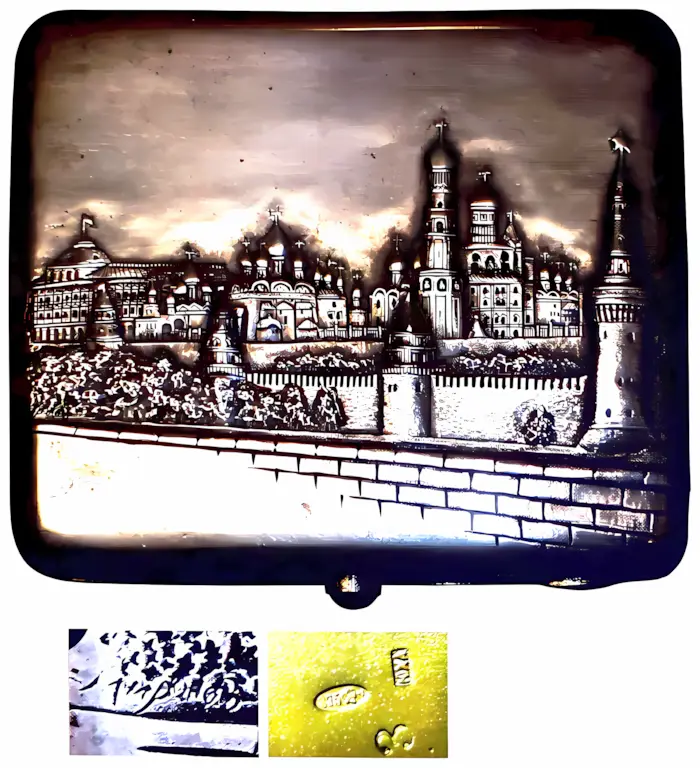
The architectural lines of the Kremlin form a harmonious series of towers, churches, and bell towers. The central place is occupied by the Ivan the Great Bell Tower, surrounded by the silhouettes of cathedrals. To the left, the Grand Kremlin Palace is visible. In the left corner of the cigarette case, among tree branches, the author's signature—"Mironov"—is hidden. The hallmarks on the item: "875," a profile of a worker with a hammer, the "delta" mark of the Moscow Assay Office, and "YuKhA"—likely the Jewelry Art Combine, 1953–1954. (Data based on the catalog edited by M.M. Postnikova-Loseva.)
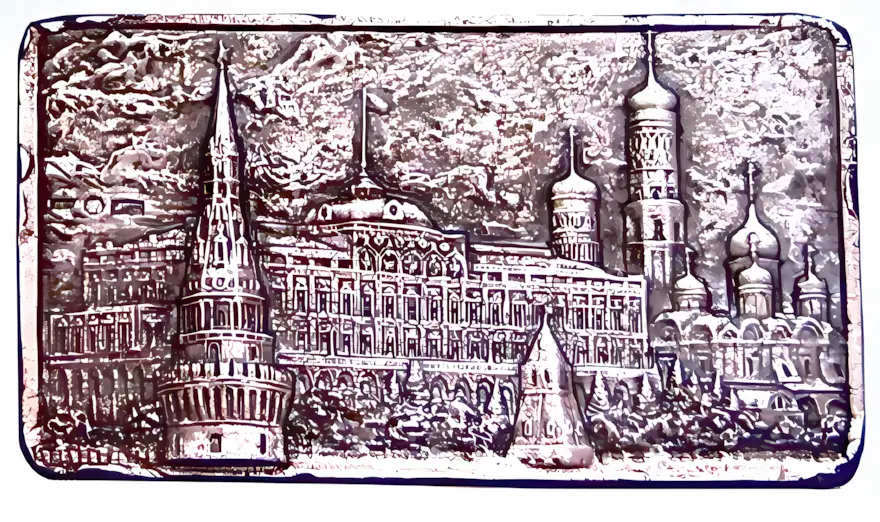
Almost the same angle, but with different proportions, is presented on a jeweled commemorative badge issued in honor of the II International Conference on the History of Cardiovascular Surgery in 2002, created by the chief artist of the Moscow Mint, V.M. Yerokhin. Here, the Grand Kremlin Palace by architect K.A. Thon occupies the center of the composition. The handcrafted work is executed with such attention to detail that one can even distinguish the brickwork of the towers and the letters on the upper tier of the Ivan the Great Bell Tower. The dimensions of the badge are 70x40x5 mm. The commemorative badge bears the fineness mark "SrM925," a "female profile in a circle," the maker's mark "MMD," and "BM." Notably, according to the Moscow Mint archive, only 27 copies of this badge were issued!
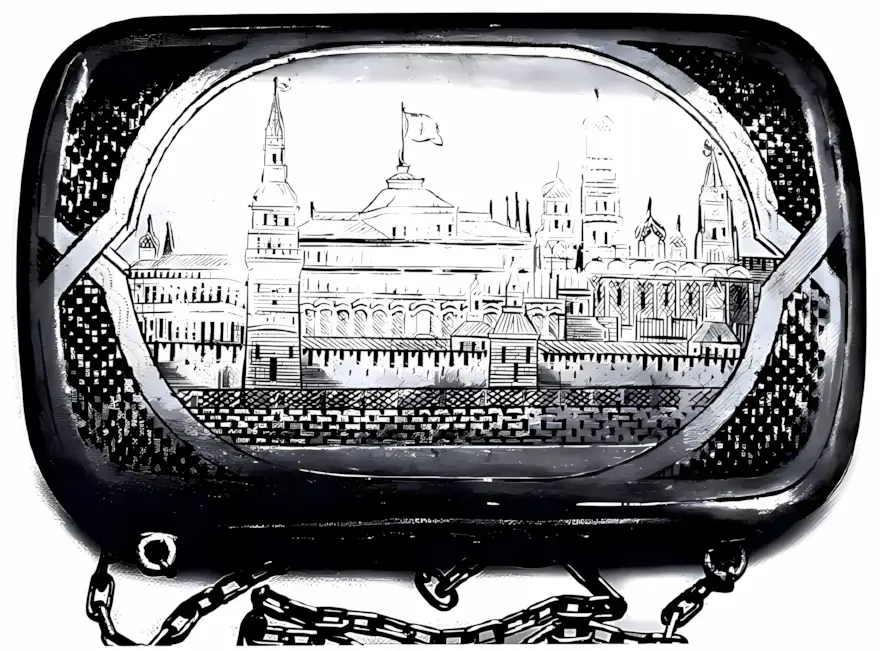
A similar view of the Kremlin can also be seen on an old theater purse with a chain, marked with the fineness "84," created in Moscow by the master "F.A.A." (meaning F.A. Abakumov, owner of a jewelry workshop from 1868 to 1908), and assay master "A.A/1891" (A.A. Artsibashev, 1891–1896). In the blackened geometric ornament of the purse, the same view of the Kremlin panorama is repeated. The changes that have occurred in history, unfortunately, are so significant that perceiving them on such a scale is not always easy.
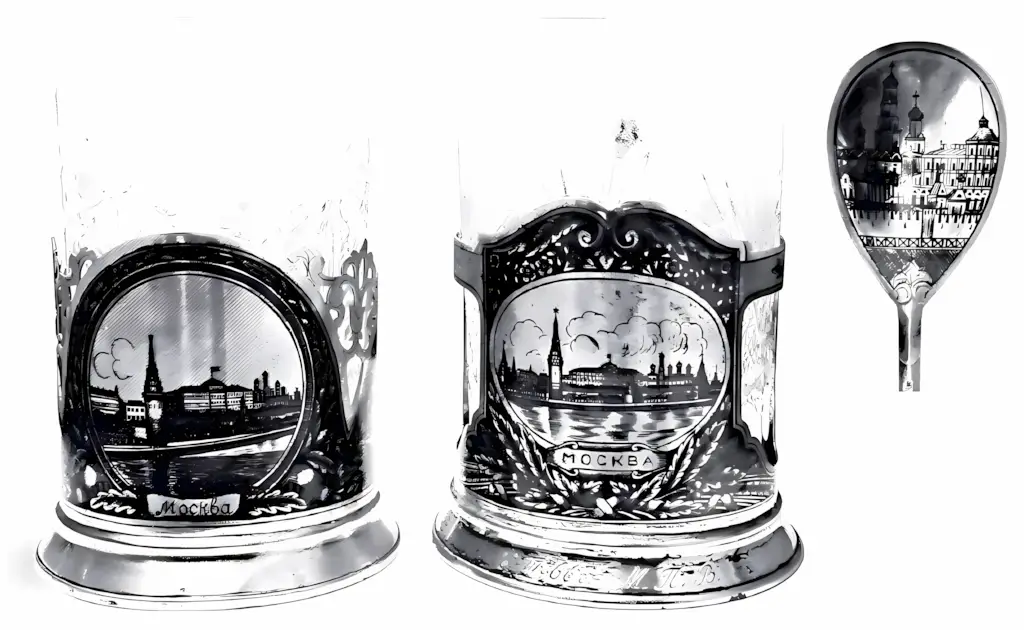
Similar sensations arise when looking at glass holders with niello, produced with a similar design. These glass holders were manufactured at the Veliky Ustyug factory "Severnaya Chern" in 1961 and 1968, marked "SCh1" and "SCh8" respectively.
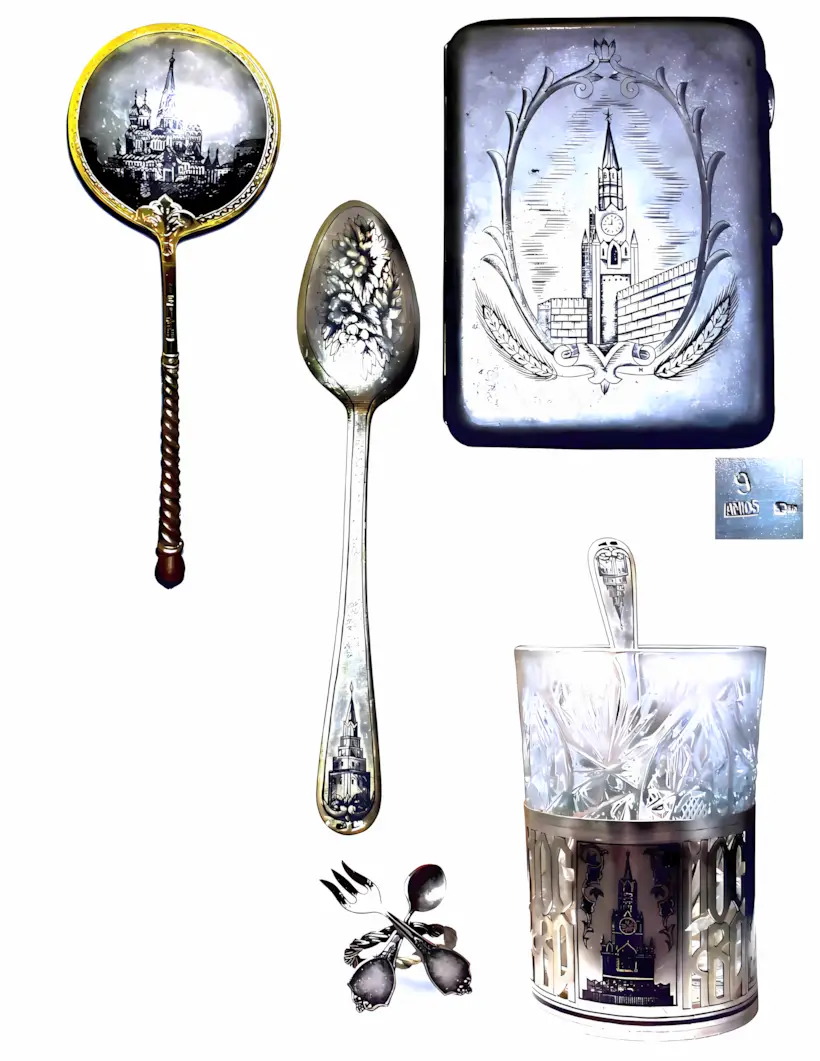
Across the realm of silverware, one can discover many unique items depicting Red Square, where St. Basil's Cathedral and the Spasskaya Tower particularly catch the eye. The finely crafted silhouette of the Intercession Cathedral, also known as St. Basil's Cathedral, adorns the reverse side of an impressive jam spoon with a twisted handle, boasting an impressive diameter of 6 cm. The spoon's handle is also decorated with niello, adding extra refinement to the piece. Created in 1880 in the workshop of V.S. Semenov, this spoon is an example of high-quality craftsmanship (hallmarks: "84-GM*, I.K/1880 and VS"). The factory's founder, V.S. Semenov, started his business in 1852, and by 1873 he already employed 40 masters. In the early 20th century, his daughter, M.V. Semenova, successfully continued the business. The small jam spoons from this set are also adorned with stylized images of both the cathedral and the Spasskaya Tower.
The Spasskaya Tower regularly appears on modern silver items dedicated to Moscow. Let's note the image of the Spasskaya Tower captured on a large cigarette case, which was made in 1955. The Gothic slenderness of the tower harmoniously fits into the architectural ensemble of the medieval brick wall. The silhouette of the Spasskaya Tower is framed by an exquisite ornament, complemented by ears of wheat (hallmarks: "AMYu5, a spade with a profile and 875"). In the same series, depicting the same tower, is a tea set including a glass holder with the detachable inscription "MOSCOW" and a teaspoon. The glass holder was made in 1968 at the Moscow Jewelry Factory, its assay hallmark: "star and 875", while the spoon was produced at the "Severnaya Chern" (Northern Niello) factory in the same year. Both items look as if they were created for a single set.
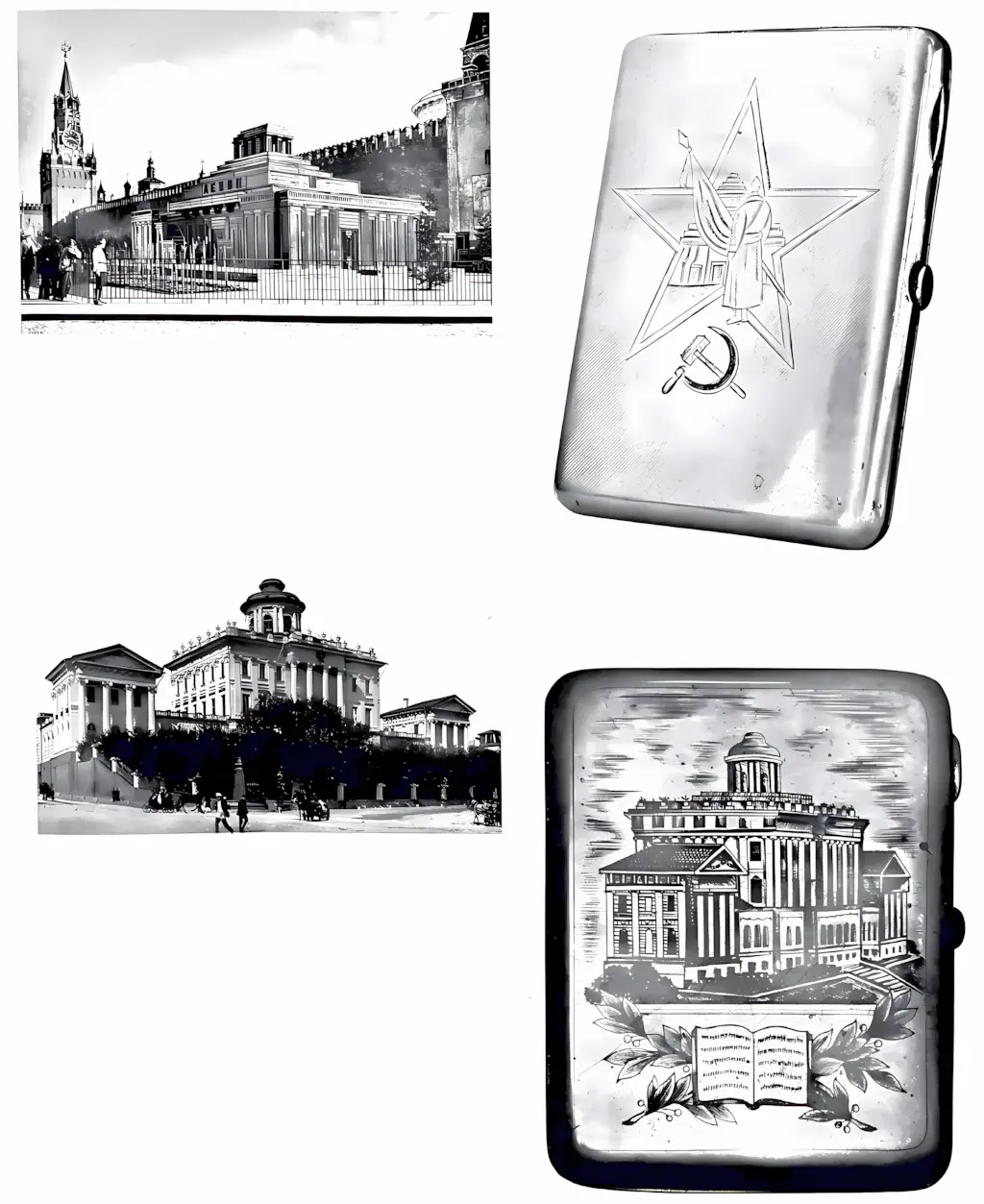
The image of Lenin's Mausoleum, built in 1934 under the direction of Academician A.V. Shchusev, is familiar to everyone. However, one item in the collection transports us back to 1924—the year the original wooden mausoleum with a truncated stepped pyramid was erected. To increase durability, the wooden elements were coated with oil varnish, giving them a stylish light-brown hue. The entrance doors and columns of the upper portico were made of black oak. Unfortunately, this wooden mausoleum lasted only five years. Considering these historical events, I discovered a rare cigarette case from the 1920s, on the inside of which this mausoleum is depicted. Nearby, as if standing guard of honor, is a Red Army soldier in a Budenovka hat, with a flag lowered in mourning. Inside a five-pointed star are a sickle and hammer—the iconic symbols of the revolution are neatly assembled in an engraved miniature that accurately reflects the spirit of its time and emphasizes the authenticity of the piece. The marking is indicated by the sole hallmark "84," suggesting that an old blank was used.
Let us ascend to the upper terrace of the palace, standing on the edge of one of Moscow's hills. Originally, this was an amazing architectural and park complex that attracted many visitors. Descending through its tiers, one encountered a formal park where crowds observed rare plants and animals. Surprisingly, a modern depiction of this place on a cigarette case captures the spirit of those times—it shows a view of the Pashkov House with an open book, symbolizing its role in the history of the State Public Library. The maker's mark: "AMYuZ" — the "Moscow Jeweler" artel, 1953; assay mark: "shovel with a profile, the letter 'delta,' and 875."
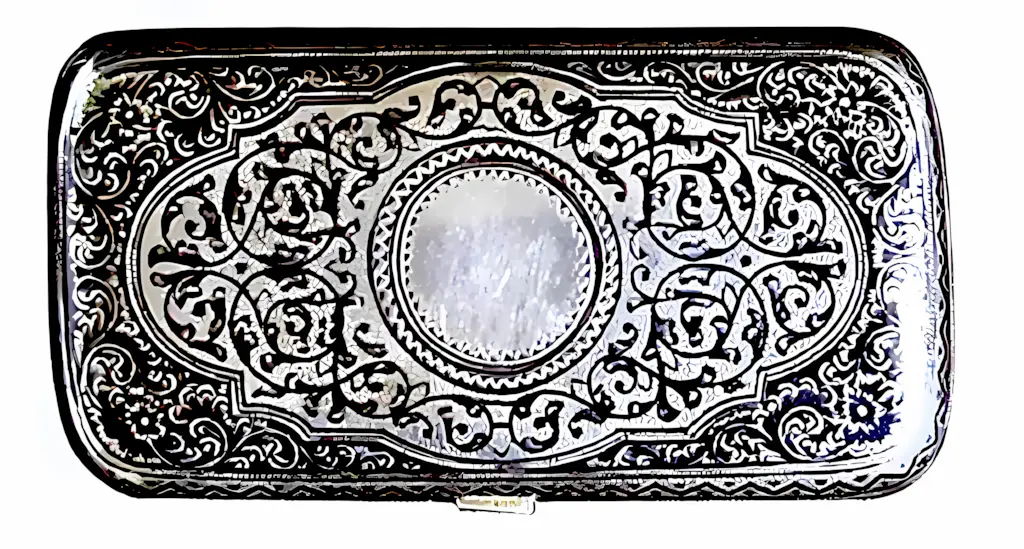
It is interesting to note that the use of the shovel-shaped assay mark was only introduced in 1954, creating a slight chronological discrepancy. In those prosperous years, not only cigarette cases were produced but also various items such as caskets, powder compacts, and glass holders, depicting the Kremlin, the Hotel Moskva, the Bolshoi Theatre, and many other Moscow landmarks.
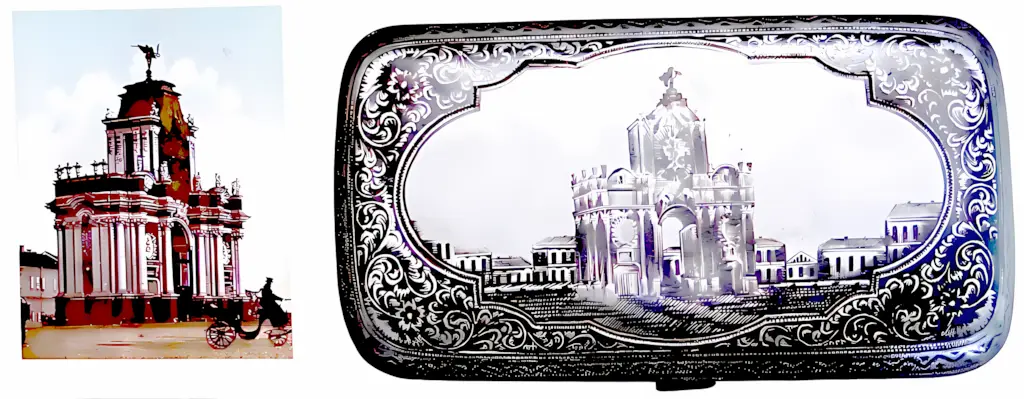
Let's travel back another hundred years. During that period, the city was protected by earthen ramparts, which over significant stretches coincided with the modern-day Garden Ring. One could only enter Moscow through huge gates located within these ramparts. In some places, these entrances looked modest, while in others they gleamed with metropolitan luxury. Ceremonial gates, besides their primary function, often served as triumphal arches. One such structure was the Red Gates—wooden constructions that burned down in 1753 and were replaced by a stone version created by the architect D.V. Ukhtomsky between 1755 and 1757. These gates stood for almost two centuries and were demolished in 1927. The name "Red Gates" is now associated by most with the eponymous metro station or the square on the Garden Ring, but in old Moscow, it simply referred to the color of the entrance. Their image can be seen on a niello cigarette case or a small snuffbox dating from the late 19th century. Hallmarks: "84-GM". Assay master: "SM/1896" (S.N. Milyutin, Moscow, 1896).
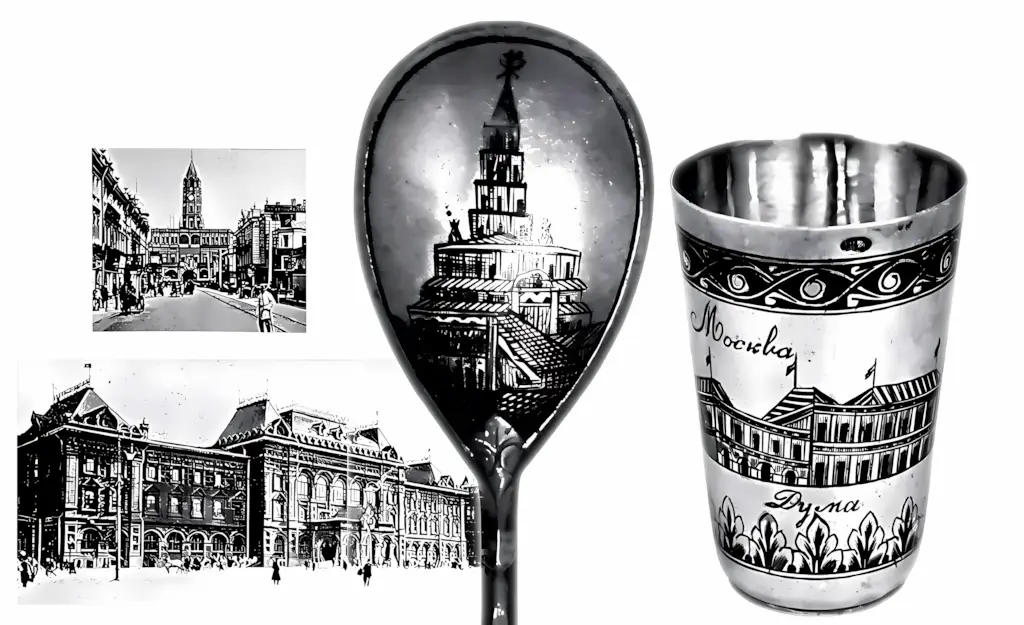
The next item sparks keen interest, and I'm willing to bet a thousand to one—you'll find it difficult to identify the place depicted on it. It is a niello vodka shot glass engraved with the inscription: "Moscow. Duma." The hallmark: "84 and a female head in a kokoshnik, turned to the right," according to the catalog, dates to 1908–1926. Many might immediately recall the location near the Historical Museum, where between 1890 and 1892 a building was specially constructed for the Moscow City Duma, designed by D.N. Chichagov. Yes, most know it as the Central Lenin Museum. However, let's look closer. The shot glass depicts a two-story mansion executed in the architectural forms of the 18th century. One might assume a new building was erected on the site of an old mansion, but this assumption is mistaken—the history turned out to be much more interesting.
The shot glass depicts a stylized rendition of the Sheremetev House, located at 6 Vozdvizhenka Street. It was once the main building of an extensive estate and stood at the rear of a ceremonial courtyard facing Vozdvizhenka, directly in front of the Voentorg building, which has also since disappeared. This house was separated from the street by a substantial stone fence with columns, giving it a particularly solemn appearance. All that remains of the Sheremetev estate is the so-called "corner house" at 8 Vozdvizhenka, which has become the sole witness to its former grandeur. Over the years, this house housed many institutions, including the Moscow City Duma, making it even more significant in a historical context.
The next building worth telling about is certainly known to many, although almost none of us have had the chance to see it in its original form. However, to anyone even slightly familiar with Moscow's history or at least acquainted with Gilyarovsky's notes, the place where the Sukharev Tower stood for over 250 years comes to mind. This majestic structure was built between 1692 and 1695 on the site of the old wooden Sretensky Gates of the Zemlyanoy Gorod (Earthen City), at the intersection of the Garden Ring and Sretenka Street, by order of Peter I and according to the design of the great architect M.I. Choglokov.
In old guidebooks, one can find descriptions of the Sukharev Tower as a truly grandiose structure, visible from many points in the capital, comparable in height to the Cathedral of Christ the Savior. This is why anyone visiting Moscow considered it their duty to first visit the Kremlin, ascend the Ivan the Great Bell Tower, pray in the Savior Cathedral, and then, at the very least, pass by the Sukharev Tower, famous not only for its wonders but also for its enormous reservoir, which supplied the city with clean water in the 18th century. In 1829, a reservoir made of cast-iron plates, capable of holding up to 7,000 buckets, was created at its base, from which water flowed into the city's water supply all the way to Mytishchi. This drew attention to the tower, making it not only an element of the architectural landscape but also a center of interest for many Muscovites and city guests.
In our imaginary journey, we approach the Sukharev Tower along the cozy Sretenka Street, and with each new step, the massive silhouette of the tower rises above us. This is quite understandable, as the tower's height reached an incredible 30 sazhens, which corresponds to almost 65 meters by modern standards. Not many existing spires and church domes could match this grandeur.
In the context of Moscow's topography, special attention is drawn to teaspoons, which often serve as a gateway to the amazing world of jewelry art. Masters creating them frequently avoided striving for exact copies, focusing instead on conveying the general impression and atmospheric perception of architectural elements. Thus, Moscow in the depictions on spoons is presented not as a strictly documentary image, but rather in a stylized interpretation, allowing familiar structures to be seen from a new angle. Although upon closer examination, certain discrepancies in proportions and details can be detected.
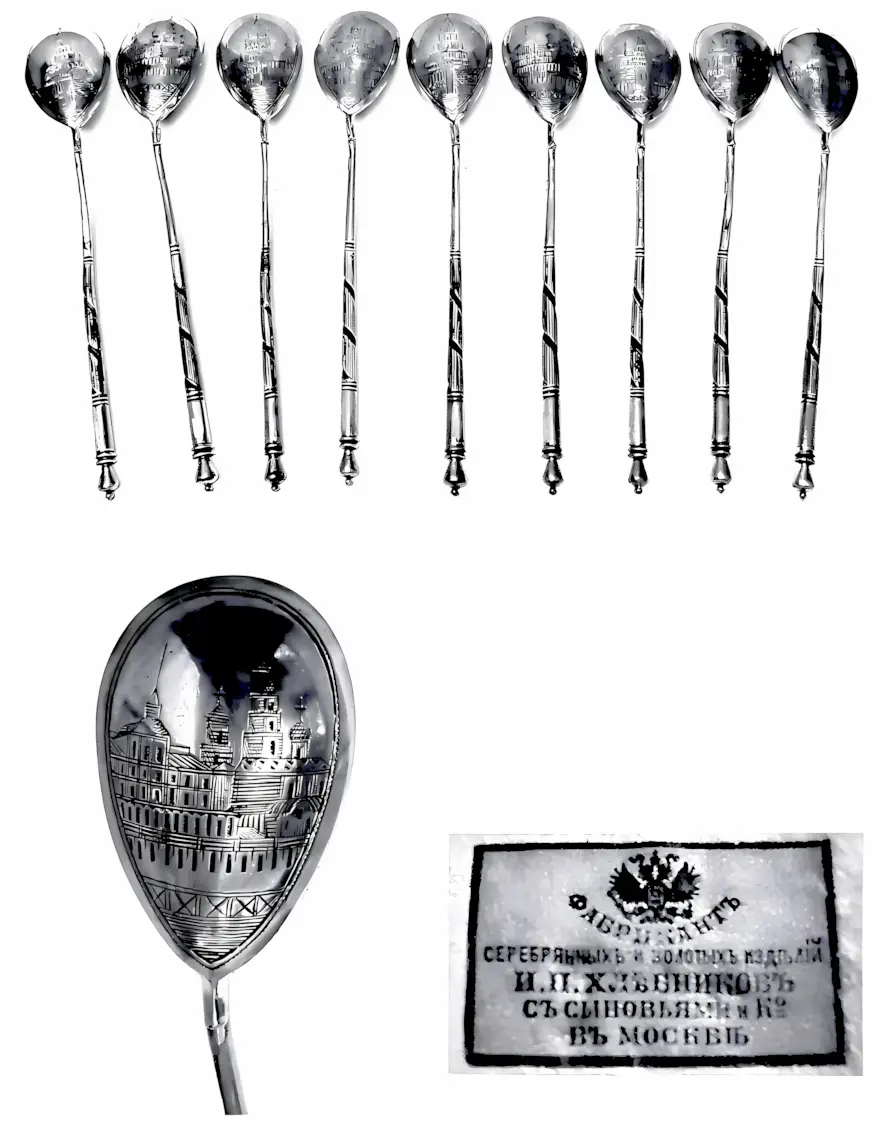
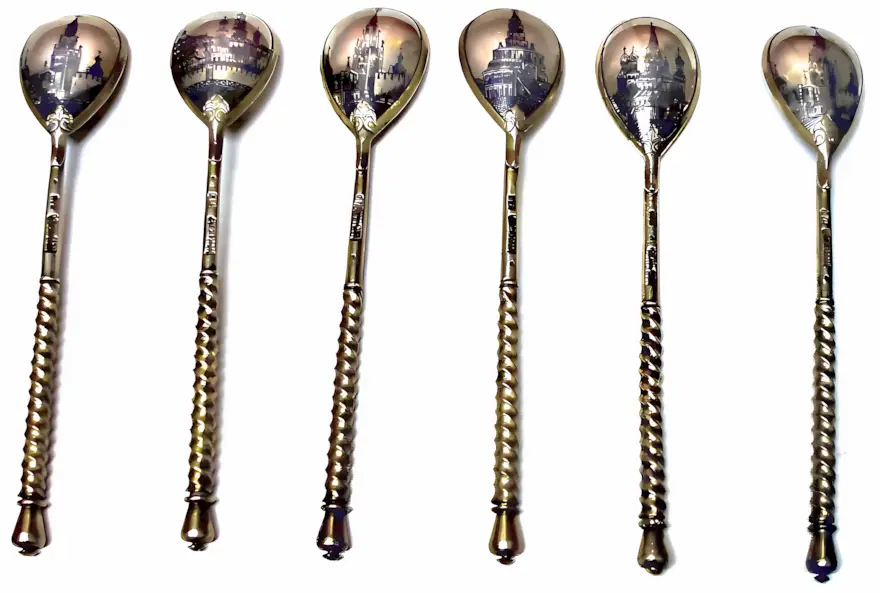
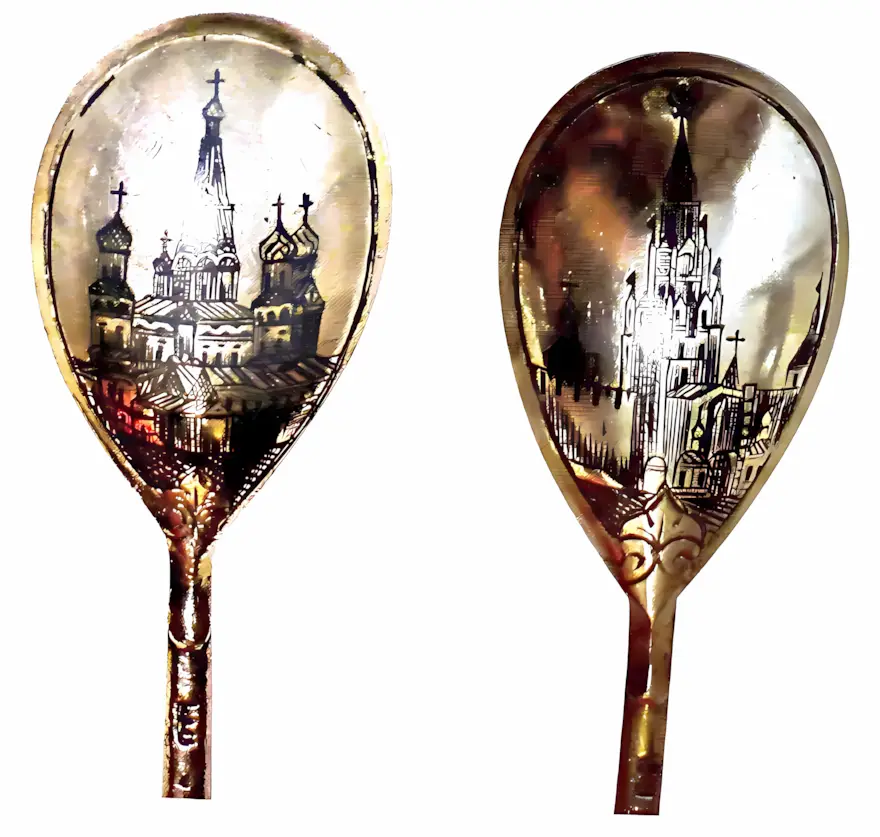
Here are six elegant jam spoons, dating back to 1879, manufactured at the previously mentioned factory of V.S. Semenov. The twisted handles are neat, executed without enamel. On the convex reverse side of the spoons, it is visible that the design is framed by a gilded border, which has no ornamentation. With jewel-like precision, the workshops worked on the depictions of the ensembles of the Grand Kremlin Palace, Cathedral Square, and the Spasskaya and Kutafya Towers. There is also a large set of spoons decorated with engraving and chemical blackening. These feature the Spasskaya Tower, the Corner Tower, the Cathedral of Christ the Savior, the Sukharev Tower, and ensembles of churches... Each spoon has an oval hallmark: "84" and an image of a woman in a kokoshnik headdress, turned to the left, indicating the period from 1899 to 1908, with the "delta" mark of the Moscow Assay Office. The maker's mark — "G.M." — is G.A. Mitrofanov, the owner of a workshop engaged in gold and silver work from 1908 to 1917.
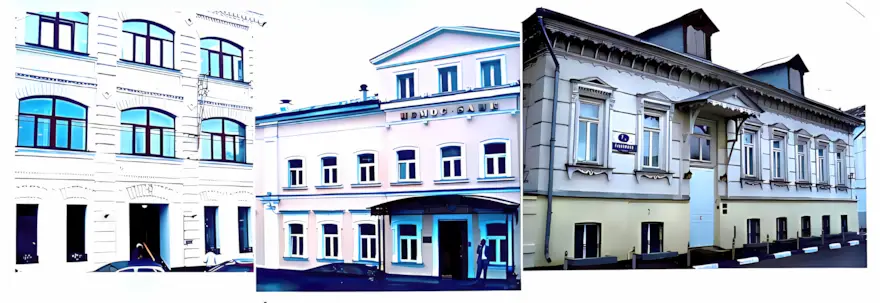
There is no need to introduce the reader to the hallmark of Ivan Khlebnikov. This hallmark with the double-headed eagle of a Supplier to the Highest Court immediately evokes associations. In M.M. Postnikova's catalog, it is stated: "Ivan Petrovich Khlebnikov, worked in St. Petersburg until 1867. In 1870 or 1871, he founded his own firm in Moscow. According to data from 1882, the factory employed 150 people, with an annual turnover of 200 to 300 thousand rubles. In 1897, two steam engines and one steam boiler were installed at the factory, which produced goods worth 172,372 rubles." Precious traditions live on in the label of the Khlebnikov firm. Their activity was inextricably linked with the work and home on Taganka. Here are modern photographs of these historically significant places for the Russian silver trade: the Khlebnikov factory (which later became the Platinum Plant), the estate opposite, where, according to legend, the company's founder Ivan Khlebnikov lived, as well as the house of his son M. Khlebnikov, located at the corner of Goncharnaya Street and Ryumin Lane. We are transported to times when jewelry art was an integral part of Moscow's cultural life. Every object, every spoon or pendant became not only utilitarian items but also works of art that conveyed the spirit of their time. The spiral of history leaves behind unique artifacts, full of emotion and memory. Spoons, for example, not only served for serving jam but carry within them the life-affirming energy of Moscow, its architectural grandeur and cultural heritage.
As one delves into the history of Moscow silver, the gaze increasingly returns to the names that left their mark on this industry. For instance, the hallmarks of talented masters such as G.A. Mitrofanov or Ivan Khlebnikov, enthusiasts of their craft, and their work served as a symbol of the high standards of jewelry craftsmanship of that time. Every stamp, every detail spoke of impeccable execution and deep respect for tradition.
Beyond spoons, the variety of forms and functions of silver items is astonishing. In a historical context, not only functional items acquired special value. Tableware, frames for festive occasions, as well as jewelry pieces well illustrate the richness of the masters' artistic language. Thus, on every item, be it a teapot or a set of salad bowls, a unique style, superior technique, and a pursuit of perfection are reflected.
Returning to the creations of Khlebnikov, it is worth noting that their hallmark on each item guaranteed high quality and authenticity. The emblem with the double-headed eagle became a symbol of trust for both clients and descendants, further emphasizing the significance of the traditions and Orthodox values assigned to them. These masters created a philosophy that spiritualized every object; their works united generations, preserving in memory the spirit of the capital and unique moments of its history.
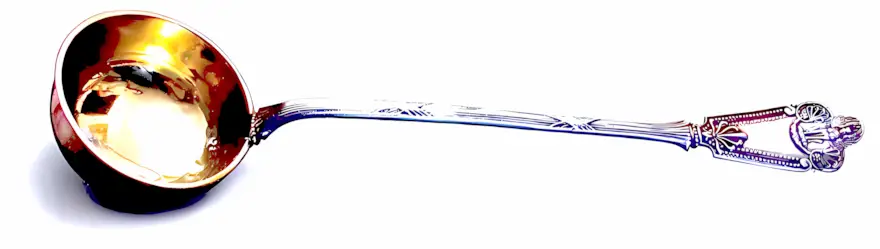
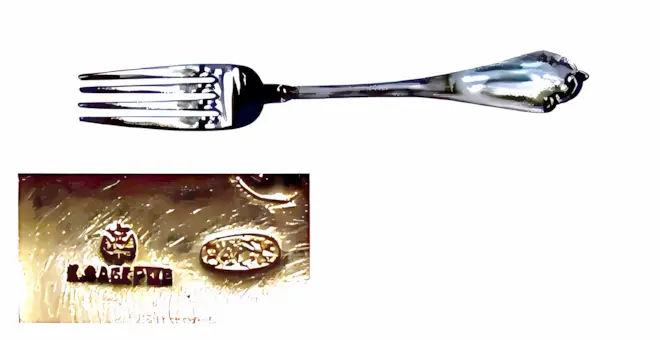
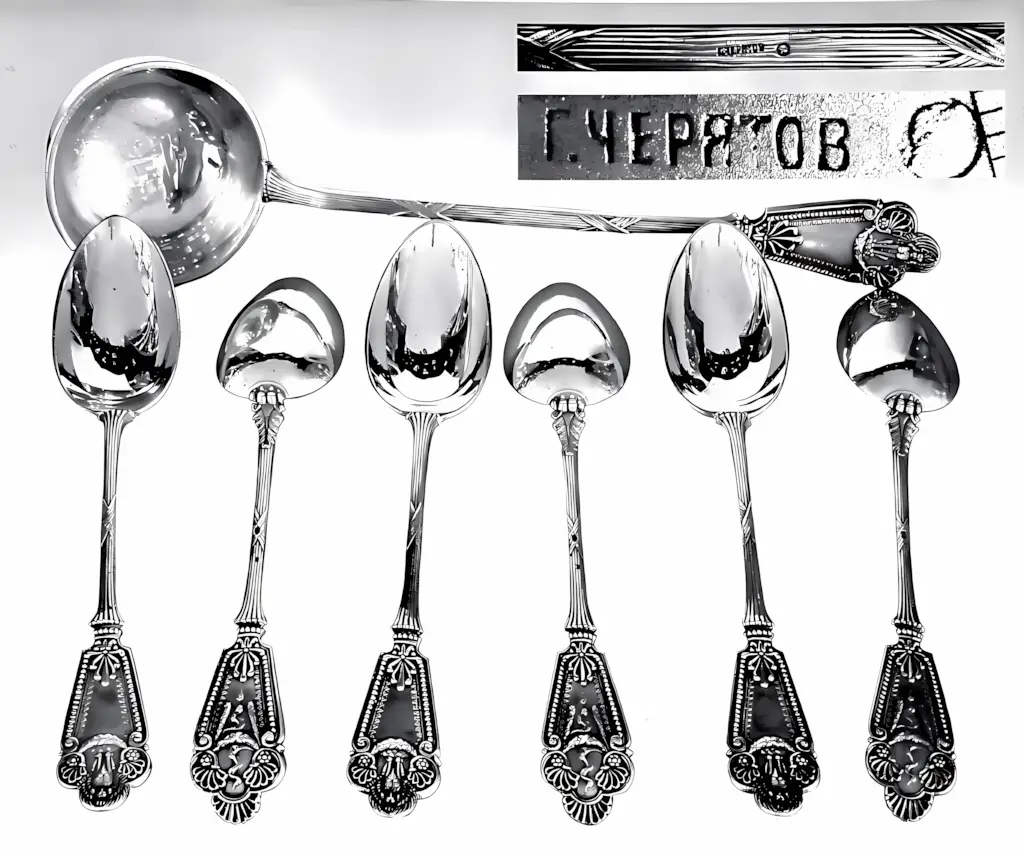
Another interesting aspect of Moscow jewelry art are the hallmarks of famous masters, which transport us to another era of Moscow. For example, the hallmarks "K. Fabergé" on the fork and the hallmarks "G. Cheryatov" and "G.Ch" on the table set represent two different levels of popularity. While Fabergé is recognized worldwide, the name of Grigory Kuzmich Cheryatov is little known to a wide audience, although his works stand out quite distinctly with their style and quality. Interestingly, Cheryatov's hallmark does not have a hard sign at the end of the surname, which is not an error; this resulted in "anticipating" the orthographic reform introduced in March 1917. The absence of the double-headed eagle on the hallmark indicates that Cheryatov did not have clients among the high-profile clientele, which included the Imperial Court. However, he often produced unique items that were sold through the shop of Fyodor Lorié ("LOR1E"), whose works enjoyed the same popularity as those of Fabergé or Khlebnikov. Information about Cheryatov's collaboration with Fabergé on a subset of items is provided by the research of A.N. Ivanov in his works "Masters of Gold and Silver Work in Russia (1600-1926)" (M, 2002).
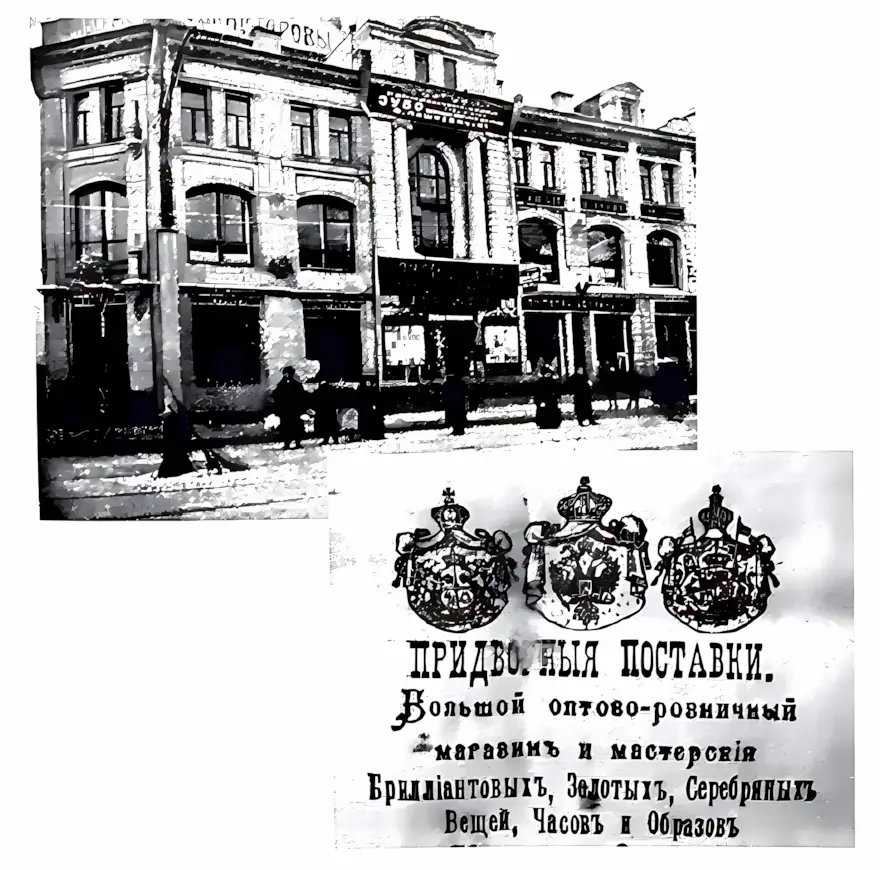
Interestingly, Fedor Lorie's flagship store was located in one of the capital's most elite districts – on Kuznetsky Most, in the building of the Moscow Merchant Society. The store of the Moscow branch of Fabergé was also located there. Although the building has hardly changed since then, in the 19th century it looked much more luxurious. Beautiful carriages and elegantly dressed people filled the streets, creating an atmosphere of prosperity and wealth. Time has changed the city's appearance, having taken the Neglinnaya River underground, and Kuznetsky Most, once a pedestrian crossing, ended up hidden beneath layers of earth and asphalt. At the same time, the silverware of the old masters has met a much more favorable fate: it is capable of surviving into new eras, preserving its uniqueness and style, while buildings, such as the house on Kuznetsky Most, become merely a shadow of their former grandeur in the history of "silver" Moscow.
M.A. Bulgakov aptly noted that "manuscripts don't burn." Indeed, the achievements of human hands will not vanish without a trace in time. Unique silver items serve as a link between eras, preserving echoes of long-gone periods, including memories of those places that time has erased from the face of the earth, or of those events that radically changed the appearance of the capital.