Для тех, кто ценит красоту и историю. Присоединяйтесь к сообществу ценителей!
Dance in Art Deco: Secrets and Passion of Plasticity
2.8КJan. 21, 2025Скульптура
In every historical direction of art, one can discover characteristic motifs and themes, as well as preferred figurative systems through which its specificity and archetypes are revealed. In European art of the first third of the 20th century, one of the most vivid motifs became dance—as an independent art form, encompassing both classical ballet and jazz rhythms, as well as modern abstract choreography. This element became an important part of the plot in many genres of visual art. It is no coincidence that by the end of the 1920s, there was hardly any avant-garde movement, let alone traditional artistic currents, that did not leave a mark on the theory and practice of dance.
As for sculpture, dance here acts as the highest form of plastic art, representing something like sculpture enclosed in rhythmic movement. Images of dance are not merely visual phenomena; they, like sculpture, are deeply connected with symbolism and content that reflect the spirit of the time in which they were created. This article will help shed light on the fascinating interconnections between sculpture and choreography, which were one of the main leitmotifs of the newest art.
In the first third of the 20th century, the art of dance in Europe, especially in Paris, demonstrated a multitude of directions and a diversity of approaches. The uncompromising 1920s stood out particularly. In Parisian nightclubs, dance was actively used to combat the traditional prohibitions and restrictions of that era. Dance was found everywhere—from renowned ballet theaters to modest cabarets—and encompassed all styles: from classical to exotic Eastern dances. Events such as the "Dancing Lights" on the Eiffel Tower in 1925, as part of the International Exhibition of Decorative Arts, became significant phenomena in the public consciousness. Even Cubism "liberated" itself to dance in the ballet "Parade" with sets created by Pablo Picasso in 1917.
European dance, in its diversity, included social, ballroom, and folk styles, classical ballet, the French cancan (cancan is a French dance of Algerian origin, which, being a type of contredanse, was also known as a country dance, and developed in Paris in the 19th century, with characteristic steps like high kicks and leaps, distinguished by an energetic and lively tempo), American jazz numbers, Latin American rhythms, and "exotic" dances. All of this filled the cultural space, interacting and influencing each other, as if creating bridges between the stages of variety shows and opera houses and the studios of painters and sculptors.
However, visual art sought to emphasize the most expressive and memorable.
True discoveries in the field of dance were exceptionally gifted individuals, true exemplars of plasticity and style, whose movements transformed into exquisite ornaments, overflowing with the spirit of Art Nouveau and Art Deco. The American dancer Loie Fuller, who did not conform to the canons of academic choreography, became a star of the Art Nouveau era. She evoked admiration from both subtle symbolists and more down-to-earth naturalists. Appearing on the stage of the Parisian variety theater "Folies Bergère," her dances were not merely performances but genuine plastic wonders, where rotations within luminous circles and acrobatic "serpentines" with giant "wing-arms" created an impressive ornament, carrying within it the elegance of the "whiplash curve." These sophisticated movements immediately inspired many sculptors, who translated them into material form—bronze, glass, and ceramics.
Replacing these aesthetics of dynamic movement came a new plastic era, introducing other dance motifs and images oriented towards simplicity and eclecticism, towards archaic forms and styles. The replacement came from Fuller's student, the outstanding dancer from California, Isadora Duncan. She was depicted in his works by L. Bakst in 1907, emphasizing her uniqueness.
Duncan, who found herself in Europe as early as 1902, by the 1910s became one of the key models for sculptural and graphic compositions. She inspired outstanding artists, poets, and writers, bringing echoes of antiquity back into their work.
The phenomenon of her style became a clear contrast to conventional canons: she revived a healthy image of a person "close to nature," and her dances, which liberated the soul from society's burdensome rules, stepped into a new era.
Dances in the manner of Duncan began to gain popularity in the turbulent 1920s after the First World War. The West, having endured terrible trials, craved entertainment, and dance proved to be one of the best ways to alleviate suffering. The thirst for life and the desire to dance became almost synonymous, offering a chance to forget oneself and escape into a world of dreams.
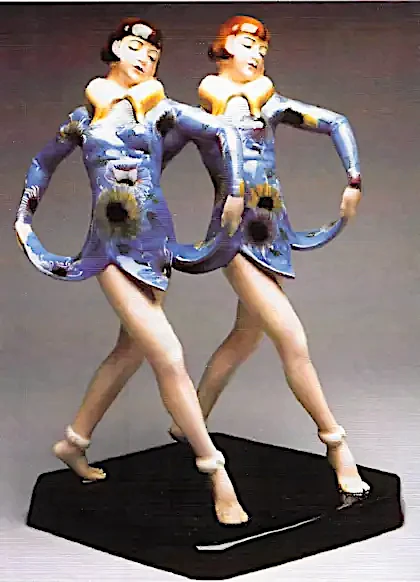
Parallel to the moods of exoticism and escape from reality, the sculpture of that time was enriched with new neo-antique motifs.
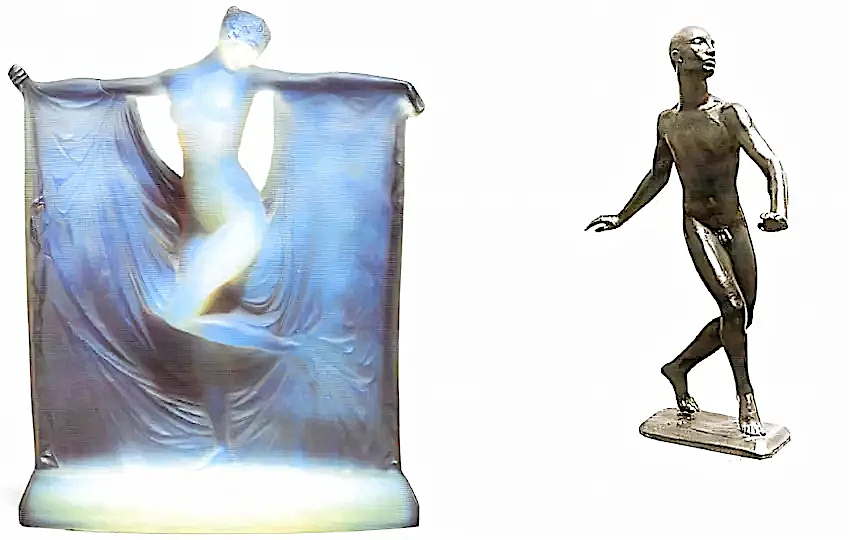
This image of a young, barefoot girl, embodying the archetype of grace and freedom, became an important symbol in the art of the period. The image of Diana the huntress became visible in various forms—from posters advertising the 1925 International Exhibition in Paris to elegant reliefs and decorative elements in hotel interiors. The shift in emphasis from Rodin's "walking man" to the "dancing man" symbolized not only a new stage in sculpture but also the general direction of the era. The transition from a slow andante to a fast vivace became a metaphor for progress, reflected not only in art but also in the life of society. New sculptural forms were associated with Rodin's works, where the leaping Vatslav Nijinsky captivated the public: G. Kolbe's "Nijinsky" (bronze, 1914) and U. Boccioni's monumental "giant"—"Unique Forms of Continuity in Space" (bronze, 1913).
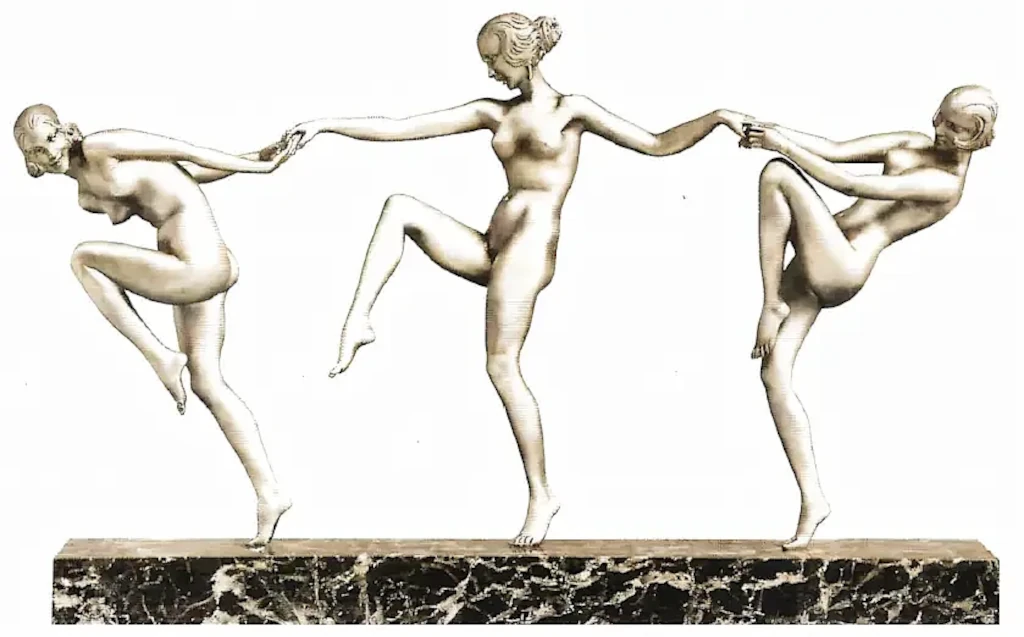
Alongside this, sculptors began to develop new approaches to interpreting movement. The plasticity and dynamics inherent in dance were reflected in bronze and stone, where each movement appeared as a frozen moment of art, preserving within it all the power and energy of its time. Such works returned us to the foundations of humanity, awakening in the viewer memory cells of primitive rhythms and rituals, which have always found their expression in dance.
At this moment, dance ceased to be merely an art form and became a symbol of freedom, self-actualization, and unity with one's body. Sculpture, interacting with the art of dance, laid a new foundation for the representation of the human body, granting it the possibility of being not only static but also dynamic, invisible in its motion. This dialogue between sculpture and dance becomes an important element for understanding 20th-century art, showing how the boundaries between genres blur, creating new paths for self-expression and aesthetic perception."
Let's return to dance and the early period of Art Deco sculpture—the 1910s.
Interesting fact: at this time, a number of researchers and critics viewed the dances of the "dilettante" Isadora Duncan as a kind of modern interpretation of a specifically understood Hellenism and the ancient ideal. Moreover, Duncan's dance was considered not to meet the criteria for evaluating ancient plasticity. However, among artists, such an interpretation evoked only positive emotions—they were utterly charmed by her free style and individuality. Such luminaries as Rodin, Bourdelle, Paul Poiret, René Lalique, Konenkov, B. Korolev, K. Stanislavsky, Erzya, D. Chiparus, and many others admired her dances.
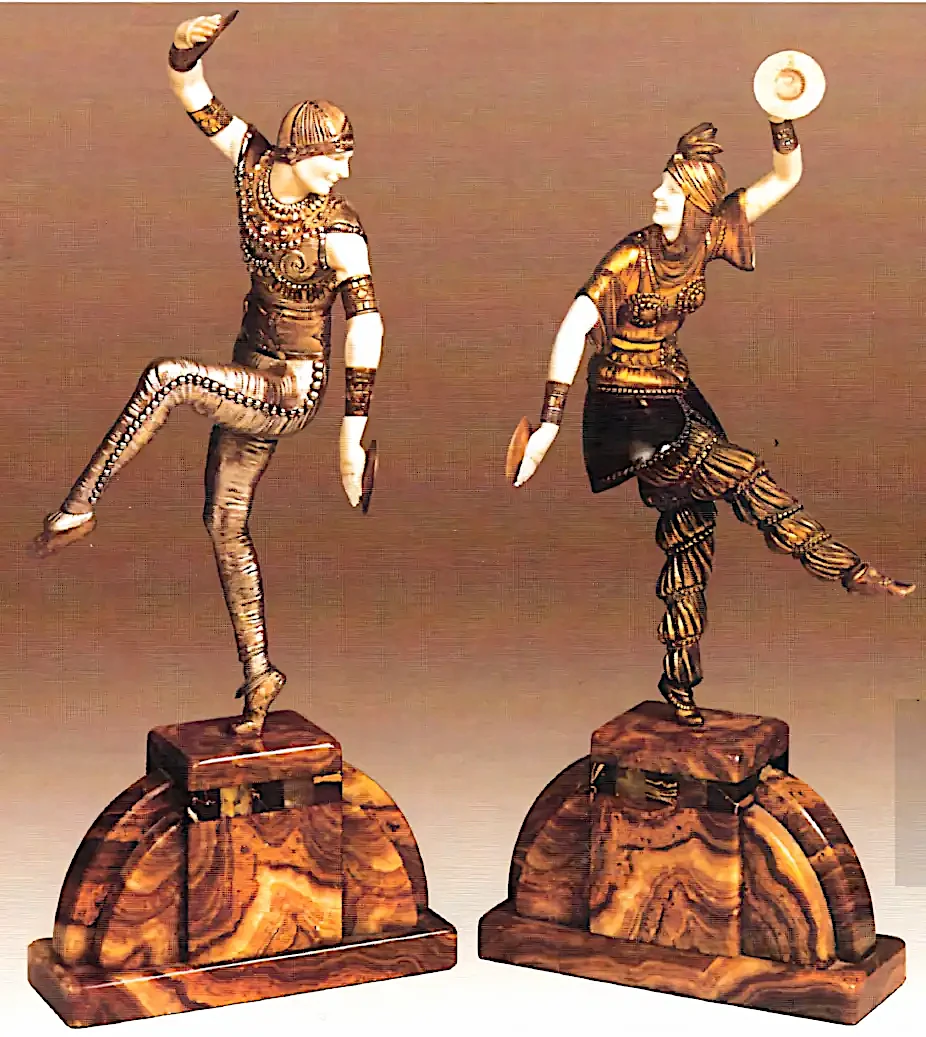
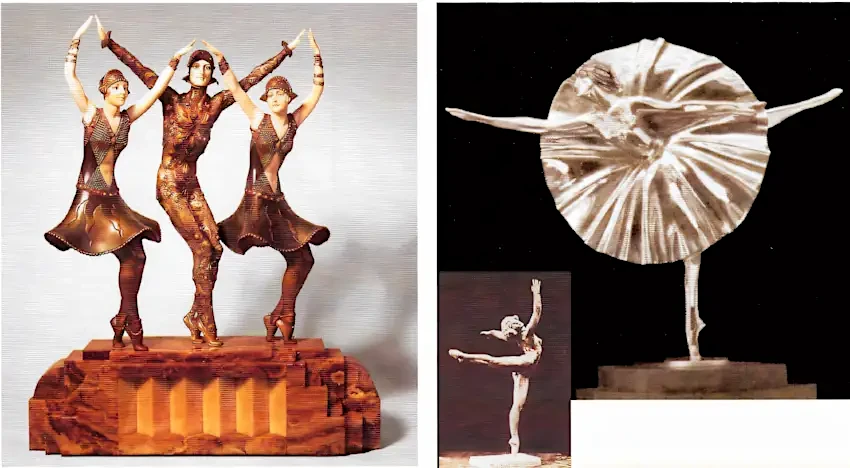
One of the most characteristic Art Deco images of Duncan can be considered the interior compositions created by the French sculptor of Romanian origin D. Chiparus in the 1910s–1920s. Chiparus was so impressed by Duncan's dances that he endowed many of his heroines with the portrait features of the American. However, in his works, he often used only external elements: capturing the mannerism of poses, the expressive curves of arms, torso, and legs. Nevertheless, as a true Art Deco sculptor, he brilliantly moved away from the dancer's free "garments," creating his unique costumes, practically unchanged from one piece to another and from one dance to another—whether Russian, Indian, or Chinese style, they included various metal elements, skirts, helmets, and other accessories.
Russian ballet served as a true "melting pot," where Art Deco and its primary dance motifs were born. This was not merely a "theater of painting," but a genuine theater aimed at the dynamic construction of massive scenes, which significantly differed from the choreographic traditions of the 19th century. The dancers of the "Russian Seasons," like Duncan, became objects of admiration for many European sculptors, including Rodin, Bourdelle, Kolbe, P. Trubetskoy, G. Lavrov, N. Danko, and S. Sudbinin.
Art Deco, as an incredibly vibrant and multifaceted style, not only sparked interest but also highlighted important shifts in the perception of artistic forms and styles of that time. The approach to movement transformed, becoming more sincere, individual, and eclectic. Dances, with their wealth of imagery and dynamism, flowed into modern art, creating new spaces for self-expression and connection with the audience. Each dance, each sculpture became a kind of bridge linking tradition and innovation; they enriched the aesthetic lexicon of modernity, opening pages to new artistic quests and changes.
In the creative imaginations of contemporaries, Vatslav Fomich Nijinsky and Isadora Duncan became symbols of the ideal ballet duo, reflecting the grandeur of two eras. This mythological union attracted the attention of artists themselves, considering that Isadora was not opposed to a real romantic interaction with the famous dancer. One of the most vivid expressions of this cultural attitude is the famous frieze composition "The Dance" by E. Bourdelle, which adorns the facade of the Théâtre de la Ville on the Champs-Élysées in Paris. However, in reality, contradictions arose between the artists: their fleeting connection was quickly terminated, with Sergei Diaghilev as the initiator.
The manifestation of the new style—decorative, simultaneously monumental and graceful, carelessly witty and adorned—can be clearly seen in Nijinsky's dance, captured in bronze by Georg Kolbe from 1910 to 1914. The dancer's pose, presented as a "twisted zigzag," was inspired by a famous photograph in which he appeared with fixed hand gestures and a sharp turn of the head.
The new dance style was also reflected in the works of other European Art Deco sculptors, for example, in the works of D. Chiparus ("Chinese Dance," 1925; bronze, ivory) and D. Chiparus ("The Dance," 1920s; ivory, bronze, stone), as well as in the stylized glass relief by René Lalique ("Suzanne," 1925), who remained a longtime admirer of the dances of Loie Fuller, which belonged to a completely different era.
It should be noted that "Art Deco" dance poses often drew upon Russian ballet productions, reflecting sculptors' particular interest in the plasticity, gestures, and exoticism of the costumes of Russian performers. These images spread in wide waves, transforming into endless variations of "Russian dances" and archetypes of Russian dancers, each time unique and inspiring.
Meanwhile, the fascinating genesis of the most characteristic poses, such as the arabesque (a classical position where balance is maintained on one leg while the other leg is raised and extended backward) and the attitude (a pose where balance is also maintained on one leg, but the other leg is bent at the knee and raised backward), allows us to understand how diverse the choreography was.
The figure of the "tremulous" Anna Pavlova, shining in the ballet "La Sylphide," inspired many sculptors, including more traditional masters, to reinterpret movement and grace. This led to a new interpretation of classical poses, demonstrating how old formulas could blend with new artistic perspectives.
It was precisely the choreography of these two great figures—Duncan and Nijinsky—that led to a synthesis of stylistic directions and themes, as well as to the revelation of new plastic possibilities, allowing sculpture to address dynamic forms. Working with bodily plasticity led to the creation of sculptures that not only captured moments of dance but also conveyed the feelings, emotions, and energy of the stage performance. This interaction between dance and sculpture allowed for the formation of a unique dialogue, in which each form was imbued with new meanings and significance, conveying to the viewer the spirit of the time and the continuity of traditions.
The influence of dance on sculpture became particularly noticeable in the 1920s, when sculptors sought to capture not only the obvious but also the intimate. Every gesture and every pose acquired symbolic meaning, occupying a special place within the cultural context of the time. Regular performances by ballet artists in Europe and the West continued to inspire masters such as Rodin, Bourdelle, and Kolbe, creating not only masterpieces but also new ideas that touched upon the foundations of human existence. The tandem between movement and stillness began to explore not only the physical aspects of art but also deep emotional and psychological connections, showing how dance can transport the viewer to other worlds.
As a result, dance became not merely an art form in its pure sense, but also a means of self-expression, transformation, and free interaction between performer and viewer. Sculpture, intertwined with dance, created new optics for perceiving the body, revealing its dynamism and beauty in motion. This interconnected language of art continued to evolve, forming the foundations for future artistic movements and expanding horizons for further research and discoveries in the realm of combining different art forms.
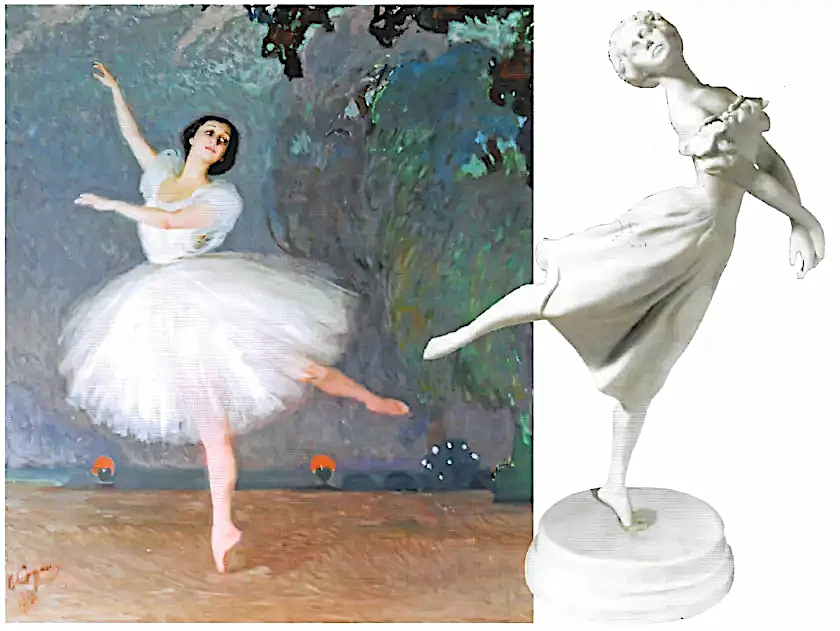
S. Sudbinina in 1913 created a magnificent sculpture of the ballerina T. Karsavina, depicting her on the demi-pointe of one foot with the other extended back, which became a classic example of an arabesque. This idea embodies the fusion of dance and sculpture, where the movements performed by ballerinas become the basis for creative interpretation in Art Deco. Classical poses, such as the arabesque and attitude, underwent changes under the influence of the dance styles of that time, leading to the creation of dance sculpture permeated with endless "pas" and dynamic "poses". These concepts were reflected in the works of masters such as D. Chiparus, A. Lipschitz, M. Portzehl, A. Gerdago, and C.-J.-R. Colin.
Also, Russian and Soviet sculptors of the 1930s captured in their works the movements of ballerinas standing on pointe with a clearly fixed pose. The beautiful "ballerinas" by S. Erzia, the figure of Marina Semyonova created by V. Mukhina in 1936, and the bronze statuettes by V. Vatagin constitute only a part of this cultural heritage. No less impressive are the porcelain compositions by E. Janson-Manizer with Galina Ulanova and Tatiana Vecheslova, created between 1937 and 1940. If in S. Serov's poster Anna Pavlova appears completely ephemeral and tremulous, like the image of a sylph, then Galina Ulanova, captured by Janson-Manizer in "Odette" (bronze 1937 and biscuit 1955), already reflects a new synthetic style that lost some emotional impulses but gained inner stability.
An equally significant component of the choreographic tradition embodying Art Deco was jazz. Its rhythms, dynamics, and emotional intensity brought into this new style that very missing injection which allowed it to become a reality.
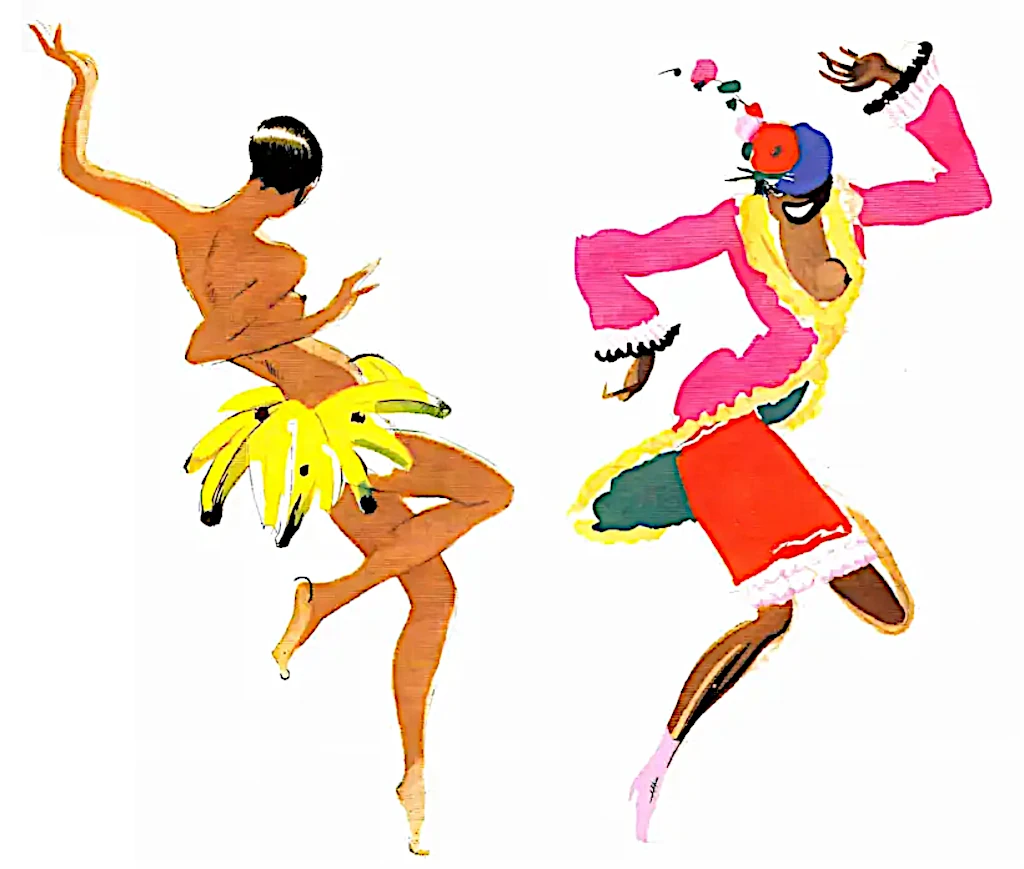
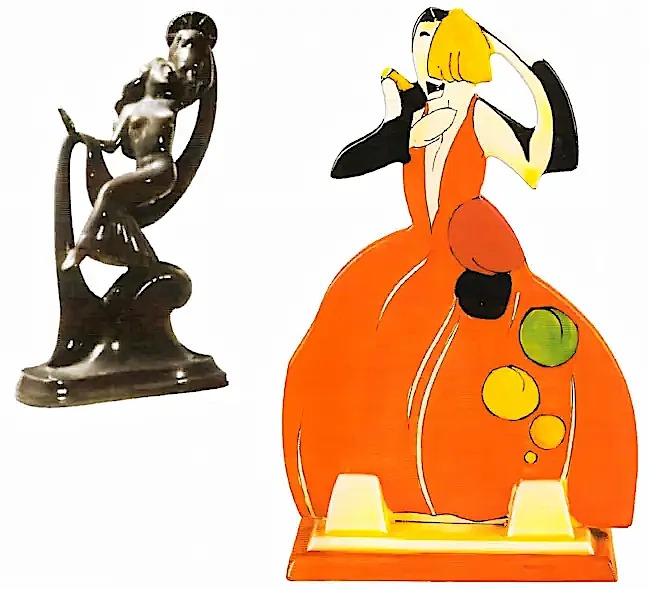
The muse of this direction was Josephine Baker, a unique analogue of Duncan, whose charm is captured on the posters of P. Colin, where she is presented in the atmosphere of a "Negro revue". In addition, traces of Latin American dances also left their mark on art, which found reflection in plastic compositions dedicated to such Hollywood icons as Dolores del Río. These works constituted a kind of artistic exchange, which was successfully presented by ceramic manufacturers in Europe and America, including the Austrian firm Goldscheider.
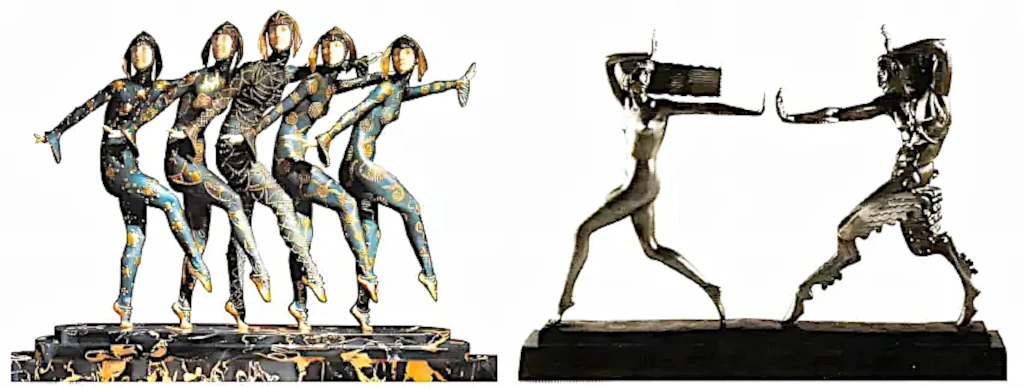
From the dance continent came various ballroom dances in the spirit of ragtime, which flourished in the late 1910s. These rhythms evolved into new Art Deco era dances, such as the two-step, one-step, and foxtrot, as well as the widely popular "Charleston" of the 1920s. This latter composition became a symbol of the time and was embodied in the works of sculptors such as P. Philippe and G. Lavrov. The most spectacular scenes, not only of solo performances by Josephine Baker but also of collective performances by entire jazz orchestras, became an important direction in sculpture. These dynamic, zigzagging compositions, full of silhouettes, were created for planar frontal perception, which adds an additional visual effect.
Night restaurants and cabarets, such as the "Folies Bergère," served as arenas for performing the most fashionable and popular dances. These performances included all the previously mentioned movements, steps, and elements that form the basis for solo dances or group performances of the cancan. Such an exotic atmosphere was created by colorful costumes, music, and the distinctiveness of the name, which together formed a true wonder of the cult party.
However, soon after the distinct Duncan, Diaghilev, and jazz stylizations, the theme of dance in Art Deco sculpture moved towards completely original, fantastical, and eccentric images found nowhere else—this is one of the unique features of this style. The evolution of artistic language and the sense of freedom of expression gave rise to a whole series of imaginative and whimsical interpretations, blurring the boundaries of traditional perception.
As a result of all these influences and layers, starting around 1925, a visual canon crystallized with noticeable characteristic features indicating an inseparable connection between sculpture and choreography. This synergy is expressed in the striking interrelation of forms and dynamics, as well as in how they convey the emotions and plastic characteristics of their characters.
First and foremost, it is worth noting:
— This is a distinctive, deeply felt stylization that covers a wide range, from Cubist interpretation (as noted by B. Hillier, "Art Deco is domesticated Cubism") to a naturalistic, almost Pop Art aesthetic. Furthermore, numerous works were created within this stylization. For example, in classical motifs, one can see a range from pristine, "Phidian" purity, embodied in the works of Pierre Le Fage, to the extremes of the "florid" salon, as in "Dance with a Scarf" by I. Lorenzl and "Charleston" by F. Preiss.
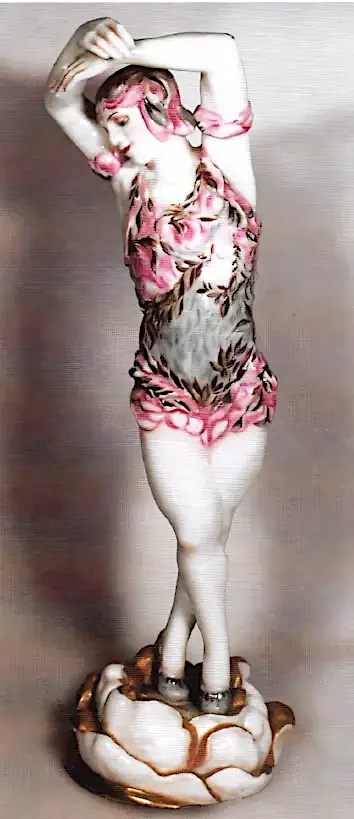
— This corresponds to sharp and zigzagging lines, an unnatural horizontal tilt of the head ("Columbine" by O. Glebova-Sudeikina, 1923–1924, polychrome porcelain), as well as geometrically bent arms, legs, and palms, embodied in the works of F. Preiss ("Dancers of Modern Dances," 1920s, ivory, bronze);
— characteristic invented dance movements — modified arabesques, attitudes, écarté, entrechats and pas de basque (these are large jumps with high throws and leg extensions), as seen in F. Preiss's composition "Torch Dance," executed in bronze and ivory in 1925.
— this is a struggle between two moods — the desire to be both modern and decorative simultaneously, which created a peculiar oxymoron, where the conventionality of forms coexists with a love for decorative effects. These stylistic contrasts became part of the internal conflict faced by many artists, striving to convey not only the physical aspects of dance but also its emotional essence, tuning the viewer to a certain mood.
Such a synthesis of stylistic directions goes beyond mere aesthetics, inspiring new explorations in the sphere of the body and its movement. This allows sculptors and artists to explore the uncertain boundaries between art and life, seeking new ways to convey the spirit of the time and sensations.
The intertwining of dance and Art Deco sculpture became an integral part of the culture of that era, providing an opportunity for self-expression and rethinking of traditional forms. As new styles and trends emerge, sculpture begins to be perceived not only as a static form but as a dynamic expression of human emotion and aspiration. Each sculpture, each pose and movement becomes not just a result of technical mastery, but also a semantic depth, reflecting complex feelings and experiences of the time.
These new concepts and forms, which threw the canons of traditional art into confusion, reflected the artists' striving for freedom of thought and action in their works. As a result, dance, sculpture, and diverse artistic practices of that time merged into a single stream, paving the way for subsequent generations of artists and their innovative ideas.
Art Deco style, with its characteristic emphasis on ornamentation, significantly changed the perception of sculpture, introducing elements that connect it with design and architecture. Sculptures of this period often had a stepped silhouette, being placed on multi-level bases that were associated with fashion show podiums. This visual metaphor naturally intertwined the space of art and the world of fashion, where zigzag lines and curved forms served as symbols of dynamism and modernity. The execution of works, such as the sculptures by D. Chiparus and A. Kalender, demonstrated a harmonious combination of art and everyday life.
Art Deco also emphasizes the richness of the materials from which the sculptures were created. The use of ceramics, polychrome porcelain, bronze, and even ivory became an important attribute, signifying a transition to a sporty, dynamic aesthetic. The finishing techniques of these materials, the high quality of execution, and the combination of various textures and shades gave the work the character of jewelry art. This innovative use of materials and techniques allowed sculptors to create works that sometimes looked like entire theaters in miniature.
The frontal composition used by many artists had its own logic and depth, reflecting the distinctiveness and significance of each element. The skill with which mirror symmetry and kinetic dynamics were executed is vividly traced in works such as "Dancer with Gazelles" by P. Manship or "Russian Dance with Cymbals" by D. Chiparus. These compositions were created with the intention not only to attract the viewer visually but also to involve them in a new artistic space, immersing them in an atmosphere of dance and movement. The special interpretation of movement, reminiscent of ancient Egyptian reliefs, as in the sculpture "Satyr and Nymph" by Pierre le Fage, emphasized the principles of the Art Deco artistic language in dance sculpture.

The direct influence on the formation of new artistic canons was exerted by a revolutionary art form born from **the work of Roman Tyrtov himself, known as Erte**. His chryselephantine sculpture enriched Art Deco with many elements of fantasy and innovation. Erte's ideas, concealing ancient Russian and Eastern elements, brought imagery and unusual constructions into sculpture, which resonated remarkably with the avant-garde art forms of the time. His attention to detailed costumes and original poses of the figurines contributed to inspiring sculptors working in this genre, such as Chiparus and Gerdago, with his approach to design and execution. Erte's aesthetics undoubtedly influenced dance sculpture. His vivid, almost theatrical images, exploring the interaction of ancient and modern culture, found an echo in the works of many artists, whose figurines with striking and extraordinary poses became part of the new Art Deco repertoire. Under the influence of this style, many sculptors began to use elements of eclecticism in their compositions, enriching them with symbolism and meaning that went beyond mere decorative art. Through the study of dance plasticity, sculpture in Art Deco reached new theatrical heights in its expressiveness. Artists sought to capture not only the physical beauty of movements but also the inner world of the dancers, their emotional state. Here, an interaction of a certain artistic freedom and the search for new ways of self-expression is observed. Dance found its new life in a material that embodied the dynamism of the time, awakening in the viewer deep feelings that seemed to elude them in everyday life. Each of Art Deco's aspirations for perfection reflected the reality of a time when movement in sculpture ceased to be a simple repetition and became self-expression and a sincere experience. The new artistic explorations of this style, saturated with extravagant forms and dynamic gestures, imparted a sense of freedom and also led to a reinterpretation of dance classics. Observing forms that seemed to be in endless motion, the viewer realized that art is capable of touching upon the most important aspects of human existence—freedom, desire, and the pursuit of self-expression. The unique interaction of dance and sculpture in Art Deco opened new horizons for self-expression, embodying the spirit of the time, where every pose of a dancer and every detail of a sculpture became a reflection of complex feelings and emotions. This capture of dynamics and plasticity created a synergy that pushed the boundaries of traditional art, strengthening the interconnection between various directions and fields of creativity.
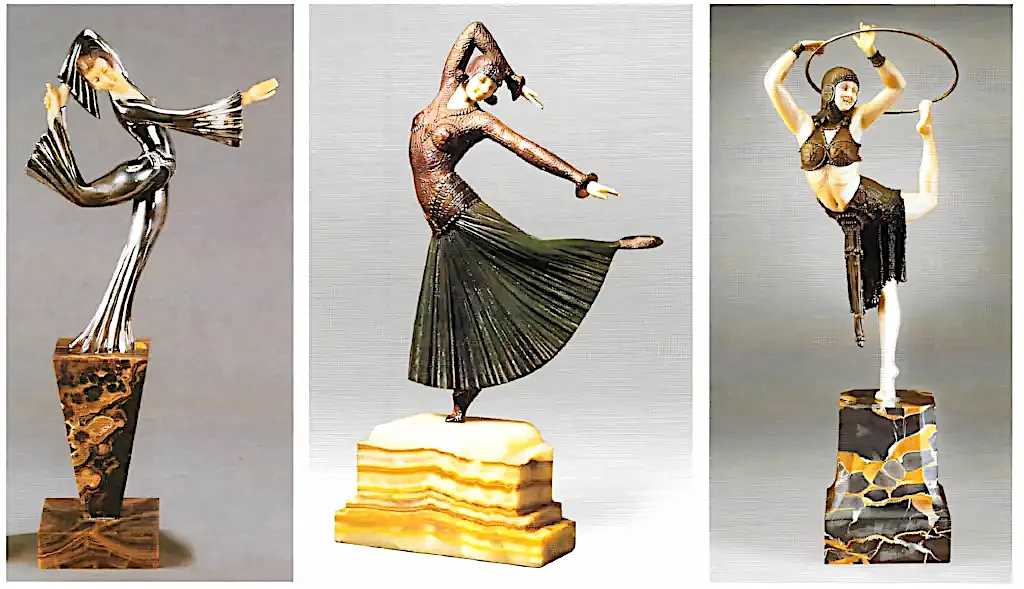
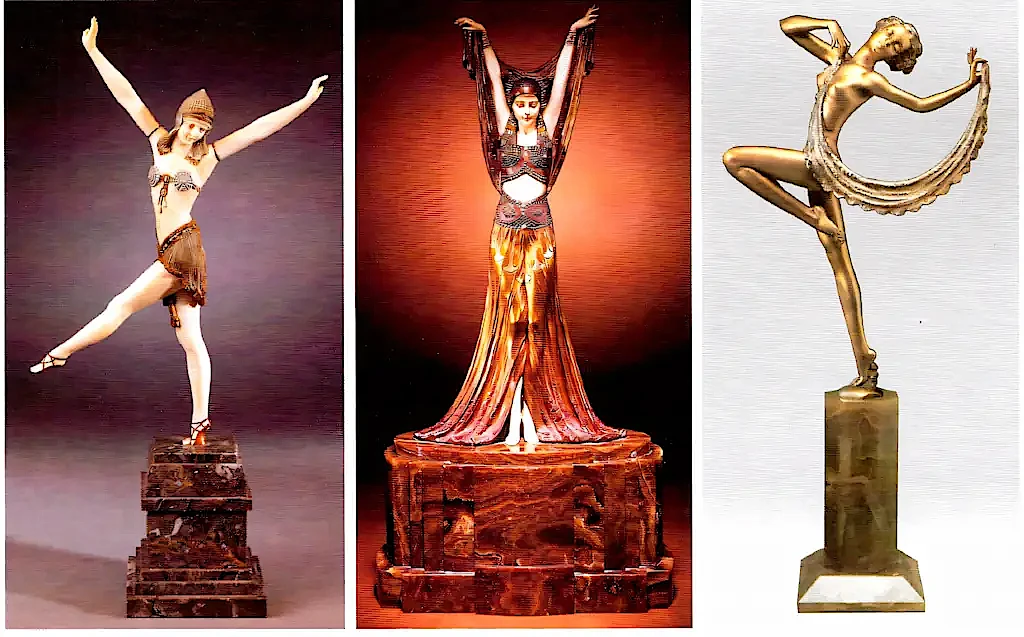
Demetre Chiparus (Shapiro), who arrived in Paris shortly before the start of the First World War, set the tone in depicting dance poses and costumes. Living and working in turbulent times, he became the founder of the "dance" sculpture of Art Deco, creating an extensive gallery of dancers of the era. His works reflected figures such as Ida Rubinstein and Vaslav Nijinsky, as well as many other famous soloists of Russian ballet and vaudeville, filling the aesthetics of Art Deco with the names of popular stars of Parisian cabarets, such as Semiramis, the Dolly Sisters, Miss Kit, Almeria, Thaïs, Yambo, Testris, and Durga. The originality of Chiparus's costumes manifested in unusual combinations. They were made in fashionable scaly tights, pleated skirts of varying lengths, with headdresses resembling turbans or helmets, open bodices, as well as spectacular sandals and avant-garde jewelry.
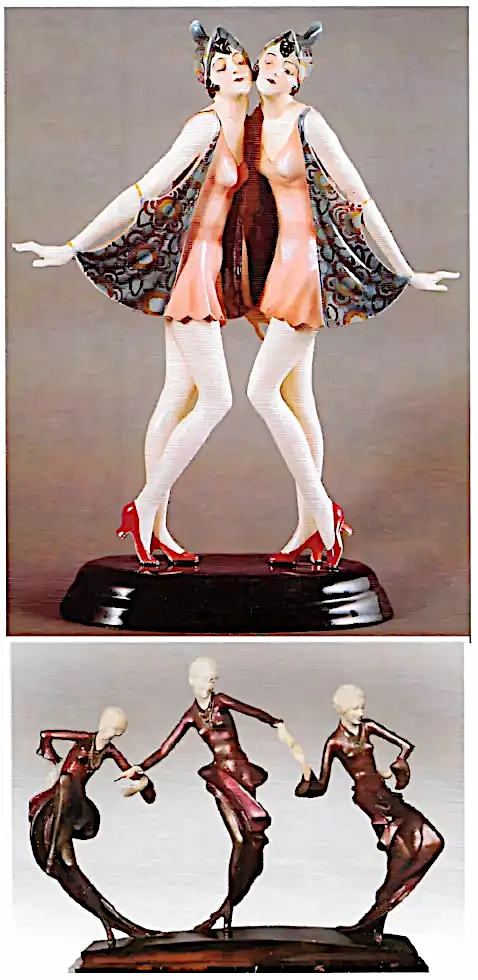
A specific category became sports dances and numbers incorporating elements of acrobatics or gymnastics, as well as performances with commedia dell'arte characters. Dances such as the works of Gilbert and Roland Parry introduced the dynamism of circus effects into everyday dance practices, adding freshness and accessibility to forms that traditionally dominated theater stages. These performances not only expanded the boundaries of art but also brought it closer to real life, involving the audience in the exciting atmosphere of the present.
These various elements and new approaches to sculpture and dance reflected the spirit of the time and the artists' desire to create something more than just a technical re-evaluation of forms. All of this ultimately created a context for further artistic explorations, where each movement carried a deep semantic load and became a metaphor for the pursuit of freedom and self-expression. Participation in this changing artistic process provided sculptors with a unique space to explore the plasticity, dynamism, and emotional expression that defined the dance art of Art Deco.
"Dance Sculpture" incorporated the "signature" numbers of European cabaret stars, where the brightness and emotionality of the performance were captured in bronze and polychrome forms. Thus, the famous Parisian "Kazachok" debuted in the works of D. Chiparus, whose aspects, inspired by folk rhythms, visually interpreted the dynamics of the dance. Even the German "Butterfly Dance" by O. Portzel, with its elegant lines and grace, was cloaked in a layer of refined aesthetics. The vibrant polychrome "Caught Bird" by I. Lorenzl became a masterpiece, where the play of colors and graceful movements created the illusion of live flight, while the "Dance with a Scarf" by authors such as Le Faguays and Preiss captured the sensuality and expression of movement, revealing the beauty of choreography through material.
The Austrian firm F. Goldscheider was noticeably influenced by American musicals such as "Let's Dance" and "Top Hat," as well as glamorous cinema with the charismatic Dolores del Río and the Dolly Sisters. Famous films of the time, including the iconic "The Sheik" (1925) with Rudolph Valentino, inspired leading sculptors such as I. Lorenzl, Walter, and Marcel, who visited Paris to capture the atmosphere of the nocturnal "flaming glamour" of post-war Europe in polychrome colored ceramics.
By the late 1920s, dance sculptural poses exhibited more gestures and mechanistic movement than expressive imagery. The dominant cult of "childlikeness" and "naivety," as noted by van Dongen, was experiencing a period of awakening, opening a new winning perspective on art. The lyricism that was so lacking began to disappear along with the emotional intensity and sincerity that filled Diaghilev's ballets. The era when the "voice of self-actualization" inspired creativity, noticeably changing the perception of dance as the thematic leitmotif of the age, had passed; choreography began to sound straightforwardly hedonistic, sinking into the bustle of eclecticism.
In the 1930s, many searching sculptors left the dance genre. Some went to the new Mecca of decorative and applied arts—America, where the "Rockefeller Center" became such a symbol, while others sought to abandon imagery. Still others, finding no creative prospects, began collaborating with large commercial firms such as Wedgwood, Dalton, and Ginari.
An optimistic epilogue to the evolution of Art Deco choreographic sculpture was its adaptation in Soviet Russia. Sculptors who remained in the USSR continued to work with popular images of dancers such as Nijinsky, as well as ballerinas Karsavina, Pavlova, and Fedorova.
This was partly due to interest in Russian art in the West and its export. However, Russian masters were rooted in a deep understanding and specificities of ballet art, which combined with the latest artistic trends, particularly the search for new solutions in color and polychromy in sculpture. Images of A. Pavlova in "The Dying Swan," T. Karsavina, S. Fedorova, V. Nijinsky in the image of a faun by N. Danko, as well as the work of O. Glebova-Sudeikina with "The Genius of Dance" and D. Ivanov in "The Firebird" embodied the expression and inner substance of their time.
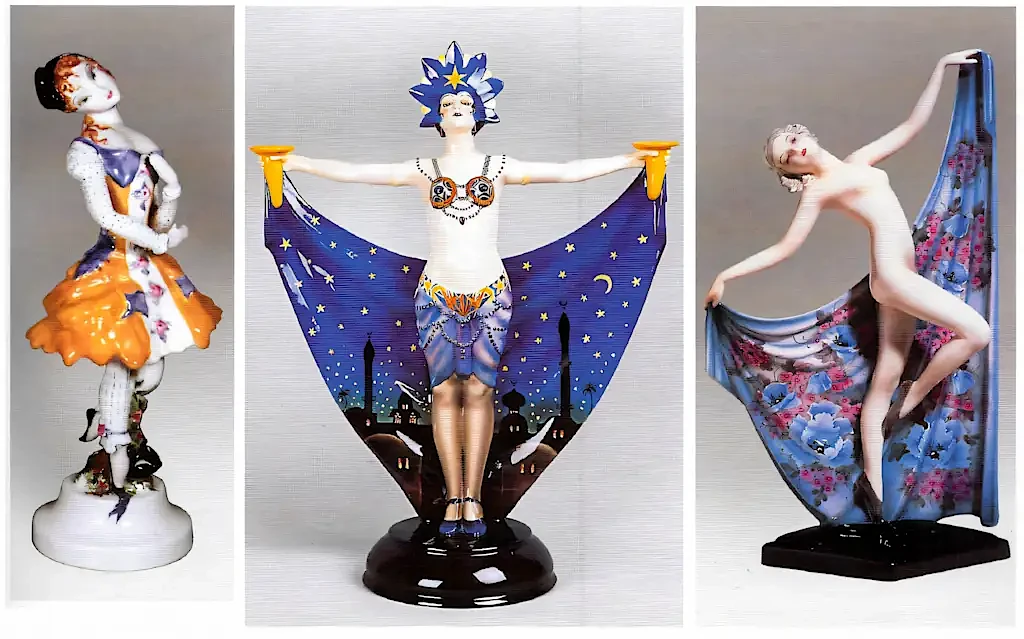
These images not only resembled Art Deco masterpieces but also served as connecting threads between dance and sculpture, lending them new depth and context. Every gesture, every pose acquired a multitude of meanings, refracted through the unique prism of Russian culture and its artistic values. As a result, a truly original aesthetic emerged, reflecting the spirit of the time and the aspiration for self-expression, created in the dialogue between movement and sculptural form.
In Soviet sculpture, surprisingly, roots are found that run deep into folk art, giving Art Deco a special lyrical content. Works from that time demonstrate incredible vitality and emotional richness. An example is the sculpture by A. Sotnikov "Dancing Cossack Boy" (1935, porcelain), which astonishes with its sincerity and beauty. Unlike the French counterpart by M. Bouraine "Russian Dance" (1925), Sotnikov's final work delves into traditions and customs, illuminating folk rhythms and movements. Figurines of dancing Uzbek, Georgian, and Turkmen women, created by masters such as N. Danko, O. Manuilova, and N. Zamiatina, reinterpret folk dances, linking them to the deep roots of culture, making them a true artistic heritage.
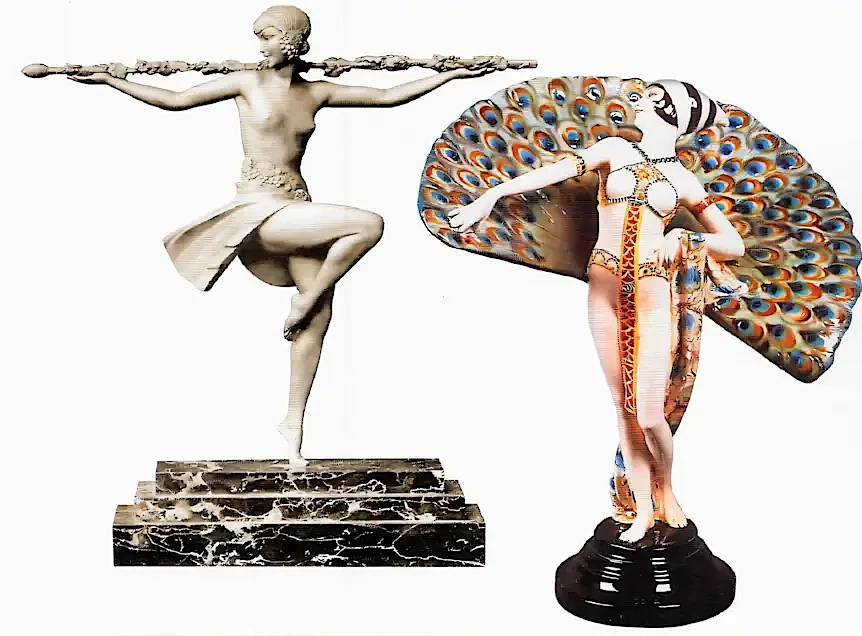
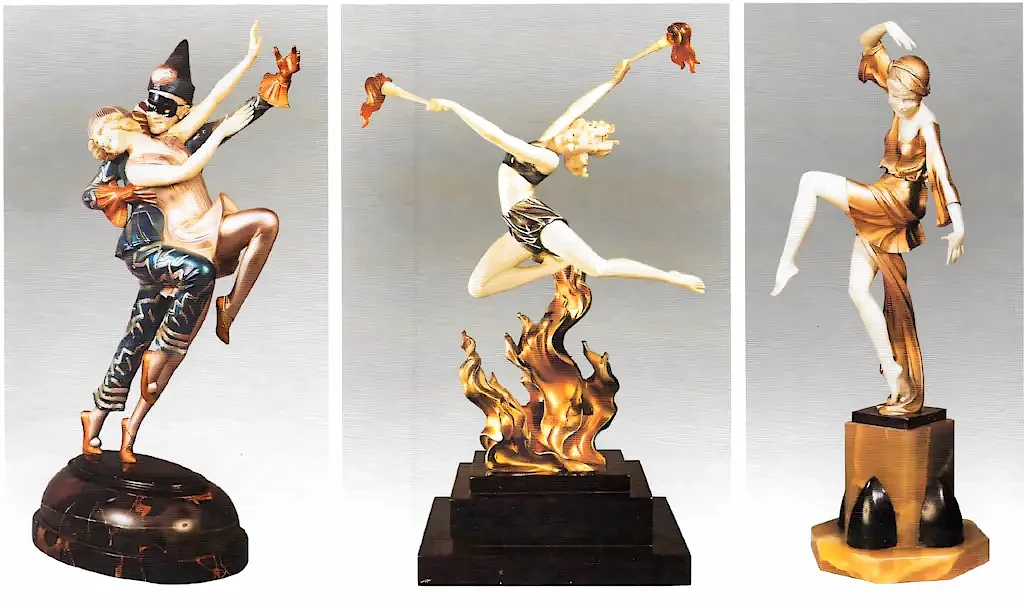
However, despite the shift in artistic emphasis, certain elements remained common with the Western direction, manifesting in the sharpness of silhouettes and the plasticity of forms. The angularity of poses, sharp turns of the head, and graceful curves of the arms indicate a persistent striving for experiment. An interest in color and texture remained a characteristic feature of Russian and Soviet sculpture, allowing it to be spoken of as a kind of "Art Deco preserve" during the incipient modernism in the West.
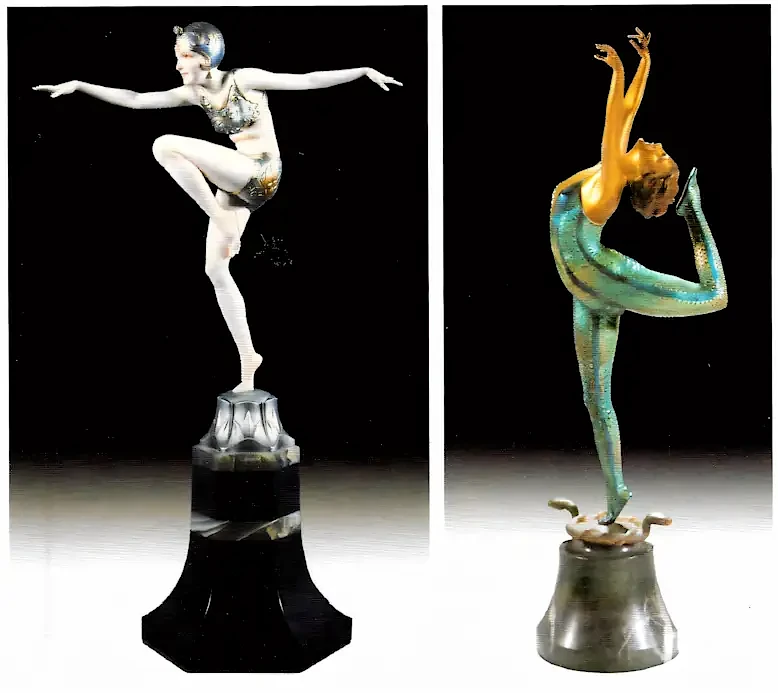
Meanwhile, Soviet sculpture continued to develop, delving into elements of classicism and searching for new forms and materials. This artistic direction, supported by state ideology, created unique masterpieces, blending the heritage of Art Deco and folk traditions. Parameters related to plasticity and dynamics heightened sculptors' interest in shaping an image that reflected not only technical mastery but also the colossal emotional will of the era. Each work became not merely a testament to an aesthetic idea but also an important part of the cultural heritage.
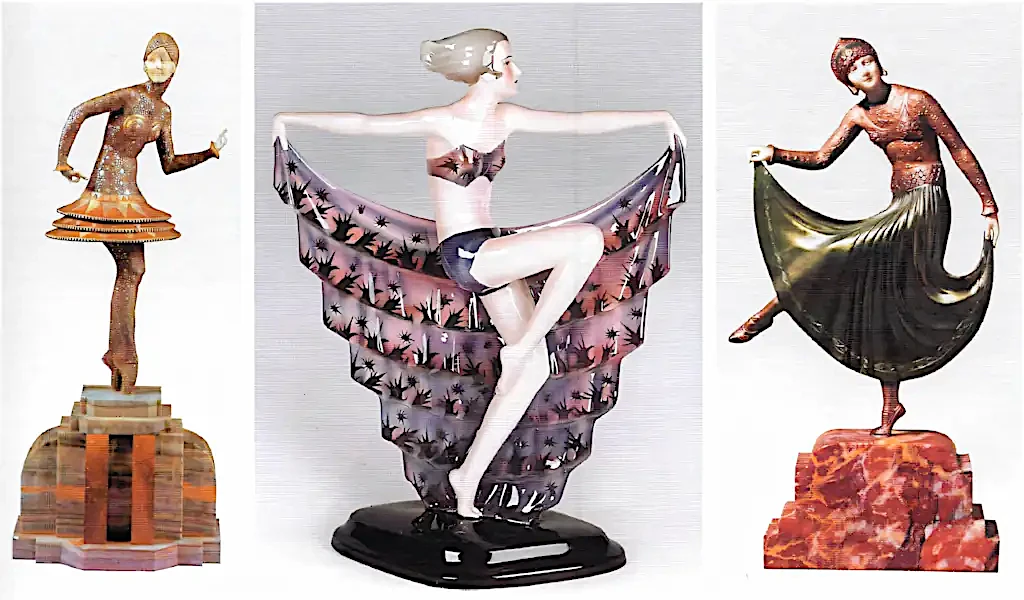
In the context of the decline of Art Deco in the 1930s, Russian sculpture experienced a distinct rethought stage, where harmony between classical images and innovative forms occurred.
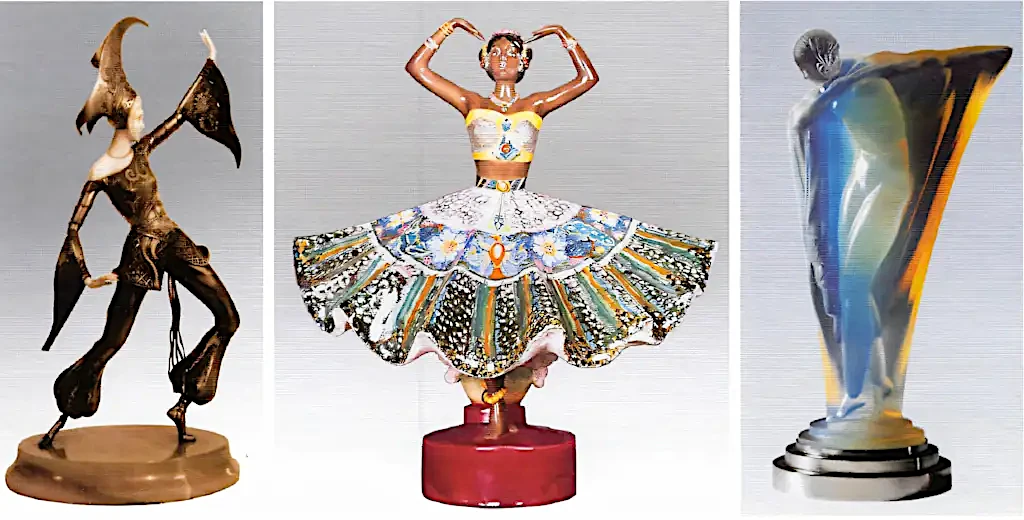
This synthetic approach revealed an interest in the dynamics of movement research, which allowed for finding unique solutions when creating dance compositions. The attempts of artists to reflect the culture of the time are shown very expressively, using stylistic elements that intersected with the advanced quests of Western sculpture, without losing their immediate stylishness and depth.
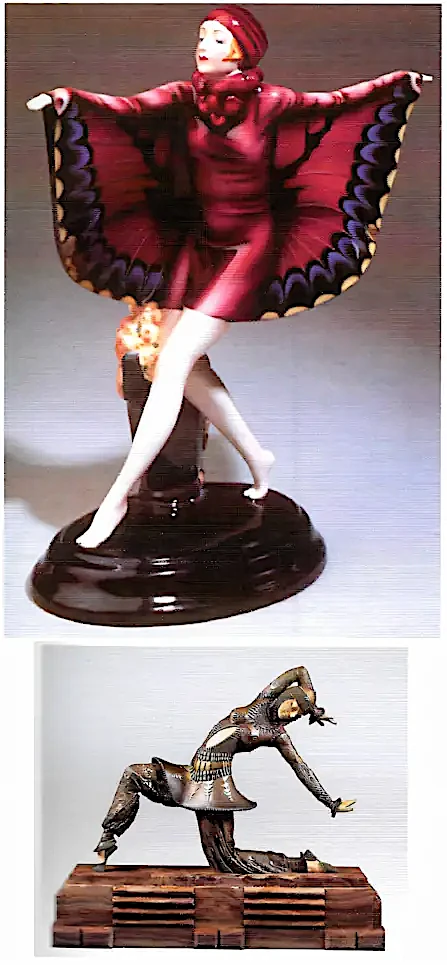
All these arts and styles interacted with each other, creating a canvas full of life-affirming images. This synergy continued to develop, conveying new semantic loads, reflecting constant aspirations for self-expression and the search for beauty in movement. Every gesture, every plot, and every placed foot spoke of the profound feelings of its time, generating a folkloric narrative that either reinforced or reinterpreted the image of dance, realizing contact between the artist and the viewer.
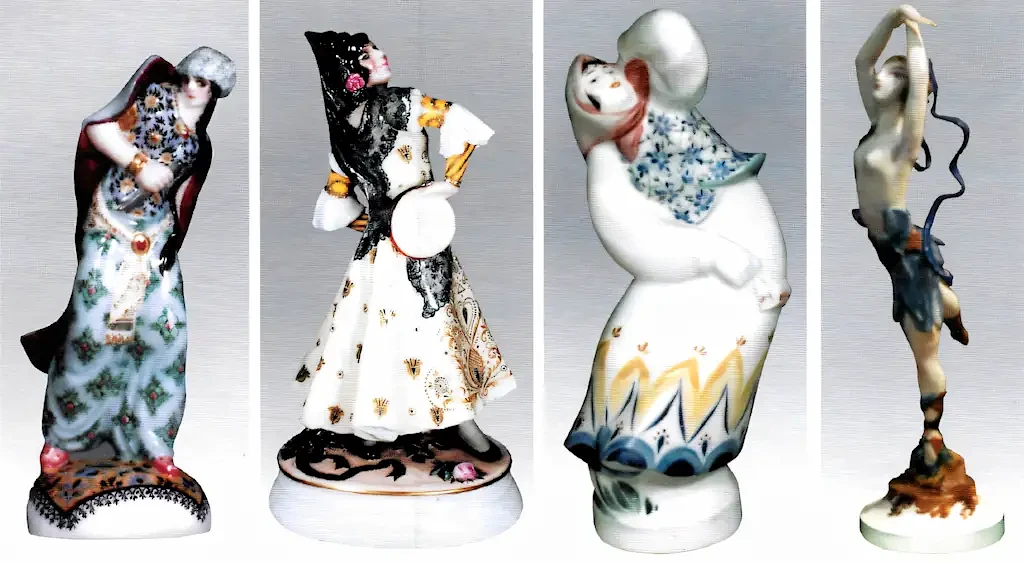
The rejection of traditional forms turned out to be not only an experiment but also a concentration of ideas that unfolded within the social and cultural context.
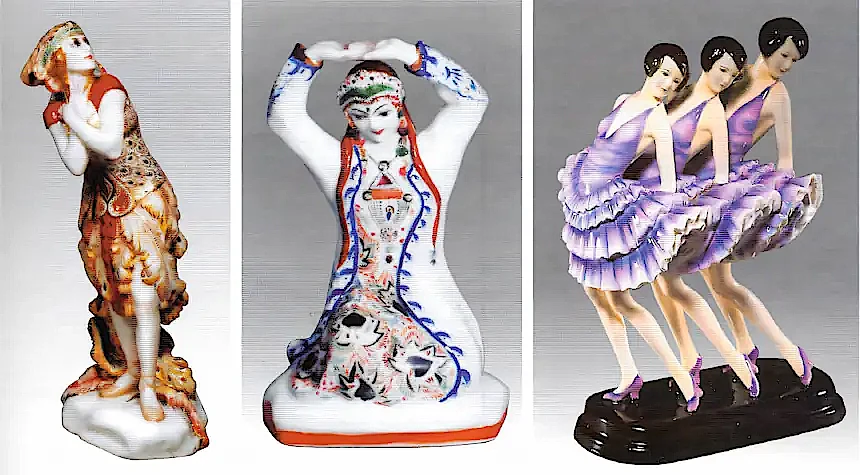
Therefore, every movement, every pose became a kind of challenge for that time, allowing the sculpture to freeze in the dynamics of dance, as each work represented a vivid illustration of emotional depth and inquisitiveness, whether it be statues, reliefs, or other forms.
Dance in interior commercial Art Deco sculpture can be considered the most important genre of the 1920s-1930s. Such sculpture was mainly made of bronze, ceramics, porcelain, faience. The most common technique was chryselephantine, combining bronze, ivory, and stone (marble or Brazilian onyx). This genre became especially popular in France, Austria, and Germany, also developed in England and the USA, and to a lesser extent in Russia and other countries. The sculpture was expensive, served as an element of luxury, and was sold in large department stores, fashionable salons, and art galleries. Today, at antique auctions, it is especially valued — from 4—9.5 thousand USD. On the domestic antique market, one typically encounters "dance" sculpture made of bronze, and ceramic sculpture by the F. Goldscheider firm is almost never found. In this sense, Soviet sculpture of the 1920s-50s, distinguished by high stylistic and artistic qualities but made from a less expensive material — porcelain, is popular and in demand on the Russian market today, and its price is constantly rising.