Для тех, кто ценит красоту и историю. Присоединяйтесь к сообществу ценителей!
Pyotr Leonov: how one man ignited Russian porcelain with color, audacity, and real life
2.8КJune 25, 2025Фарфор
Keyhole to Another World
Be honest: have you ever thought of a porcelain cup as a manifesto of an era, a challenge to society, and the cry of an artist's soul? Probably not. For most of us, porcelain is a delicate, refined, but somewhat retro-forgotten little cloud from grandma's sideboard. But imagine: beneath the glaze of snow-white tableware lies the same intensity of passion as in Matisse's canvases, the daring energy of Malevich, the astonishing power of the Russian character — and all of this can be taken in hand, pressed to the lips against the rim of a cup.*
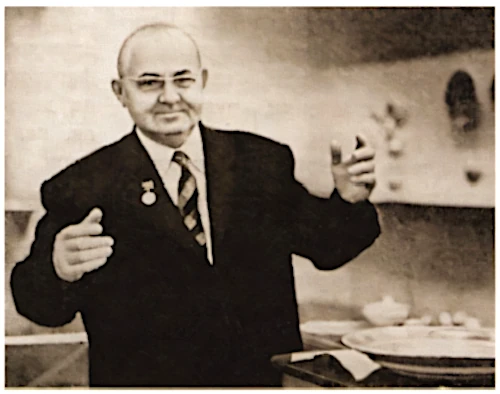
Today, I will tell you about Pyotr Leonov — a man who, with a single stroke of his brush, turned Dulevo porcelain into an arena of grand experiments and emotional outbursts. After reading this story, you will never look at a tea set simply as tableware again. Behind every pattern, every splash of color — lies an entire world, a living biography, a struggle between the familiar and the unexpected. This is the story of a man who embodied in porcelain the joy and audacity, the pain and hope of his time.
***
Energy Enough for Twenty Lifetimes. Who Was Leonov?
Pyotr Vasilyevich Leonov was not merely the greatest porcelain artist of the USSR and the chief artist of the Dulevo factory for four decades. Imagine a man who bursts into a closed system where every cup is like a tedious bureaucrat: prim, routine, emotionless. And then — Leonov. He didn't live — he burned. He had such a powerful emotional charge that it seemed all the exhibition halls of the Soviet Union shimmered only with his works, even if 'de jure' dozens of others were on display.
In Soviet times, everyone knew him: the name Leonov sounded like a symbol of the porcelain revolution, and his style — like a hallmark of the era. But then silence came. People changed, ideals faded, and even the artist's famous name began to be forgotten along with the bygone epoch.
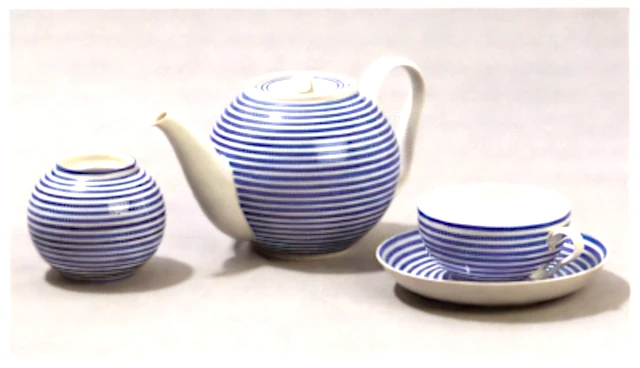
However, when interest in the art of the 1920s-1930s flared up again, when Art Deco — the style of the admiring twenties — once again sparkled in fashionable interiors, on movie posters, in coffee table design, it became clear: Leonov's time is returning. Only now we look at his porcelain not just as "Soviet heritage," but as a unique phenomenon of 20th-century art, without equal.
Art Deco and the Daring Porcelain Man
What incredible thing did Leonov do? Why did porcelain in his hands become alive, sharp, full of daring?
Look: most artists of that time were captivated by the struggle for "new Soviet content." In porcelain, this meant—emblems, slogans, tractors, posters. All of this looks lively, but extremely boring, as if you were drinking tea from a newspaper cup.
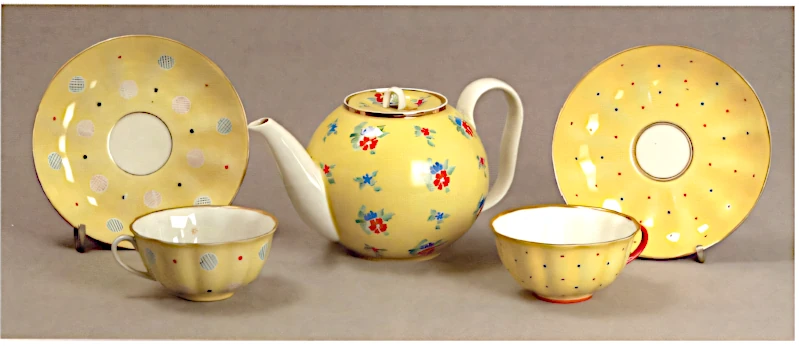
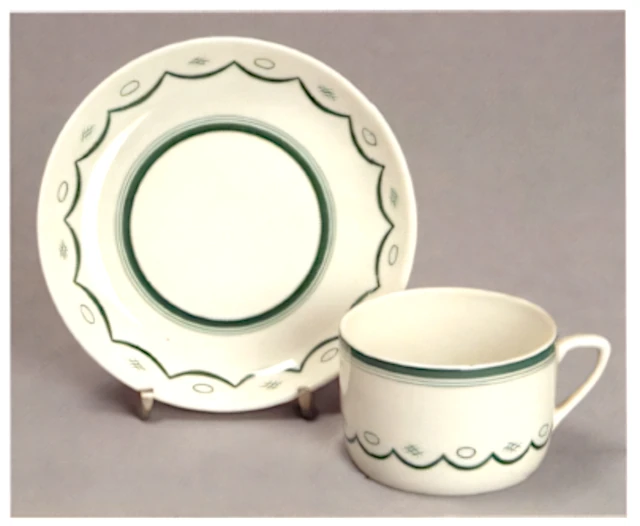
Leonov finds this uninteresting. He seems to breathe completely different meanings into porcelain. He is drawn to "pure" decorativeness, the magic of color and composition. Instead of slogans and illustrations—incredibly rich, vibrant, unexpected colors. Geometry, lines, dizzying ornamentation, like a jazz improvisation—and all of this combines with the latest European trends, which Leonov absorbs like a radio tuned to an experimental frequency.
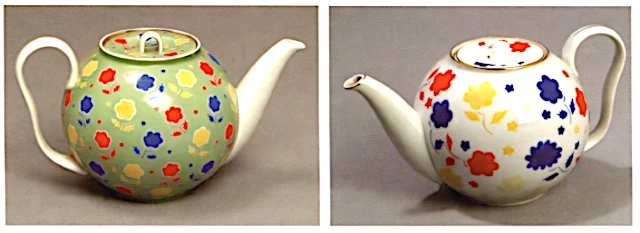
But the most amazing thing is that all this luxury of color, boldness, and modernity appears in the porcelain of a provincial man who had never been abroad, inspired by… his own childhood. The Kuban steppes, Cossack huts, the colors of folk shawls, architectural memories—Leonov transformed personal recollections into a universal aesthetic code. His pragmatic training under the Mova brothers, passion for architecture, first successes in textile design (Soviet fabrics with chic for China!), became steps towards the future "fairyland on porcelain."
Dulyovo Meets the Revolution
At 22 years old, like a meteorite, Leonov appears at the Dulyovo factory, which had just been wrested from the embrace of the merchant Kuznetsov dynasty. The place is Old Believer, quiet, patriarchal. Imagine: a young, fiery, dark-eyed guy, who was immediately nicknamed "the Chekist." The first impression was like a Bolshevik invasion—and indeed, his appearance became a bolt from the blue for the factory.

What does he bring with him?
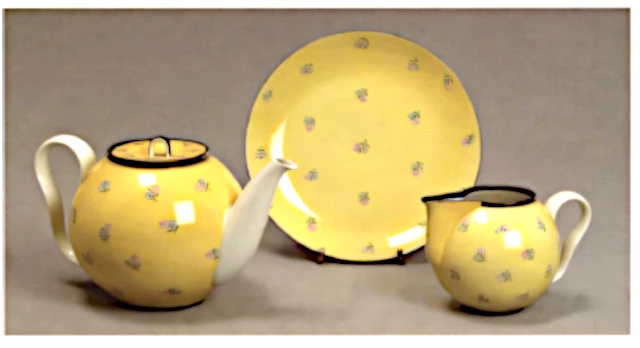
An explosion of color. It literally bursts into the refined but dull "aristocratic" porcelain, introducing free mastery of decorative motifs, contrasts, elements of "chintz" textiles, and the graphic determination of the avant-garde.
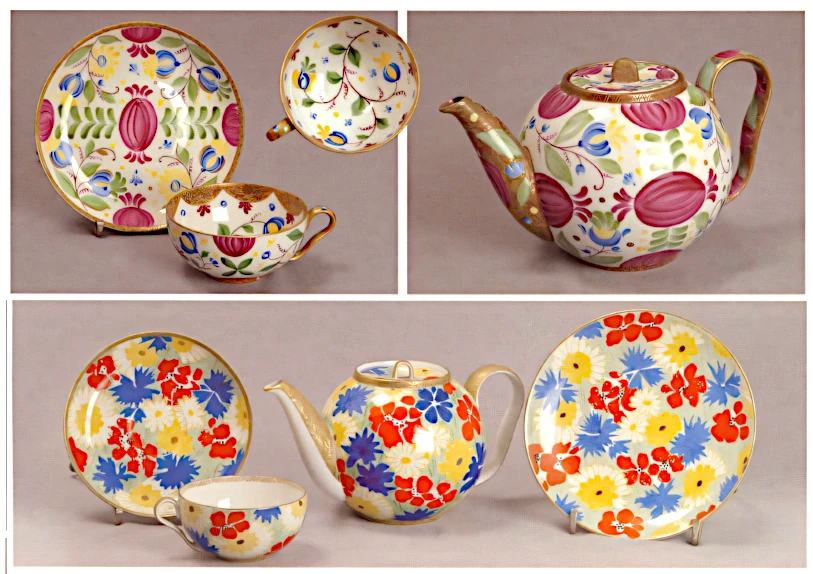
Dulevo before Leonov tried to be modern, invited artists, held conferences, experimented with new painting styles, but all of this was superficial, inorganic. Tractors and slogans on expensive tableware pleased no one—neither the artists nor the buyers. Only a strong personality could make porcelain organically new. Such a personality was Leonov—his style immediately appealed to society. Tableware with his painting sold like hotcakes. The experiment succeeded, and porcelain became both fashionable and "ours."
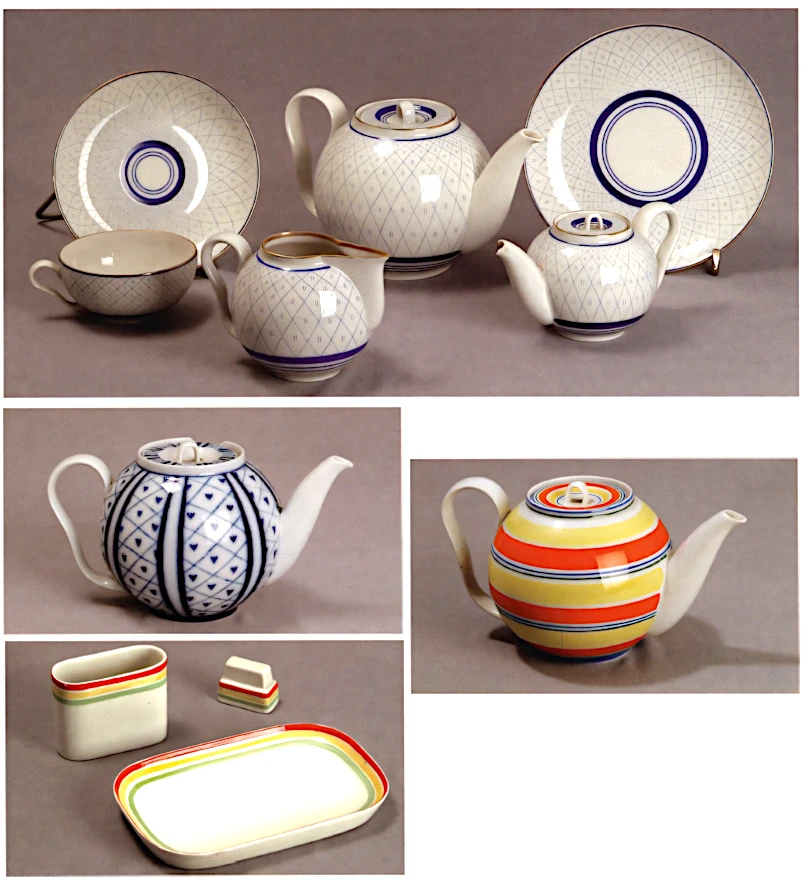
Dance with Time: Porcelain as a Mirror of the Spirit
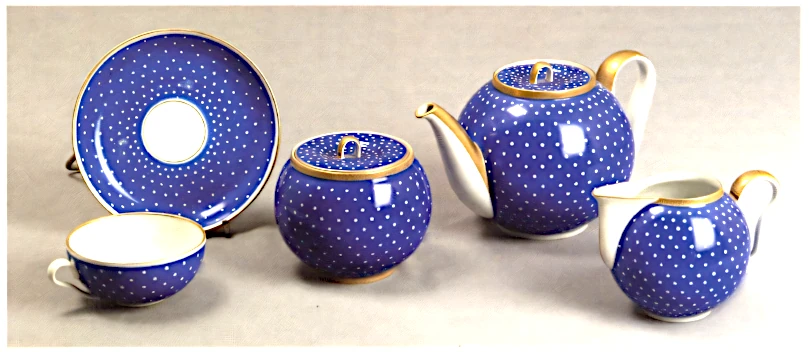
The first thing Leonov did was remove the pathos from porcelain. He abandoned narrative themes and "lines" of agitation, focusing instead on the subtle beauty of the white material, the delicacy of color, and the joyful, almost childishly pure sensation from combinations of brushstrokes. In just the 1933-34 series alone, over 120 sketches were created! Entire collections of "floral," "pea," and "striped" ornaments.
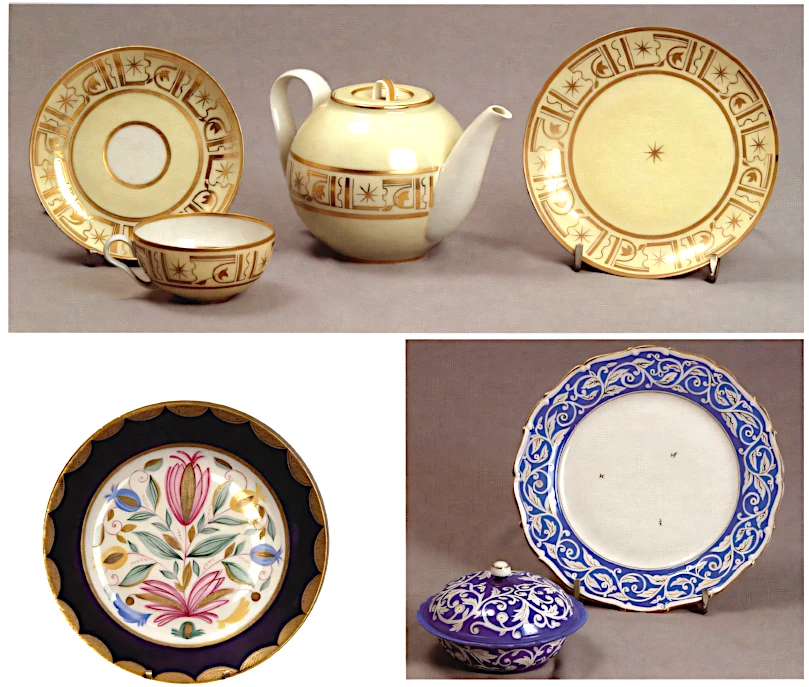
The turning point was the arrival at the factory in 1934 of Eva Stricker (Zeisel), a European prima of decorative arts, and Alexander Sotnikov, a talented sculptor and student of V. Tatlin. Together, they infused the forms of ambitious services with lightness and flexibility for vibrant painting. This is a fusion of Soviet avant-garde, folk art's sly motifs, and the influences of European Bauhaus, Werkbund, and Art Deco styles.
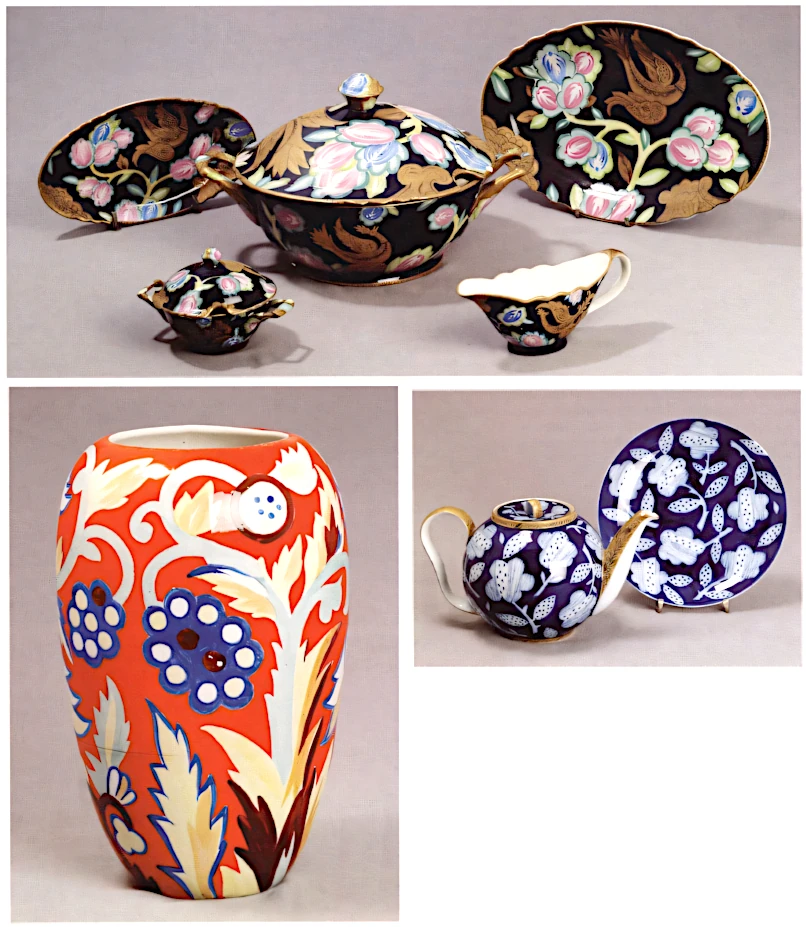
But Leonov's secret was not only that he "kept pace" with fashion. He was like a sponge, absorbing everything—from Kandinsky, Malevich, Popova to European geniuses like Matisse, Delaunay, Poiret. Open brushstrokes, bold color spots, ornamental compositions—all of this was fitting both on a cheap chintz teapot and on a formal presidential service.
Color, Energy, Joy — as Innovation
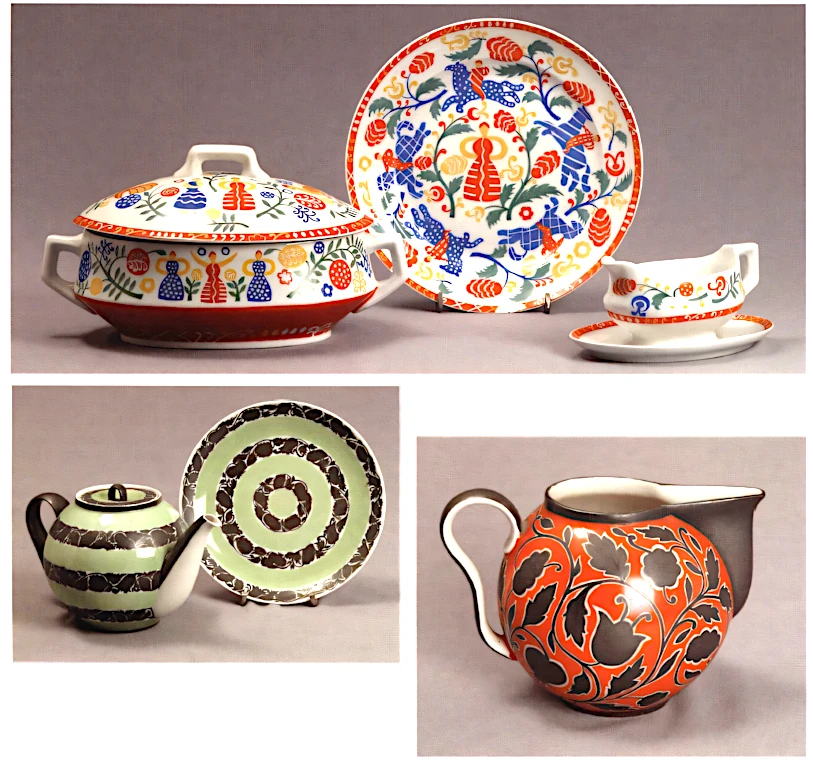
Just take a look at the "Moscow Girl" service—simple form, brightness, a feeling of spring. The young women of 1930s Moscow wore cheap fabrics but looked happy in these floral dresses—and here they are, twirling on Leonov's cups. Or "The Parisienne"—a visual manifesto, skillfully assembled from fragments of dreams about France, a country Leonov himself never visited. Yes, "The Parisienne" lives in the same visual cosmos as Delaunay's dresses, Lempicka's portraits, and Paul Poiret's drawings.

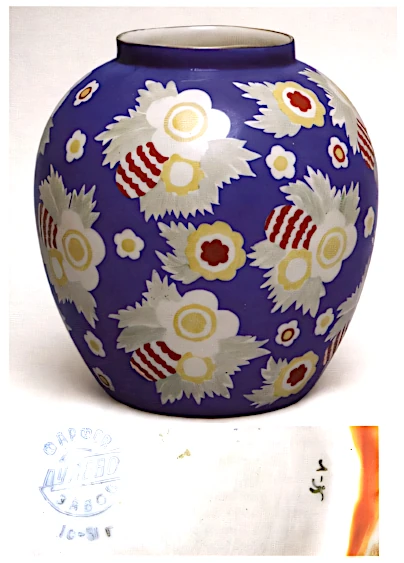
Leonov's services are not just tableware, but scenography of life. In his paintings, textiles become porcelain: rustic chintzes, geometric dresses, cheerful stripes, playful "fringe" of patterns and borders. He combines folk dreaminess and the strict urbanism of the avant-garde in a single cup. The "Little Bees" vase, the "Daisies" service, the "Meadow" service—each piece is filled with inner music, an individual voice.
Symbolism and Associations: The Secret Alphabet of Porcelain
What is most intriguing—Leonov was not obsessed with symbolism and an "ideological layer."
His drawings are a play of associations. Here are stripes—they suddenly become sea waves and Odessa sailors; circles—transform into the dancing patterns of shawls. Textile motifs glide freely across the surface, now a fluffy "Meadow" field, now a mischievous "cobalt net," now a witty "polka dot" on a red background.
Read the patterns—like lines of poetry!
Squares, spirals, border-vines—Leonov whirls you through a hall of associations: from ancient Greek ornament to Soviet fiery posters, but never flirts with blunt stylization.
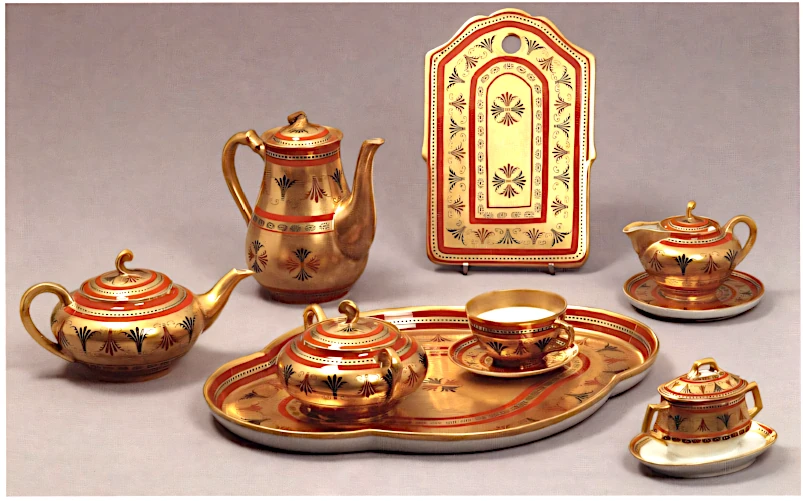
Influences of the East and antiquity can be felt in the "Scythian" service: gold, massive forms, grooves, and floral rosettes. There is a genuine prophetic power in this "barbaric" grandeur, like that of shamans—simultaneously exotic and deeply national. The "Ambassadorial" service, created for American President Roosevelt, is a clear illustration: Soviet motifs, Bauhaus decor, Egyptian lotuses—an ornament "for export," energetic and paradoxical.
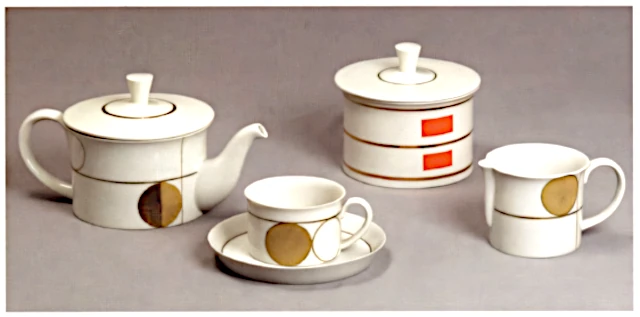
Russian Folk Art, Lubok, and Fairy Tale as a New Modernism
After all the experiments, Leonov gradually returns to his roots—but does so in a revolutionary way. He discards conventions and "politically correct" themes in favor of the pure energy of folk painting: broad brushstrokes, laconic decoration, the spirit of Pavlovo Posad shawls and Zhostovo trays, humorous lubok prints, and fairy-tale motifs from folk songs.
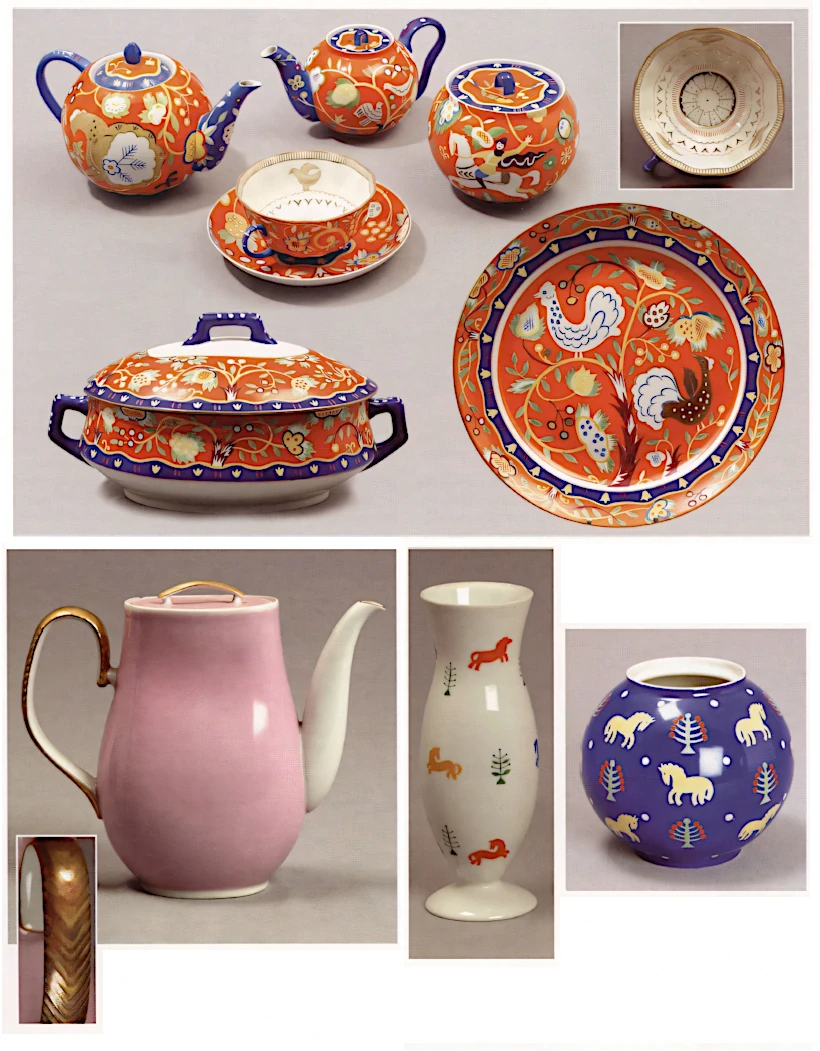
The "Krasavitsa" (Beauty) service becomes the culmination: a powerful color scheme, a floral wreath like a medallion, an almost black deep blue background—all of this even captivated Stalin (according to legend!). In 1937, the Paris Salon applauded Soviet porcelain, with six of Leonov's works receiving the Grand Prix and gold medals. This was recognition not only of his talent but also of his bold courage to step beyond the traditional.
The Postwar Period—Maturity and a Second Youth
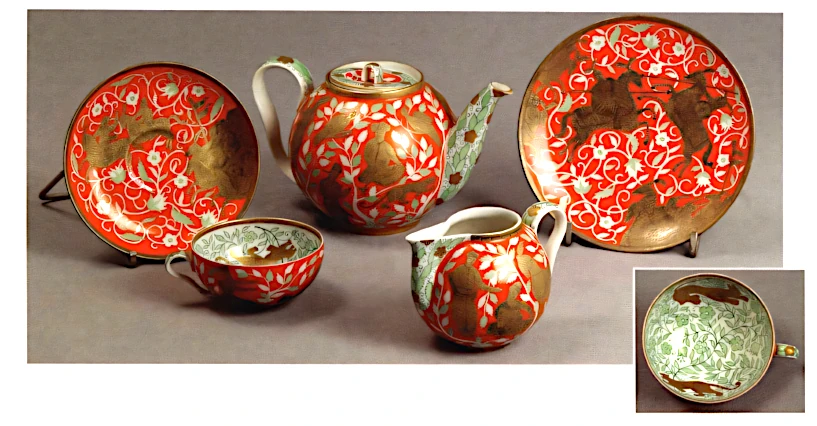
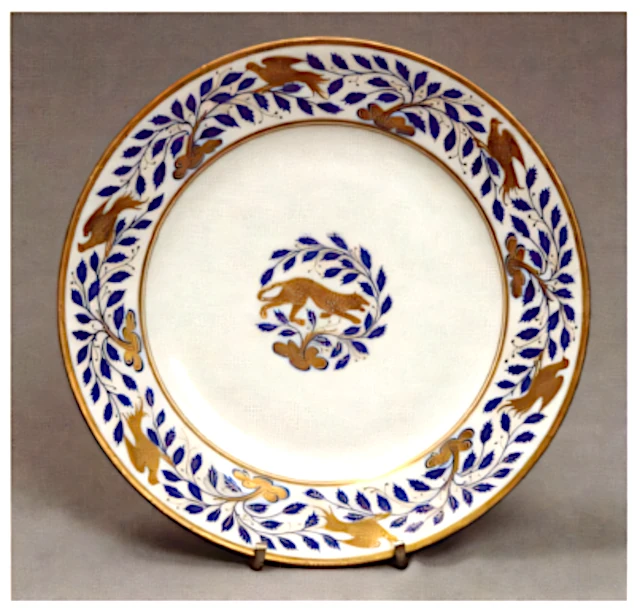
After the war, Leonov's style becomes even more intense and expressive. Color fields are powerful, saturated, even dissonant, yet harmoniously brought together. His porcelain is now luxuriously Baroque: an abundance of gold, fairy-tale engravings, fantastical birds and flowers, with forms given a festive heaviness. The "Golden Deer" service is not just an object but a true ode to victory, a song of happiness.
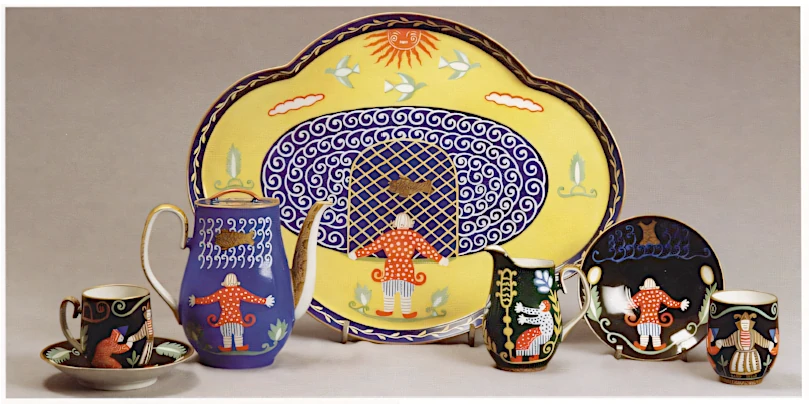
And all this energy remained with the artist until the end of his life. Leonov's apartment in Dulevo was a true avant-garde experiment: walls like a Suprematist artist's experiment, shelves of books, and nearby—children's Dymkovo toys. In his soul, a love for synthesis remained forever: Art Deco and folk art, the joy of color and the depth of tradition, the audacity of experiment and the sincerity of manual labor.
A Story That Never Ends...
Leonov's biography is not museum dust. It is an invitation to see the beauty around oneself, to feel the power of national tradition, and to be bolder. Against the backdrop of his porcelain, any of our "ordinary" cups suddenly becomes an opportunity to admire, to wonder, to create. After all, art is always about striving for the unexpected, about inner intensity, about connecting times through color, ornament, and brushstroke.
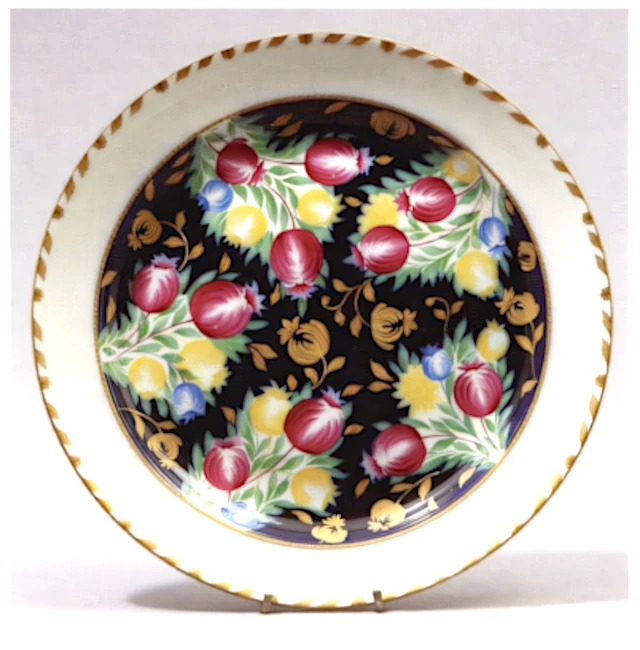
Perhaps now, when you raise a cup to your lips, you will ponder: what is the purpose of this color, this rhythm of the pattern? Whose story does it tell? And what motif would become your personal symbol?
Let's continue this conversation: tell us, what piece of art once made you change your view of the world? What is beauty to you, what is audacity, what is tradition? Or perhaps it is precisely such details that turn our lives into true art...