Konstantin Makovsky
303Nov. 28, 2024Живопись
In the history of Russian art, there are few artists who enjoyed such high popularity during their lifetime and were so quickly forgotten after their death as Konstantin Makovsky. His artistic legacy is fragmented and scattered around the world, which became one of the reasons why the master's work long remained in the shadows. Makovsky's works were not collected, he was not given due attention in the academic community, and his oeuvre remained outside the field of view of researchers.
Because of this, many of the artist's works today belong to other countries and are located in "hot spots," which presents a particular problem for the preservation of cultural heritage. Most often, these are portraits and depictions of personalities whom the Soviet authorities tried to erase from Russian history. However, over time, tastes, opinions, and approaches to evaluating works of art have undergone changes. At the end of the 20th century, attention to Konstantin Makovsky began to shift, and his contribution started to be reconsidered.
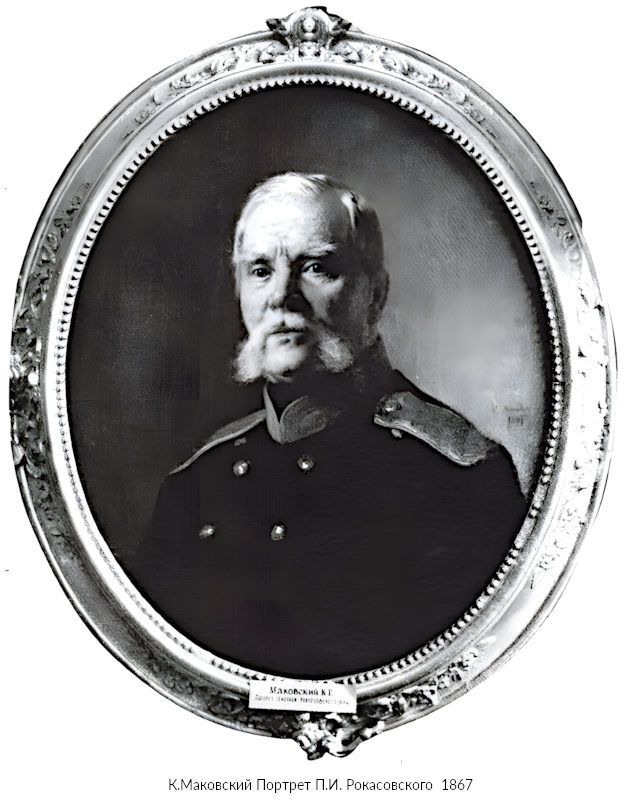
Very recently, information appeared in the media that a portrait of General P.I. Rokasovsky, painted by K.E. Makovsky, had been discovered on the "black market." This work was stolen from a Georgian museum in the 1990s. Thanks to the efforts of specialists from the Department for the Preservation of Cultural Values of the Ministry of Culture of the Russian Federation, the painting was returned from London to its homeland. However, unfortunately, it was in terrible condition, with a folded canvas and paint flaking off in places. Currently, the work has been transferred to the I. Grabar Restoration Center, where it is to be restored to its former beauty.
What is the history of this portrait?
In 1939, by order of the Ministry of Culture of Russia, two works by Konstantin Makovsky were transferred from the holdings of the Russian Museum to the Chechen-Ingush Museum of Local Lore. One of these works was the aforementioned portrait of Platon Ivanovich Rokasovsky (1799–1869), an outstanding statesman, General of the Infantry, who served as the Governor-General of Finland from 1861 to 1866 and was also a member of the State Council. This canvas is a vivid example of the artist's early creative period.
The portrait was exhibited at the academic exhibition of 1867, where it was neighbored by another famous portrait—that of K.P. von Kaufman, which had been executed by commission of the Ministry of War. In 1867, Kaufman became the Governor-General of Turkestan and commander of the troops of the Turkestan Military District. Unfortunately, the fate of this portrait remains unknown to this day. For both of these works, as well as for a number of genre paintings, the young painter, at the age of 28, received the title of Academician.
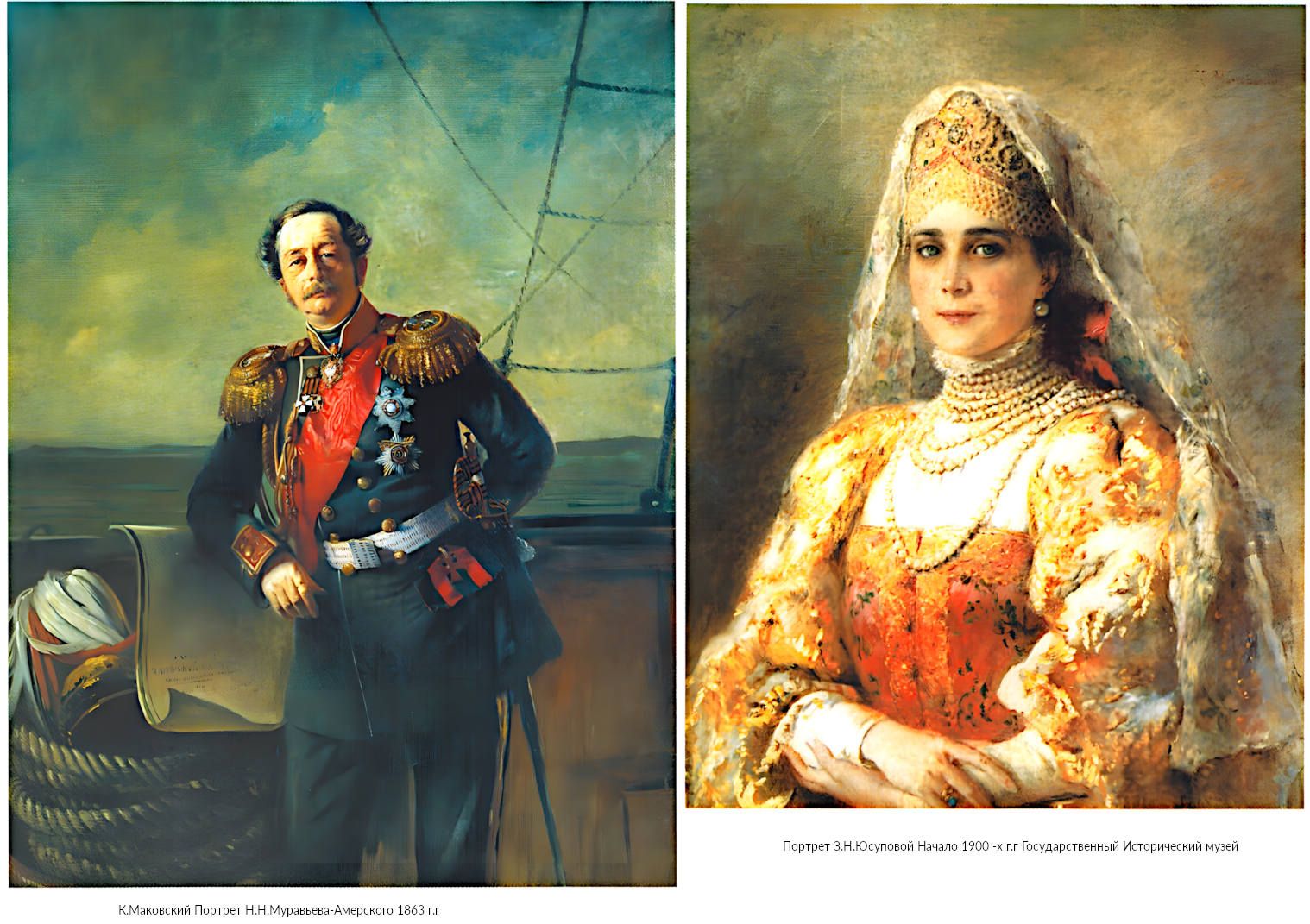
However, even during his studies at the Academy of Arts, Makovsky created another significant work—the portrait of the Siberian Governor-General N.N. Muravyov-Amursky in 1862. This canvas was commissioned by the residents of Irkutsk, who sought to immortalize the image of a man who made an invaluable contribution to the development of their region. The portrait, created with public funds, became a kind of monument, which made such a strong impression that soon Emperor Alexander II himself posed for the young artist in the Winter Palace, acknowledging his talent.
His works were distinguished by a high fidelity of depiction, harmoniously combining an accurate capture of appearance with rich painterly skill.
In the portrait of Rokasovsky, a personal assessment and an objective characterization of the subject's appearance are masterfully combined. The concentrated gaze and expression of deep reflection, reflected in the furrows between the eyebrows, convey the image of a Russian general from that era when the ideals of noble honor still retained their high significance. This portrait not only captures the individual but also recreates the historical context characteristic of the era, as well as reflects national traits and a cultural type.
The attention to Konstantin Makovsky's work from notable figures in the arts, such as V. Stasov, played a decisive role in the fate of the young artist. Stasov, analyzing the achievements of the Russian school of painting in the field of portraiture, emphasized that "the first to appear on the scene was K. Makovsky." On his recommendation, P. Tretyakov approached Makovsky with a proposal to create a portrait of the composer A.S. Dargomyzhsky in 1869, and then of the opera singer O.A. Petrov in 1870, which was later repeated in 1871.
These portraits played an important role in Makovsky's career and became the foundation for creating the "gallery of the best faces of the nation," initiated by P. Tretyakov. However, the fate of the portrait of Rokasovsky proved to be difficult. In 1918, anticipating possible difficulties, the owners wrote a warning on the back of the canvas stating that in case the portrait was lost, it must be returned to the owner or representatives of the Wrangel-von family. Unfortunately, no one could predict what difficulties awaited this work of art in the future. It can be said that the portrait of Rokasovsky survived by a miracle.
Regarding other works, it is worth mentioning that simultaneously with the portrait of Rokasovsky, a work titled "Portrait of Two Boys in Sailor Suits," also created by Makovsky's brush, was transferred to the Grozny Museum. While the fate of the first portrait turned out relatively favorably, the whereabouts of the second remain unknown to this day.
Makovsky's art has its own distinctive features that set it apart from other masters. Each of his portraits is not merely a depiction of a person but also a profound exploration of the model's inner world, an investigation of human nature and emotional richness. The artist sought to convey not only external features but also character, creating portraits that breathe life and are true works of art.
As a result, over the years of his creative activity, Konstantin Makovsky became not only a popular portraitist of his time but also secured a place in the history of Russian art. His works, fused with the cultural realities of his era, continue to interest and inspire the modern generation of viewers and researchers. Makovsky's extensive legacy, although fragmented, still leaves a noticeable mark on the country's cultural memory, serving as a bridge between the past and the present, reminding us of the significance of each individual's personality in history.
The degree of fame among Makovsky's portraits varies significantly. About the first portrait, created in the early stage of his career, many documentary records have been preserved, and it has become a well-known part of Russian art history. The second portrait, however, although from a later period, is of no less interest. It has been possible to establish the names of the depicted children: they are Felix and Nikolai Sumarokov-Elston, who later became the Yusupovs—representatives of a famous aristocratic dynasty, long since a symbolic element of Russian history and culture. The portrait is executed in oil on wood and measures 59 by 75 centimeters. It is signed, but there is no data on the date of its creation. One can attempt to determine the approximate date of the work's creation based on the age of the depicted boys. Nikolai was born in 1883, and Felix in 1887.
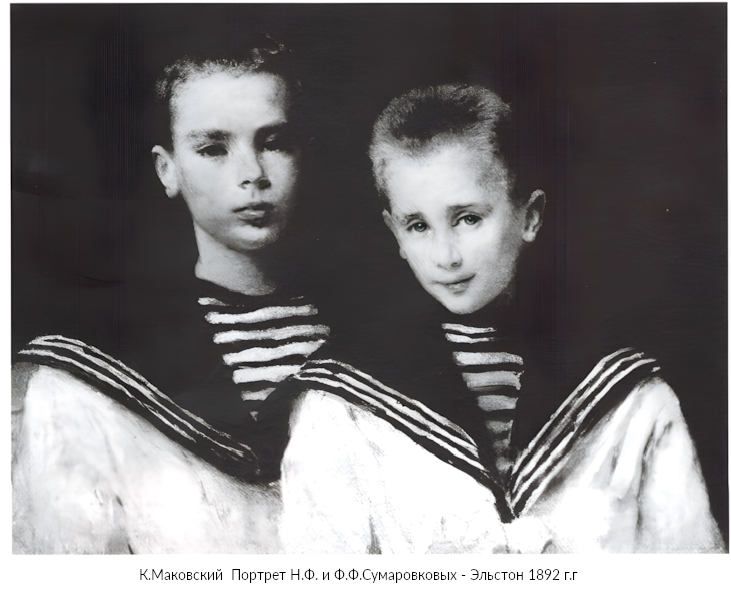
Judging by their age in the portrait: the elder is no more than nine years old, the younger is about five, the presumed timeframe for the creation of this portrait is 1891-1892. Makovsky likely worked on this portrait concurrently with the depiction of their mother—Princess Z.N. Yusupova, presented in a traditional Russian costume, which was characteristic of patriotic trends among the Russian elite. The portrait of the princess is held in the collection of the Historical Museum and, like the portrait of her sons, contains no data on the time of its execution.
It should be noted that the creation of portraits of several members of the same family indicates the high esteem in which the artist was held by a family that possessed one of the richest collections of Russian and Western European art. Unlike well-known children's portraits conceived with an emphasis on interior details and various decorative accessories, the portrait of Nikolai and Felix Sumarokov-Elston stands out for its emotional depth. It belongs to a more subtle line in Makovsky's portraiture, where his works approach significant examples of the psychological portrait that took shape in the second half of the 19th century.
In creating these portraits, the artist sought to reflect the individuality of each of his subjects, exploring not only their appearance but also their inner world. His approach to portraiture in this case demonstrates Makovsky's ability to combine artistic technique with emotion, making the viewer feel warmth and genuine interest in the captured personalities. This creates not just an image, but a complete story in which every stroke and color plays an important role. Portraits of children, painted with such meticulous kindness and attention, present the viewer not only with an aesthetic task but also with the opportunity to look beyond the external framework, exploring the complexities and the absolute void of human experience.
Makovsky's work remains relevant and important for understanding portrait painting as it developed in Russia. With each new discovery of his works, admiration only grows. The images created by the artist continue to live in the memory of the public and art historians, deepening our understanding of the cultural context of that time and the significance of personal stories told through art. The uniqueness of his style, his ability to convey the spirit of his time and the feelings of the people embodied in the images, make him a significant figure in Russian art, and his works become a link between the past and the present.
Apparently, the artist managed to become more deeply acquainted with the young models, paying attention to their characters and mannerisms. In each depicted child, he highlights individual traits, emphasizing the main, vivid quality of their nature. The older brother demonstrates self-confidence, while the younger one possesses a childishly charming shyness and gentleness. Contemporaries' accounts confirm that, upon growing up, Nikolai became domineering and arrogant, while Felix inherited from his mother not only her external features but also many characteristic traits, as well as her talents. The complex psychological portraits of children created by Makovsky remarkably echo what Valentin Serov would reflect in his works much later.
The fate of this portrait is inextricably linked to the previous work. From the famous Yusupov Gallery, which was disbanded in 1925, it ended up in the Hermitage, where many nationalized valuables were transferred, and then, in the same year, moved to the Russian Museum. In 1939, the painting was transferred to the Grozny Local History Museum, and then, in 1961, to the Chechen-Ingush Republican Museum of Fine Arts named after P.Z. Zakharov. However, subsequent events related to the war left this portrait in the shadows, and its fate remains unclear to this day.
Currently, the Ministry of Culture of the Russian Federation is making efforts to restore the lost collection of the museum in Grozny. One of the main achievements in this work was the exhibition catalog and collection of materials titled "Let's Return the Museum to Grozny" (Moscow, 2002). This publication became the first dedicated to the Grozny Museum, which until that moment had no published catalog of its collection. Moreover, not all works ever stored in its funds were documented.
This makes the collection of amateur photographs, sent by the museum's director, Raisa Saltmuradovna Akhmatova, in the mid-1980s, all the more valuable and unique. These photographs played an important role in my research project dedicated to the works of Konstantin Makovsky. They allow a glimpse into history, preserving a small part of the lost heritage.
Makovsky's works, possessing not only artistic value but also historical significance, represent a unique cultural layer. Each of his works reveals the character and spirit of the time in which it was created, allowing the viewer to immerse themselves in the atmosphere of that era. The collection and catalog brought from Grozny carry not only an artistic but also a social burden, offering new, thoughtful perspectives on works of art that were once destined to become the foundation of cultural heritage.
Drawing a comparison between the fates of the portraits, one can note how even art faces the challenges of time and changes in the socio-political situation. Works that were once in the spotlight can be forgotten or lost, and Sebastian Makovsky, despite his fame, became a victim of such changes. However, it is precisely in difficult times that such works of art should be restored and preserved so that future generations can appreciate their significance and experience their multi-layered nature. Each portrait is not just an image of a face, but a multifaceted story about people, their lives, hopes, and dreams.
Despite being forgotten, Makovsky's legacy is experiencing a revival. The artist, with his unique traits and depth, continues to celebrate various human destinies, linking them to the history and culture of his country. His works leave an unforgettable mark on the history of art and serve as a reminder of the eternal value of human experience, which, through the prism of painting, finds its expression, viability, and continued existence through the ages.
According to the assessment of his son Sergei, Konstantin Makovsky's portrait legacy represents a unique gallery of contemporaries. This collection covers almost all of Russia during the era of the last tsars, including representatives of the arts, officials, businessmen, writers, scientists, and aristocrats. Sergei dreamed of being able to gather all these portraits together, creating a living chronicle of his era that illustrates the diversity of human destinies and social strata.
The worldview and characteristic uniqueness of that time are well reflected not only in Makovsky's artistic style but also in his approach to creating portraits. This master's painting became a kind of window into 19th-century society, opening up to the viewer a rich palette of human relationships and the country's social dynamics. All his works, from majestic portraits of aristocrats to more modest depictions of ordinary people, are created with special attention to detail, shedding light on the inner world of their subjects.
Makovsky's works remain an important part of the cathedrals of Russian artistic heritage. It should be noted that many of his portraits were created during turbulent and changing eras. The political shifts, social changes, and cultural transformations occurring in Russia were reflected in his works. Each portrait, executed by the professor of painting, becomes not only an image of a person but also a symbol of the time in which it was created. This is especially important in the context of historical memory, where every detail, every fold of clothing, every facial expression acquires meaning that immerses us in the context of that inextricably linked era.
Today, Makovsky's legacy is consulted not only by art historians but also by historians, sociologists, and representatives of other humanities disciplines. His works are seen as having not only aesthetic but also educational value, contributing to an understanding of the characteristics and psychological aspects of 19th-century Russian society. Observing how the artist reproduced the images of life in his time helps to better understand what drives people in their daily lives, how they saw themselves and each other.
It is worth separately mentioning the accompanying cultural context in which Makovsky functioned. The artist's work coincided with a time when new movements and directions were emerging, positioning themselves against traditional art forms. Yet despite this, Makovsky remained true to his core principles, creating rich, expressive images that served as reflections of both personal and collective societal experiences. And although his legacy has been tested by time, it continues to spark interest and admiration among both viewers and researchers.
By the first decade of the 21st century, a significant shift occurred in the perception of Makovsky's works.
New exhibitions, publications, and research began to revive interest in his figure, breaking down stereotypes about forgotten artists. Collectors began rediscovering his work, while museum staff diligently worked on restoring the collections housing his paintings. This indicates that interest in Makovsky, though it had periods of lull, was never completely extinguished.
It is no surprise that many researchers began re-evaluating his artistic legacy in a new light, analyzing not only his style but also the influence he exerted on the development of Russian painting. Furthermore, attention to the identities of the people depicted in his portraits was directed towards the significance of individual stories within the context of a broad social panorama. They become not merely images, but living witnesses to the country's ecological and cultural evolution.
The works of Konstantin Makovsky indulge the viewer, creating an opportunity for deep reflection on human nature, the inner world, and the substance of historical memory. His exhibitions and events created around his work emphasize not only artistic achievements but also the importance of personal history within the context of larger cultural and social processes. Each piece he created breathes with life and, transcending time, continues to communicate with the contemporary viewer, evoking a multitude of questions and emotions.
Such a multi-layered structure of his legacy reflects the complexities of the time and the scale of the personality, which cannot be overestimated. Makovsky's art continues to inspire new artists striving to better understand how to realize their ideas and explore human nature through the lens of portraiture. His artistic legacy has become a symbol not only of the era in which he lived but also of the eternal value of painting as a means to peer into people's souls and emphasize their uniqueness.