Secret symbols on Elizabeth's coins
1.3КDec. 17, 2024Монеты
The medalist who gained worldwide fame spent only a few months in Russia. Nevertheless, this time proved sufficient for his works to take an honorable place among the outstanding works of medal art of the 18th century.
During this time, he gained popularity thanks to his series of medals depicting famous personalities and was able to establish himself as a talented master with many other remarkable works.
The reasons why J.A. Dassier decided to come to Russia sometimes do not quite fit into the usual ideas about the motivation of foreign masters seeking sovereign service. The financial aspect of the matter played a significant role. It is known that foreign specialists received a salary significantly exceeding the salaries paid to their Russian colleagues in similar positions. The contract with another foreign medalist, W. Scott, concluded in 1747, stated that he would receive from the Mint Chancery "... 500 rubles in salary per year... and 100 rubles for an apartment."
Whereas a Russian specialist in die-making was entitled to only 70 rubles. J.A. Dassier, however, was to receive 2500 rubles a year, which was a significant sum for those times. However, it is unlikely that financial aspects alone played the leading role in his decision—he already had sufficient wealth. His family, including his father, the famous Jean Dassier, owned a workshop in Geneva, well-equipped for executing large and responsible orders, including those from the royal courts of France and England. Consequently, material circumstances might not have concerned such an outstanding master.
The reasons for J.A. Dassier's arrival in Russia probably remain hidden from us. One can only assume that he was lured by the romance of a distant country, both attractive and mysterious to a European. In his Russian works, especially on the coins of Elizaveta Petrovna, one can indeed detect notes of romanticism.
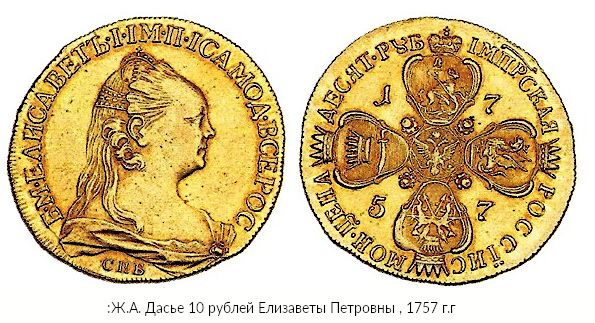
On the obverse of one of Dassier's coins, he depicted an elegant woman with expressive facial features, which gives the portrait a special appeal. The face, devoid of order attributes and extravagant details, is permeated with grace and harmony. The light dress, reminiscent of Roman clothing, and the coquettish crown, not corresponding to the imperial image, created an elegant compositional solution.
Alas, this portrait failed to find its destiny. The reason for this is attributed to the ears, realistically depicted by Dassier on the faces. There is a legend that Elizabeth was self-conscious about what she considered her large ears, so artists working on her portraits tried to conceal them as much as possible. Dassier, however, decided to portray the empress truthfully, which caused dissatisfaction among the higher circles. Despite the possible displeasure of the august personage, Dassier created a remarkable example of a miniature, whose artistic qualities were far ahead of its time.
The portrait in question was minted on a gold coin with a denomination of 10 rubles and on silver rubles. In his work "Corpus of Russian Coins," Grand Duke George Mikhailovich mentions two variants of ruble dies created by Dassier.
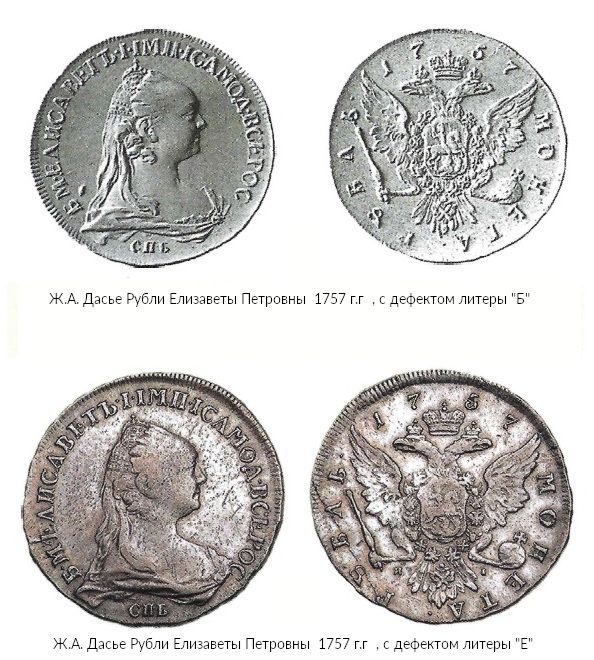
In subsequent years, previously unknown varieties of dies were discovered. R. Zander mentions four variants of rubles whose portrait side belongs to the brush of this remarkable master. V.V. Bitkin also reports the existence of four dies executed by Dassier. Interestingly, both authors illustrate their works, but the images of the same ruble presented by them differ noticeably.
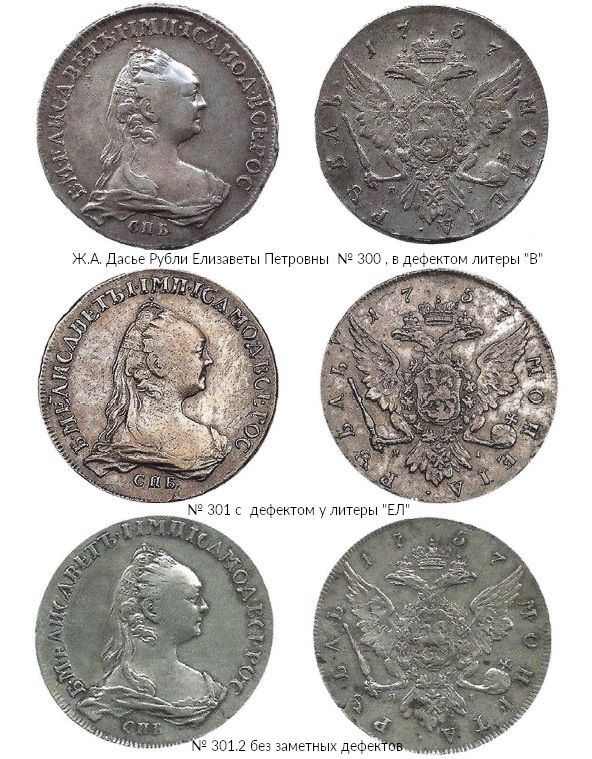
Currently, it can be said that at least five variants of the portrait side of the ruble created by the master exist. The coin impressions of the obverse differ not only in the placement of the legend relative to the portrait fragment but also in the details of the image itself.
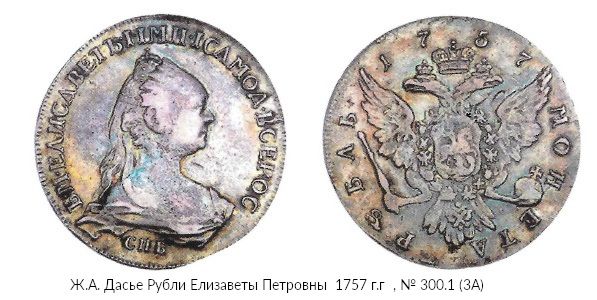
Lovers of the exotic and followers of R. Zander, inclined to see secret signs in defects on the working surface of dies, can supplement their observations with a constant defect on the obverse of ruble No. 300.1. This unique element attracts the attention of collectors and researchers, sparking discussions about hidden meanings or errors made during the minting process.
Each new discovery of a separate die specimen or a variant of a ruble executed by Dassier implies not only a deepening of knowledge about his work but also an opportunity to reinterpret the historical contexts in which these coins were created and used. With each new specimen under study, there is a chance to shed light on hidden aspects of the life and times of this outstanding master.
Attempts to interpret the mentioned defects on the dies made by Dassier as secret marks most often have a romantic tinge rather than an objective research approach. Nevertheless, the question of why this famous medallist might have marked his works in such a way should perhaps be viewed from a different angle. According to his contract, Dassier not only had the status of an engraver but also had an apprentice—Andreas Cavellar. This raises a number of questions.
Why would a foreign assistant, possessing good skills, be considered a valuable resource for the Russian service? Was the master really supposed to train someone, who might eventually leave the country, solely at his own expense?
The answer to these questions lies in the very context of the contract: Cavellar was more of an assistant than an apprentice in the traditional sense. He was necessary for Dassier to alleviate the difficulties in establishing the coinage operation. The master himself created the tools for making dies and simultaneously supervised the processes of copying and precise finishing them, while his assistant helped with secondary aspects, leaving the unique design elements to himself.
To achieve this goal, Dassier likely used a specific technique to mark his work with a special sign or symbol. Such a practice is known among outstanding artists: to determine the authorship of an original and a copy, when comparing creations, the original was emphasized in a special way. In the context of medallic art, this could be implemented through special marks on the dies. Possessing good technical skills, Dassier could, either by himself or through his assistant, leave a distinct mark on the dies, allowing for individual features in his creations.
The practice of involving foreign apprentices to work at the Russian mint has its roots. Hedlinger, for example, had previously successfully used a similar model, thereby achieving optimal conditions for his work. Dassier, understanding the importance of quality control and protecting his work, likely sought to have his works bear individual specific marks distinguishing them from those created by his assistant. Although Cavellar carried out his tasks according to Dassier's instructions, he might have left different marks during the engraving process, which in the future raised the question of the authenticity of some of the coins.
Furthermore, against the backdrop of pan-European trends in improving the quality of coinage, it is also worth noting that fulfilling the assigned tasks was far from a simple process. Cavellar, working under Dassier's guidance, had the opportunity to observe and adopt experience, while the masterpieces themselves had to meet the high standards of craftsmanship accepted in Europe. Thus, the creation of a new die became not just a task, but an entire process in which every element played its role, and the marking emphasized the special connection between the master and his works.
Among the known varieties of portrait dies, one stands out as significantly different from the rest and was likely created by Dassier. This refers to the variety of die No. 301, noted in the "Corpus of Russian Coins" as "very rare."
Why does this particular specimen deserve special attention?
Firstly, its occurrence is extremely limited. Dassier developed the original portrait type, engraving it on a single die, after which the work was passed on to copyists. Secondly, the compositional organization of this coin's obverse demonstrates meticulousness even in the smallest details. It is especially worth noting that the circular inscription does not encroach upon the portrait, indicating a high level of skill on the part of the engraver. It is unlikely that a world-renowned medalist would neglect such seemingly minor, yet important, aspects.
By 1757, Russian mints already had an established coining technology using a master die. This method was as follows: first, a craftsman would make a die with a raised (positive) image of the coin. At this crucial stage, the medalist himself most likely worked. After heat treatment, this die became the master die, which, when pressed into soft, unhardened steel, could produce impressions (negative), aiding in the creation of the other dies. These dies, once hardened, became suitable for coining, allowing for the production of coins without changes to the image, even despite material wear.
However, within this process, there was another key stage, which was probably carried out by assistants. After creating a die using the master die, it was refined with minor corrections and, most importantly, the legend and mint marks, as well as individual portrait elements such as the crown, were applied using punches. It was at this stage that die variations most often arose, as perfectly positioning the circular inscription or mint marks in correct proportion relative to the portrait part was a rather difficult task when working with punches. For this reason, the five known varieties of the ruble portrait die executed in Dassier's manner are most likely the result of the work of Andreas Kavelar.
These dies undoubtedly represent a certain boundary between the creation of artistic perfection and the production realities of the time. The facial expressions and the specific features of the legend inscriptions testify to the taste and exacting standards characteristic of Dassier as a master. Every element, from the very form of the coin to the minutest details of the portrait, deserves the close attention of researchers and collectors.
This production model, where exceptional importance is placed on every stage, confirms Dassier's uncompromising approach to his craft. Against the backdrop of a general pursuit of high standards of craftsmanship, works such as rubles executed according to Dassier's designs become important documents of their time, as well as a reflection of the cultural and artistic demands of that period. Every detail proves significant, and based on these dies, one can trace the evolution of medal art in Russia. They allow us to piece together the history of numerous ideas, cultural interactions, and transformations that may have occurred in the life of the master and in the society for which he worked.
A hypothetical reconstruction of events allows us to imagine that in his interaction with the Empress, Dassier, as an experienced master, focused his attention on studying portraits, perhaps even held personal meetings with her. The emotional connection and understanding of the inner world of the famous personality played a key role in the creation of his work. Inspired by his communication with Elizabeth, Dassier infused the portrait with a profound artistic concept, based on the high demands and tastes of his patron. However, the results of his work, despite obvious professionalism, turned out to be unsuccessful. The Empress's personal perception and subjective opinions overshadowed the objective artistic qualities, and she did not approve of the presented portrait. Sensing dissatisfaction, Dassier, according to the terms of the contract, which obligated him to spend two years in Russia, began to strive for a quicker end to his stay in that country and intended to return to his homeland.
Dassier's work on the ruble is notable because he engraved the reverse himself. Each version of the reverse side of the ruble differs in minor details, which testifies to his creative approach. The reverse of ruble No. 301, noted by Grand Duke George Mikhailovich as a "very rare coin," lacks mintmaster marks, emphasizing its uniqueness. Meanwhile, the reverses of specimens No. 300 and No. 300.1 are no different from each other.
Interestingly, at one auction, a ruble appeared with a previously unpublished reverse side but with a well-known obverse.
The innovation on the reverse is clearly noticeable and allows one to establish a difference if attention is paid to details, such as the position of the cross on the orb relative to the letter "H" in the word МОНЕТА. Taking into account the mentioned reverse variant, six different types of rubles created by the skill of J.A. Dassier have been identified, which should be considered when compiling a catalog of coins by this outstanding medalist.
The participation of assistant Andreas Cavellar in the medal-making process may indicate that more discoveries are expected in the future—unpublished lifetime variants of coins and medals created by the talented Dassier and preserved as copies by his devoted student.
The mysterious secret signs on ruble coins, associated with the work of Dassier, add an enigmatic aura to the majestic persona of the master. Before his departure from Russia, Dassier left behind another intriguing mystery, the solution of which is likely destined never to be solved. This secret is surrounded by conjectures and rumors, based on the individual peculiarities of his craftsmanship and style, which continue to attract the attention of collectors and historians. Every argument or new specimen merely adds to the mosaic of his life and talents, highlighting his influence on medallic art and enriching the rich legacy left after his short but brilliant sojourn in Russia. Each discovery of new variants or interpretations of his works creates momentum for further study of their qualities, historical context, and artistic decisions, so that the eternal mystery accompanying the name of J.A. Dassier continues to inspire a new generation of researchers. And although his significance as a master at the turn of eras remains undeniable, certain elements of his work are still shrouded in mystery, awaiting their moment of revelation.
On January 22, 1758, a "Report from the Mint Chancery... — On the submission by the Mint Chancery of a ruble coin, struck with a die newly engraved by the medallist Dassier" was sent to the Empress's Cabinet. An important point in this document is the information about Dassier creating a new ruble die, replacing the rejected version. According to this report, the medallist was instructed to engrave "new dies for the portrait of Her Imperial Majesty and in the attire and dress," while he was to base it on the 1755 ruble. It is necessary to note that in 1754 and 1755, ruble coins created by the medallist B. Scott were minted as state currency.
Such a complex task placed Dassier in a difficult position—the renowned master had to use a rather mediocre-quality portrait to satisfy Elizabeth's ambitions.
Obliged by the terms of his contract, Dassier proceeded to create another version of the ruble coin. On the new impression, the empress would appear in all the splendor of her regalia. The document indicates that a trial specimen of the coin was produced, which was then sent to the Mint Chancery for evaluation. However, further traces of this specimen are lost. Only a recorded fact remains: "the die has been newly engraved, and the printed product for submission to Her Imperial Majesty for approval, a ruble coin, is hereby attached by the Mint Chancery to this [report] for the said Cabinet."
Thus, within the framework of available publications, another mysterious page is added to the secret signs attributed to Dassier, related to the ruble coin that was submitted for approval to the highest authorities.
Where did the coin created by the famous medallist and presented for evaluation to the Russian empress disappear?
Is there not too much left unsaid in the mysterious odyssey of Dassier across the expanses of Russia?
At this stage of analyzing Dassier's work in Russia, it is worth temporarily setting aside the assumption that the master, upon leaving the country, took all his secrets and developments with him. Each of his works left a trace that continues to pique the interest of researchers and collectors striving to shed light on his brief but brilliant sojourn in Russia. This story is filled with countless questions and perplexities, intriguing details, and unique works that still require attention and study.
In search of answers to questions about the fate of Dassier's new dies and plans, historians and numismatists delve into archival materials, striving to reconstruct the picture of that time. Each newly discovered document or coin enriches the understanding of his craftsmanship, adding even more color to the portrait of this outstanding medallist. The pursuit of truth and an understanding of the historical context creates a necessary foundation for new research and discoveries. The memory of Dassier remains alive, and his secrets, poignant and multifaceted, continue to captivate the attention of future generations.