Outstanding specimens of gold coins — multiples
1.3КJan. 10, 2025Монеты
In ancient times, there was a wide assortment of gold coins that gained popularity and respect: Persian darics, Greek staters, and Roman aurei and solidi. These coins existed within systems largely based on silver and were distinguished by the stability of their weight standards, which were maintained over many eras.
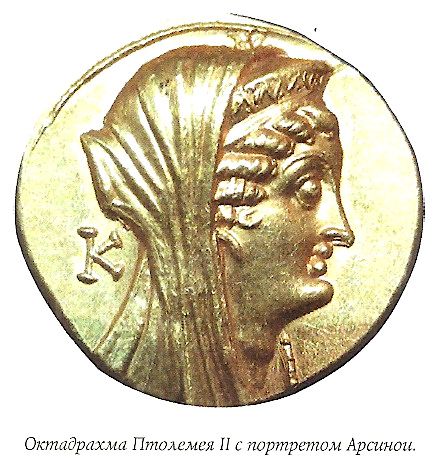
Also belonging to this period are the "presentation" octadrachms (approximately 34 grams) of the Seleucid monarch Antiochus III, made from gold material he extracted from the temple of Ena in Ecbatana in 203 BC. The obverse of these coins features a profile portrait of Antiochus in a diadem, while the reverse depicts Apollo, portrayed nude on an omphalos.
The most famous among ancient medallions are the Roman multiples from the time of the solidus, which were introduced by Emperor Constantine the Great (306–337 AD) around 310 AD. The standard solidus was minted at a rate of 72 coins from a pound of gold (327 grams), resulting in each coin weighing approximately 4.54–4.55 grams. Similar to Hellenistic ones, Roman multiples were not used in regular monetary practice but served as legal tender in the market, perfectly fulfilling their role.
The range of denominations for Roman multiples is impressive—it varied from 1.5 to 72 solidi. The gradations of these multiples were measured in half-solidus increments or 12 siliquae according to the Roman system of values. Each solidus equaled 24 siliquae, which allowed for easy conversion: 1 1/2 solidi corresponded to 36 siliquae (6.82 g), 2 solidi to 48 (9.1 g), and so on. The largest number of multiples that have survived to this day date back to the 4th century. By the 6th century, their production had significantly decreased, yet it was during this century that the heaviest coins, reaching the weight of an entire pound, were minted. These specimens were created in Constantinople during the reign of Emperor Tiberius Constantine (578–582), but unfortunately, none of them have been preserved. However, precise descriptions of several coins that Tiberius sent as a gift to the Frankish king Chilperic remain. In Gregory of Tours' "History of the Franks," one of the coins is described: on one side is the emperor with the inscription "Tiberius Constantine Perpetual Augustus," and on the other, a quadriga with a charioteer (likely the emperor himself in consular attire) and the inscription "glory of the Romans." It is important to note that such iconography of the ruler was standard for depictions where he is performing the ritual duties of a consul; a similar example can be found on the multiples of Tiberius's son-in-law and successor, Maurice, although their denomination was significantly smaller.
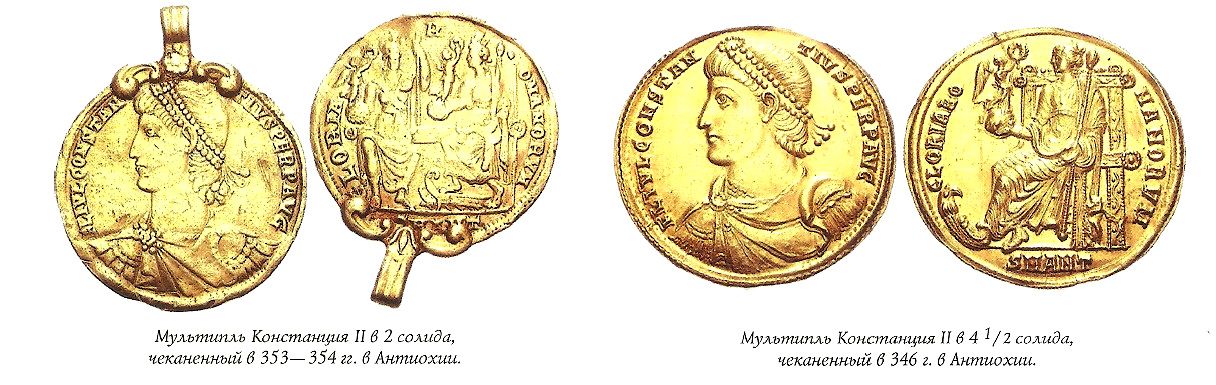
Among the known extant coin specimens that are close to those of Tiberius, several giant issues stand out, each only slightly inferior to them. These include a 40-solidi multiple of Valens (365–378), weighing 178.9 g, and multiples of Constantius II (337–361) with denominations of 56 and 48 solidi, which were later converted into jewelry (now housed in the Vienna Museum). Their weight without the setting is unfortunately unknown, but the greatest interest undoubtedly lies with the 36-solidi coin of Justinian I, which we will discuss in more detail below.
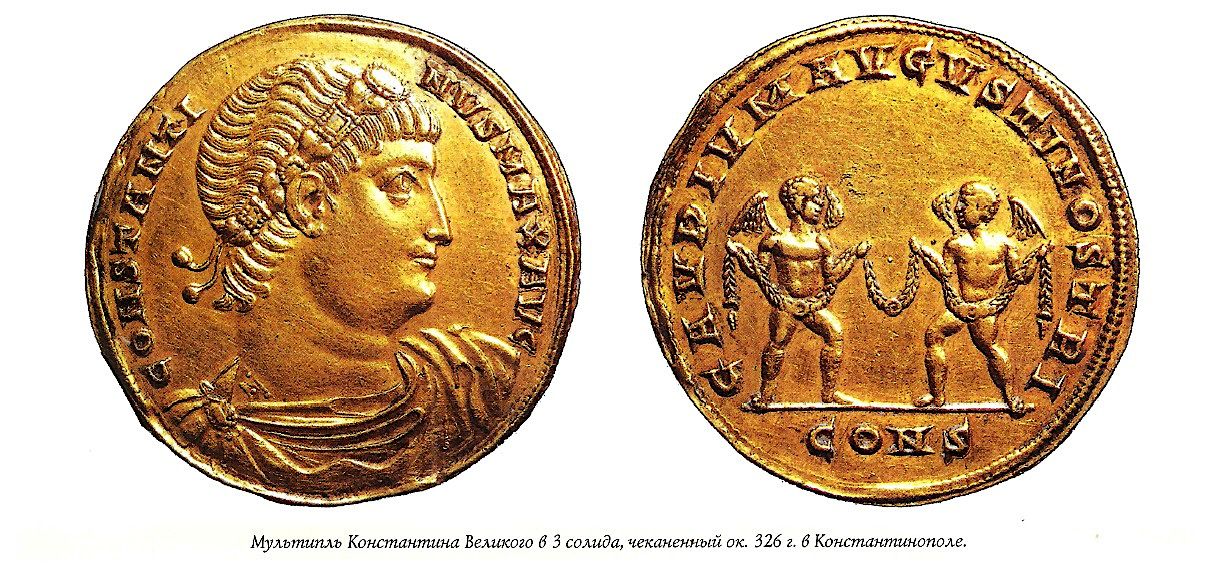
The multiples of the 4th century are distinguished not only by their technical perfection but also by the richness of their iconographic themes. One of the earliest known specimens, issued by Constantine the Great, was minted around 326 AD in the newly founded Constantinople and is now held in the Cabinet des Médailles of the Bibliothèque nationale de France in Paris. This multiple weighs 13.32 g and is equivalent to 3 solidi. Interestingly, it was discovered in 1780 during the repair of a wall at the Château d'Étoupeville, located near Cherbourg, alongside several coins of 3 and 9 solidi denominations. The obverse of this multiple features a profile bust of Constantine, adorned with a diadem and a military cloak; the reverse depicts two naked, winged genii holding a floral garland. The legend GAVDIVM AVGVSTI NOSTRI ("The Joy of our Augustus") indicates that the issue of this coin was timed for the official celebrations marking the twentieth anniversary of the emperor's reign, who was proclaimed Augustus in 306.
Also, in Nicomedia in 324 AD, a 2-solidus multiple was minted, dedicated to the 3rd consulship of Constantine's eldest son, Crispus, as well as to the elevation of the future Caesar Constantius II. The obverse of this coin depicts Constantine himself wearing a radiant "solar" crown, with his right hand extended forward in the gesture of the imperial address, adlocutio. The reverse shows both young Caesars, Crispus and Constantius, facing each other. Crispus, as consul, is clad in a toga and holds a scepter and an orb, emphasizing his high status.
Under Constantine's successor, Constantius II (337–361), the tradition of issuing multiples continued with an improved minting order. During this time, new denominations were established: 1½, 2, 4½, and 9 solidi, each with unique iconography that persisted until the end of the 6th century. The largest coins depicted the emperor himself in a chariot, while the 4½ solidi featured a personification of Constantinople. The 2 solidi presented the personifications of both Rome and Constantinople, and the 1½ solidi depicted a standing emperor.
Particular attention is deserved by the multiples minted by Constantius II in Antioch. Notably, a 4½ solidus multiple is recorded, which may have been issued to commemorate the 1100th anniversary of the founding of Rome and is now held in the Paris Cabinet des Médailles. The reverse of this coin features a magnificent depiction of the enthroned Tyche of Constantinople, representing the personification of the empire's new capital in the form of a female figure, iconographically echoing the ancient goddess Rhea-Cybele. Such symbolism was extremely common on the reverses of coins from the 4th–5th centuries, and often both capitals—the old and the new—were depicted side by side. The Tyche of Constantinople is easily recognizable by her right foot placed on the prow of a galley, symbolizing her supremacy at sea.
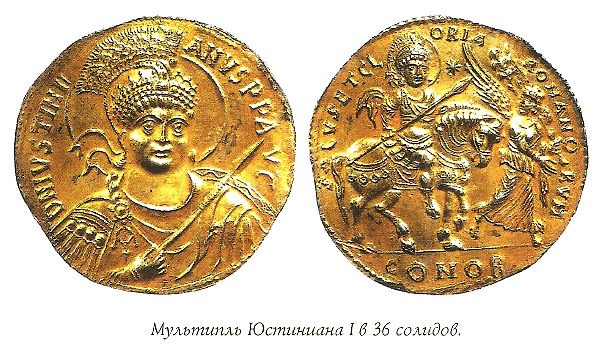
The 36-solidus coin, known as the "lost medallion" of Justinian I, is rightfully considered one of the most famous specimens of gold numismatics. This coin was found in 1751 to the south of ancient Caesarea in Cappadocia, in what is today Turkey. After a fierce bidding war with English antiquarians, the coin was purchased on behalf of the King of France by the French ambassador in Constantinople, Count Desalleurs, and became part of the collection of the Cabinet of Louis XV. In 1759, the keeper of this Cabinet, Claude Gros de Boze, first published information about the coin. Struck in Constantinople, the medallion weighed 160.6 g and measured an impressive 86 mm in diameter. The obverse featured a bust portrait of Justinian, executed in a style uncharacteristic of his coins: the emperor was depicted in a three-quarter view, surrounded by a nimbus, wearing a helmet with a plume and a cuirass, with a spear pointing towards his chest. The coin's legend followed the traditional style: "D[ominus] N[oster] IVSTINIANVS P[er]P[etuus] AVC(ustus)" — "Our Lord Justinian, Perpetual Augustus." On the reverse side of the coin, he was shown full-length, also with a nimbus, in armor and on horseback, preceded by a winged personification of Victory holding a laurel branch. The legend on the reverse read: "SALVS ET GLORIA ROMANORVM" — "The Welfare and Glory of the Romans," and the exergue bore the monogram CON[stantinopolis] OB[ryzum] — "pure gold of Constantinople." This iconography echoed the theme of Adventus, reflecting the triumphal imperial entry, which was widespread on coins of the 3rd century. The issuance of this multiple likely occurred in 534 to commemorate the large-scale victory of Justinian's general, Belisarius, who recaptured Carthage from the Vandals, an event celebrated in the capital with unprecedented grandeur.
Justinian's coin, like many works of art from that era, fell victim to time. After the French Revolution, this outstanding gold find was housed in the Cabinet des Médailles of the Bibliothèque Nationale in Paris. But on the night of November 5-6, 1831, it met with misfortune: a thief needed only a moment to carry it off along with 4000 other gold coins, medals, and valuable artifacts. Among the poignant memories of what was lost were six multiples of Constantine the Great with denominations of 3 and 9 solidi, also part of the Étupes hoard. Fortunately, some of the stolen items were returned immediately, but the sad fate of Justinian's medallion printed its mournful page in the history of numismatics. The brother of one of the thieves, a working jeweler, managed to melt down not only this unique medallion but also a good hundred rare Roman multiples, amounting to about 2000 lost artifacts. Today, the lost monument is brought back to life thanks to copies made by electrotyping, which were produced for the museums of London and Paris in the 19th century.
In addition to the more famous medallion, the multiples minted under Justinian include other outstanding issues. For example, one of the smaller denominations, the 4½ solidus, which is preserved in the Louvre collection. On the reverse, one can see images of the emperor standing in a nimbus, with one hand making a welcoming gesture, and in the other, a globe with Victoria, the symbol of victory, and a labarum standard. This coin serves as confirmation that even in smaller denominations, numismatics continued to preserve the solemnity and grandeur characteristic of Byzantine coins.
Following the loss of Justinian's medallion, late Roman-Byzantine coins of this kind have been preserved in the Cabinet des Médailles in Paris. One of the last was a 1½ solidus coin, issued in 518 by Justin I. These coins often bore images of the imperial procession (Adventus). The obverse of the coin depicts a mounted emperor with a nimbus, and his outstretched hand demonstrates a welcoming gesture. The legend on the reverse reads: "ADVENTVS ROM[ae] AVG[usti]" ("The Emperor's Entry into Rome"). And although Justin never visited Rome, his imperial portraits were sent to the Eternal City and received with the same honors as the emperor himself. Coins of Justin, minted in Constantinople, were often attached to the portraits for ceremonial distributions to the senatorial body of Rome.
By the end of the 6th century, the emissions of multiples had noticeably decreased. The last major wave of their issue occurred during the reign of Emperor Maurice Tiberius (582–602). Four specimens of 6-solidus coins, discovered in the Kyrenia hoard in Cyprus, were created using one pair of dies and are now in the collection of the Metropolitan Museum in New York. The obverse of these coins depicts a bust of the emperor, clad in a diadem and consular toga, with a scepter and a mappa ending in an eagle. The reverse again presents the triumphal procession of Maurice in a consular chariot, where he is surrounded by a nimbus and the image of Victoria, the personification of Victory. Numismatists attribute the issue of these coins to the two years of Maurice's consulship—583 or 602—confirming the high quality of minting and the preservation of traditions in the process of their creation.
The State Hermitage Museum holds a unique "two-and-a-half-solidus" coin of Heraclius (610–641). This coin appears to be the latest known specimen of medallions, and it is surprising that it is not even mentioned in old editions of Western catalogs, which concluded the chronicle of multiples with the issues of Maurice. The obverse of this rarity depicts bust portraits of Heraclius himself and his eldest son Heraclius Constantine, accompanied by the legend: DD. NN. hERACLIVS ЕТ hERA. CONST. РР. AV. The reverse side is adorned with a Golgotha cross, set on three steps, and below is placed a legend characteristic of the iconography of ordinary solidi of that time.
Gold Roman-Byzantine multiples have left a vivid mark on the history of numismatics, serving as an illustration of the public life of the empire's rulers and the rich ritualistic celebratory events over three centuries. These coins did not merely perform a silver and monetary function; they were an important symbolic element, weaving threads between power, religion, and society, reflecting the cultural and economic changes of their time. Studying these issues helps not only to understand the monetary systems of the past but also important aspects of the social and political life of that era.
Each specimen carried its own history, capturing the spirit of an entire epoch. The images of emperors, gods, and mythological creatures presented on the coins speak of the blessing of rulers and their aspiration for eternal glory. These multiples became part of rituals, ceremonies, and festivals, symbolizing not only material wealth but also cultural and ideological values, the people's striving for unity under the banner of their monarch.