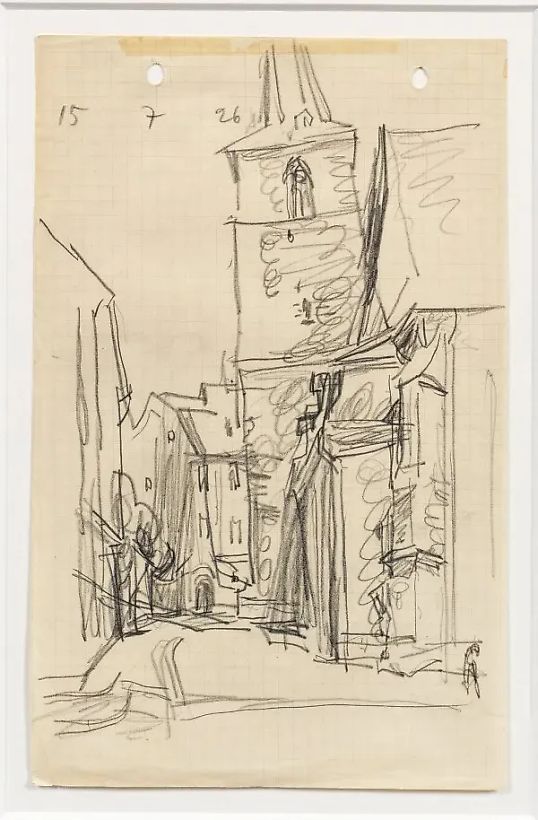
Feininger: Village Church and Bell Tower
Description
(1871, New York – 1956, same place) Village view with a church in July 1926, most likely in the vicinity of Weimar, a study by Feininger, in whose work churches and bell towers play an important role both in his paintings and drawings, as well as in his watercolors and graphics. Especially the shape of the tall, pointed, spire-like bell towers, for example, inspired by Gelmeroda, led him to create crystalline compositions. In 1919, Feininger was immediately appointed the first master of the Bauhaus by Walter Gropius after the founding of the State Bauhaus in Weimar, where he lived until 1926 and also headed the printmaking workshops until 1925. On July 30, 1926, Feininger and his family moved into one of the newly built master houses in Dessau, although he officially remained a "master" at the Bauhaus until 1932, he was relieved of all teaching duties. After the forced closure of the Dessau Bauhaus in 1932, Feininger moved to Berlin, and in 1937 finally returned to the USA. During National Socialism, Feininger's works were officially considered "degenerate art," and 378 works by the artist were confiscated from public collections. Pencil on graph paper with double perforation. Inscription at the top "15(.)7(.)19)26". Dimensions: 22.5 cm x 14.5 cm. Framed. Provenance: From the collection of Laurence Feininger (1909–1976), the artist's son.
Similar lots
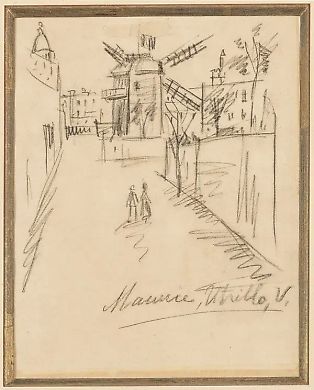
Lot No. 14605 Moulin de la Galette: A View of Montmartre
Maurice Utrillo
Lot No. 11090 Thoughts on Dostoevsky paper, ink
Irina Dubinina
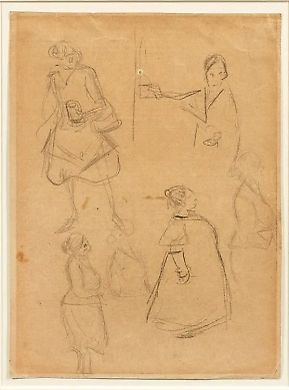
Lot No. 14639 "Radeburg - Berlin: studies of visual figures i…
Heinrich Zille
Lot No. 14169 "Dupré is the founder of modern French landscap…
Jules Dupré
Lot No. 14062 "Mary's Walk in the Temple: Original Engraving …
Albrecht Dürer
Lot No. 14755 Bürkel - master of watercolor, Munich
Heinrich Bürkel
Lot No. 14637 The Study of Woman: Art and Heritage
Heinrich Zille
Lot No. 14056 "Copper Engraving by Roberto van Audenarde: Art…
Carlo Maratta
Lot No. 14123 "Young, naked"
Gerhard Marcks
Lot No. 14116 Exquisite Sunbeam Salon
Werner Hartmann