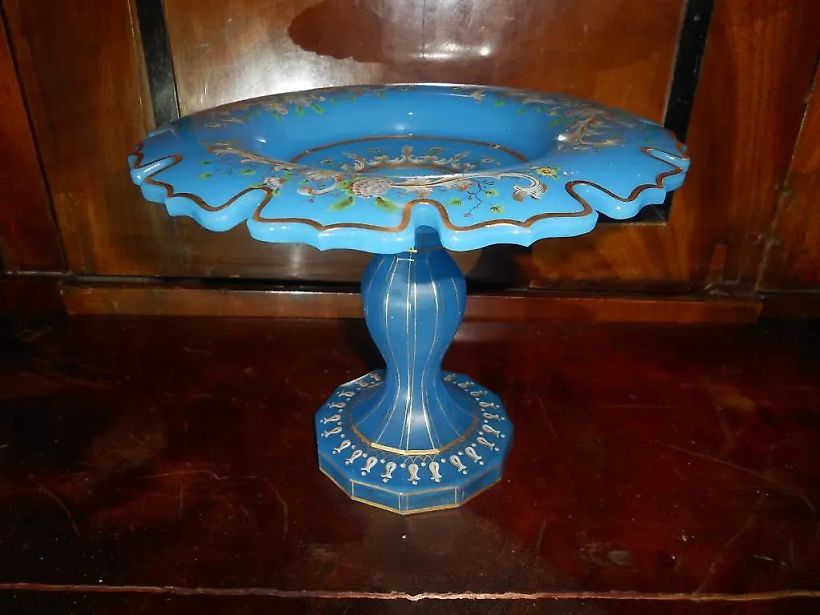
VINTAGE TWO-PART COMPOTIER VASE: FIELD FLOWERS blue opal glass painting BAKHMETIEV 1840s-1850s
Description
An antique two-part (composite) VASE-COMPOTIER: WILD FLOWERS, carved heavy dark blue opaque glass, hand-cut and polished, hand-painted with enamels and gold. BAKHMETYEV, Russia, 1840s-1850s (listed in the catalog). Dimensions: height - 17 cm, stem height - 14.5 cm, dish height - 3.5 cm, dish diameter - 22 cm, base diameter - 10.5 cm, glass thickness - 0.5 cm. Exquisite hand-painting. The letter "K" is stamped on the bottom of the base: possibly, the vase's painting was based on sketches by Fyodor Krasovsky (painter, "flower master" at the Imperial Glass Factory). Condition as shown in photos (micro-chip on the lower part of the base). Delivery of the lot to another region - via Russian Post (or courier service by arrangement). FOR REFERENCE: Fyodor Ivanovich Krasovsky (1820–1863) was the son of a serf master painter on porcelain at the Popov Porcelain Factory. The factory's output was very diverse, producing both expensive bespoke dinner services and simple tableware for the middle and lower classes. In addition to various tableware, they made sculptures, vases, and various porcelain household items. In 1835, Fyodor became an apprentice at the St. Petersburg Porcelain Factory of the Kornilov brothers, and in 1839, a painter at the Imperial Porcelain Factory. The factory administration noted the master: "his work was distinguished by a special artistic skill, remaining to this day outstanding among all other painters of this kind." In 1861, the Academy of Arts awarded F.I. Krasovsky the title of Free Artist of Painting of Flowers and Fruits (on porcelain) for his work "A Bouquet of Spring Flowers," painted on canvas in oils. Artists from the Imperial Porcelain Factory were sometimes invited to work at the Imperial Glass Factory. Fyodor Ivanovich was an enterprising man (shortly after starting work at the Imperial Porcelain Factory, he was already able to buy a house in St. Petersburg). It is not unlikely that, in an effort to earn more, he also made sketches for Bakhmetyev (Bakhmetyev, fulfilling court orders, had connections with the Imperial Glass Factory).
The Nikolsko-Bakhmetyevsky Crystal Factory (Nikolo-Bakhmetyevsky, or Bakhmetyevsky Crystal Factory) was founded in 1764 with the highest permission of Empress Catherine II by retired military officer Alexei Ivanovich Bakhmetyev on his own estate in the village of Nikolo-Pestrovka, Penza Governorate. From its founding until 1884, the factory was managed by three generations of the Bakhmetyevs, after whom the factory was named. The Bakhmetyevs were connected by kinship with the finest families of Russia: the Trubetskoys, Gorchakovs, Volkonskys, Obolenskys, and Tolstoys. The factory became the first private enterprise in its industry in Russia and one of the leading Russian crystal and glass producers. Starting in 1795, the factory fulfilled orders for the highest aristocratic nobility and the Church. Each such order was executed in a unique manner. Items, including those made of colored glass and crystal, were decorated with painting, enamel, paints, gold and silver, matte engraving, and diamond-cut facets. Ancient techniques were used, such as filigree (Venetian thread), imitations of chased gold and precious stones.
As early as 1789, N.A. Bakhmetyev, the son of the factory's founder, with the aim of mastering the experience of the world's best glass and crystal manufacturers, founded a Museum of Glass and Crystal. There, he began collecting the finest examples of his factory's production and the best works of European glass art, which were often used by the factory's craftsmen as models. In 1829, at the first All-Russian Exhibition of Manufactured Goods, the factory was awarded the Grand Gold Medal for its exhibited items. From 1836 to 1861, the family enterprise reached its peak prosperity. The highest award—the right to apply the State Coat of Arms to its products—was granted to the factory in 1836, and this award was subsequently reaffirmed at exhibitions in Moscow in 1839, 1861, and 1865, and in Nizhny Novgorod in 1896. In 1884, the factory passed by inheritance to a relative of the Bakhmetyevs, Prince Alexander Dmitrievich Obolensky. In 1900, at the Paris World's Fair, the products of the Nikolsko-Bakhmetyevsky Factory of Prince A.D. Obolensky were awarded the Grand Gold Medal, and the craftsmen received personalized bronze medals.
Similar lots
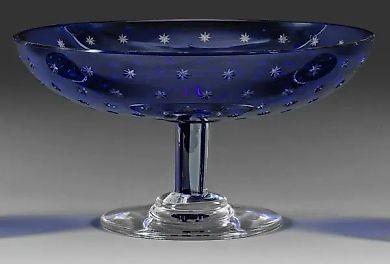
Lot No. 14517 St. Louis Bowl with Star Decoration
St. Louis
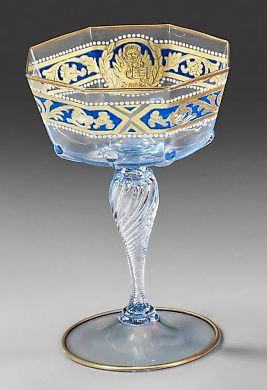
Lot No. 13116 A Murano light blue glass goblet with enamel an…
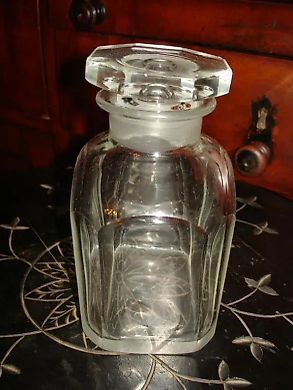
Lot No. 12462 Antique large tea canister, glass, hand-cut, gl…
<Original work>
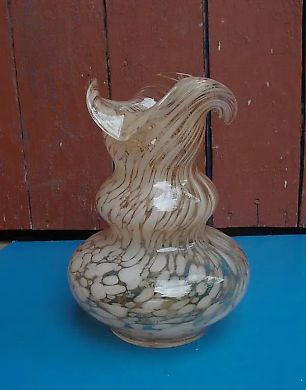
Lot No. 12716 SPOTTED VASE for flowers
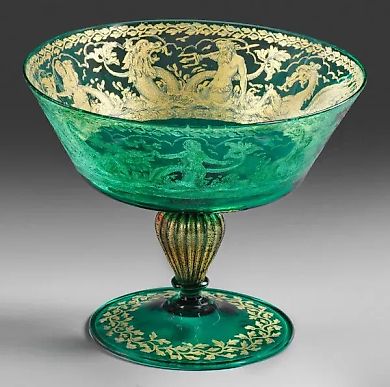
Lot No. 13114 The bowl is adorned with gold engraving depicti…
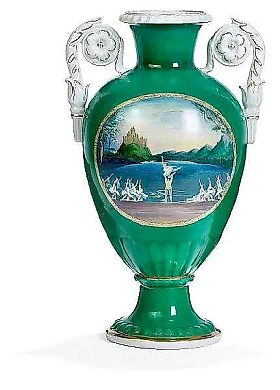
Lot No. 14998 Russian porcelain vase depicting a scene from "…
Dulevo Porcelain Factory
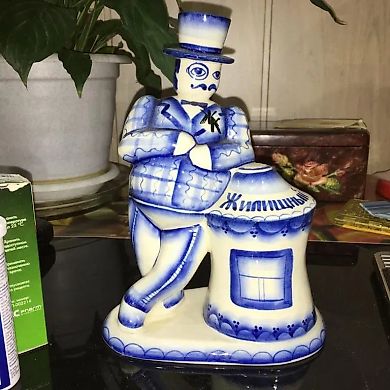
Lot No. 12744 "Housing Capital". Height 20 cm
Gzhel