
Nikolai Demyanovich Gritsyuk
The name of Nikolai Demyanovich Gritsyuk, a Novosibirsk artist, has won the hearts of many both in Russia and abroad. With his passing into the world of art, his reputation did not fade but only stren

The name of Nikolai Demyanovich Gritsyuk, a Novosibirsk artist, has won the hearts of many both in Russia and abroad. With his passing into the world of art, his reputation did not fade but only strengthened—his works today occupy worthy places in institutions such as the Tretyakov Gallery, the Russian Museum, and the Berlin National Gallery, as well as in museums around the world, including galleries in France and other countries.
Введите подпись
Gritsyuk's creative path in the 1960s-1970s seems special and even contradictory against the backdrop of the contemporary art of that time. Amidst heated debates about his expressiveness, the artist's works attracted the attention of both opponents and admirers. Over the years, it has become increasingly clear that his legacy represents an invaluable contribution to modern Russian fine art. It is unlikely that in recent decades there has been an artist capable of so expressively and subtly conveying the drama of his time, focusing not so much on significant subjects as on personal experiences. Although his watercolors and pastel works are not tied to specific themes, the main source of inspiration for him always remained memories of what he had lived through and the world around him.
It is unclear why some critics accused him of complexity and indifference to real life. In fact, life seethed in his works, and the artist himself was absorbed by the desire to feel and convey on paper the fullness of his existence. He was interested in events happening in Novosibirsk, Moscow, and across the country. He did not seek individual plots but transformed a vast stream of emotions and thoughts into color and form. His works can be viewed as amazing fantasies or, in his own words, "interpretations." Gritsyuk's art is permeated with symbolism, allegories, and grotesque forms; he used the possibilities of his imagination to create unique images.
During his lifetime, Gritsyuk led the representation of Soviet fine art at major exhibitions both in the Soviet Union and abroad. His solo exhibitions attracted many viewers and brought forth new cycles of works, introducing the public to the author's original ideas and style.
Введите подпись
Gritsyuk's creative work coincides with an important period in Soviet art that began in the early 1960s. This moment marks a transition to new approaches, the development of aesthetics and the understanding of art. Artists and viewers sought depth in art, penetrating previously unknown realms, leaving behind the familiar frameworks of beauty and harmony without additional meanings. This striving for novelty and the unexpected was reflected in his works, sparking interest and admiration among viewers.
However, the period of the Thaw proved to be short-lived. After the events that occurred in 1961 at the exhibition in the Manezh, it became clear that only a fleeting freedom had stirred the hopes of artists, but quickly dispelled them. Artists were clearly shown in which direction their creativity should develop, and many of them had to adapt to the harsh demands of the authorities. Nevertheless, truly gifted individuals, possessing inner determination and honesty, continued to follow their artistic instincts and invariably sought their true path.
During this difficult period in the world of fine arts, the talent of Nikolai Demyanovich Gritsuk shone brightly—an artist who stood out for his originality and uniqueness. Notably, despite his confidence and bold self-assertion, Gritsuk was not a graduate of prestigious art academies. He lived thousands of kilometers away from the central artistic capitals—Moscow and Leningrad—residing in the provincial city of Novosibirsk, which in those years was not renowned for its artistic traditions. Gritsuk studied for only two months at the Moscow Architectural Institute but quickly realized that the "engineering" nature of architecture did not bring him satisfaction. Failing to gain admission to the Surikov Art Institute, he did not want to risk taking the entrance exams, even though after the war, all doors were open to veterans. Gritsuk had traveled through many countries in Europe, from Ukraine to Austria, finishing the war with the rank of communications lieutenant and the Order of the Red Star, yet he always remained modest, accepting his gifts and opportunities.
Введите подпись
Later, it became evident that his choice in favor of the Moscow Textile Institute was the right one. The word "textile" in the institution's name did not deter him. Moreover, it was at this institute that one of the classics of Soviet art—A. V. Kuprin—had taught before the war, whose artistic principles created a unique teaching atmosphere. This provided many opportunities for young talents striving to develop their skills.
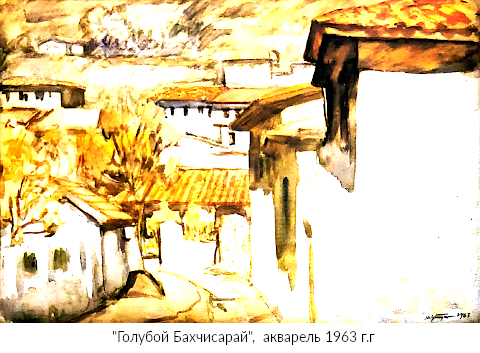
Another teacher, Vasily Pochitalov, who long remained in the shadows, had a significant influence on Gritsuk. By the mid-1970s, it became clear that he had been preparing the core group of extraordinary "Sixtiers," which included masters such as V. Ivanov, G. Korzhev, V. Gavrilov, and others. By the time he graduated, Gritsuk was on par with the best students of the "Surikov" institute, a result of his determination and diligence. During that period, he had already created several cycles of watercolor landscapes, endowed with vivid and touching motifs, executed with particular warmth and unity. The abundance of his works made him one of the most hardworking students, and his mastery only grew with each passing year.
Введите подпись
Nik
Введите подпись
Gritsyuk's deep love for Moscow is reflected in many of his works. Nevertheless, after completing his studies, he decided not to stay in the capital but to return to Novosibirsk, seeking "peace and freedom." Here, he began working at the House of Fashion and actively engaged in creating a fashion magazine. In the early 1950s, life in Novosibirsk was characterized by loneliness and a lack of conditions for creative work, but this gradually changed, and active and talented young artists began flocking to the city. A spirit of healthy competition and collaboration emerged among them, fostering the development of new ideas and perspectives in art.
The works of Nikolai Gritsyuk stood out among other artists for their unique depth and artistic expressiveness. Soon, he was elected to the board of the Novosibirsk branch of the Union of Artists and later served as its chairman for many years. Every time a commission from Moscow visited Novosibirsk, the members' attention invariably focused on the cheerful artist who tirelessly brought and displayed new watercolors. In 1953, his works were first presented in Moscow at an exhibition of artists from the RSFSR, after which two of his compositions were printed in the magazine "Yunost" (Youth). In 1961, Gritsyuk was invited to the capital for his first solo exhibition, after which his watercolors became an integral part of various exhibitions, both domestically and internationally. No artist from Novosibirsk, before or after Gritsyuk, achieved such a level of recognition.
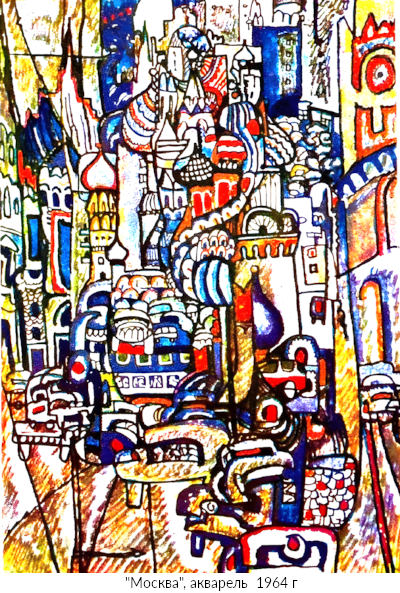
It soon became clear that Nikolai Gritsyuk was the only Soviet artist who could delve so deeply and consciously into the theme of life in a modern Russian city. The theme of the GIANT CITY, overwhelming a person with its immense power and unhealthy energy, became central to his work. Gritsyuk never embraced the dacha lifestyle, felt no sympathy for dacha-goers, and was not inclined to spend time away from the urban bustle. Although he was born in a rural area—at the Posevnaya station in the Cherepanovsky district of Novosibirsk Oblast—he was always a true city dweller in his thoughts, preferences, and habits.
Введите подпись
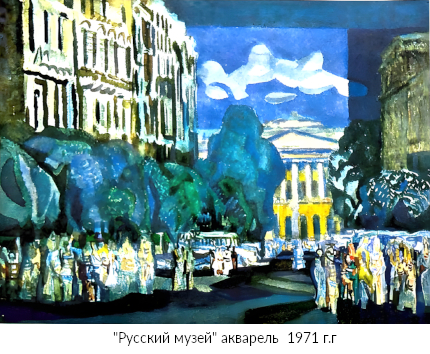
Over time, each new exhibition by Gritsyuk opened with another cycle of cityscapes — these series included "Novosibirsk," "My Moscow," "Leningrad," "Crimea," "Kuzbass." Each of these cycles created a holistic image of a multifaceted city, showing how the artist found his individual colors and expressive means, selecting unique motifs and interpretations. His rapturous perception of Moscow gave way to a calm admiration for the beauty of the Moscow region. The strict classicism of Leningrad was reflected in other forms, rhythms, and color solutions, allowing the viewer to "read" this city in a new way. Tallinn beckoned with the whimsical graphics of narrow streets and majestic cathedrals, mysterious and alluring with the hiddenness of its inner world. Crimea, in turn, was dotted with the warmth and tranquility of the harmony between sea and sun. Kuzbass, for its part, astonished with the nobility of the color gray, against which the silhouettes of blast furnaces and factory chimneys stood out mysteriously, while splashes of molten metal created an image of the region's might, which tirelessly works for the good of the country. In his works, Gritsyuk taught the viewer to grasp industrial power and the role of humans in this process. People sacrifice themselves to create these machines, endowing them with inhuman strength and even a semblance of intellect. But a question arises: does the human being, who created these technologies, not become defenseless and weak in the face of their own creation? In this context, who are they — the masters of the machines or their slaves?
Each new composition by Gritsyuk became entwined with invisible threads connecting the past and the present, helping the viewer understand the dialectic of their interaction. His works repeatedly raised important questions about life, the flow of time, and humanity's place in this boundless world. This artist transformed abstract reflections into concrete images, making his work accessible and understandable to everyone. His works were simultaneously a celebration and a contemplation — they led the viewer into a world of their own emotions and experiences, where everyone could find something close to their soul.
With each new cycle, Gritsyuk encouraged the desire to explore the surrounding world and find unique reflections within it. His watercolors became more than just images; they transformed into mosaics of human feelings, reflecting the complexity of urban life with extraordinary clarity and comprehensibility. Gritsyuk pondered questions not only about the essence of the city but also about those who daily live in its lights and shadows, encompassing their multifaceted aspects. The sheep-like world of the machine's rotor and the soul-inspiring harmony of nature — these are the contradictions that played a leading role in his artistic practice.
Введите подпись
Each new work inspired the viewer, sharpened their perception, and heightened the level of emotional engagement with what was happening on the canvas. Gritsyuk masterfully played with forms and color palettes, creating an indescribable atmosphere permeated with the meaning and energy of his personal vision. In this context, his works become an interdisciplinary language, speaking not only about urban life but also about the inner state of people, the context in which they exist, and how the world around them influences their perception of themselves. The works of Nikolai Gritsyuk are not merely a reflection of reality; they are an invitation to dialogue, a stimulus for reflection, and an opportunity to explore not only art but also oneself within the context of this boundless world.
Nikolai Gritsyuk used the theme of the urban landscape for profound philosophical contemplation, striving to express those feelings and experiences important to every inhabitant of a metropolis. For him, the key was not to highlight exceptional events or architectural achievements, but to convey what is common and unites city dwellers—constant tension, anticipation, and even fear, the result of life in an endless stream of people and machines. Gritsyuk realized that within this whirlwind of emotions lie faith, hope, heartfelt attachment, and, of course, passion, sometimes intertwined with hatred.
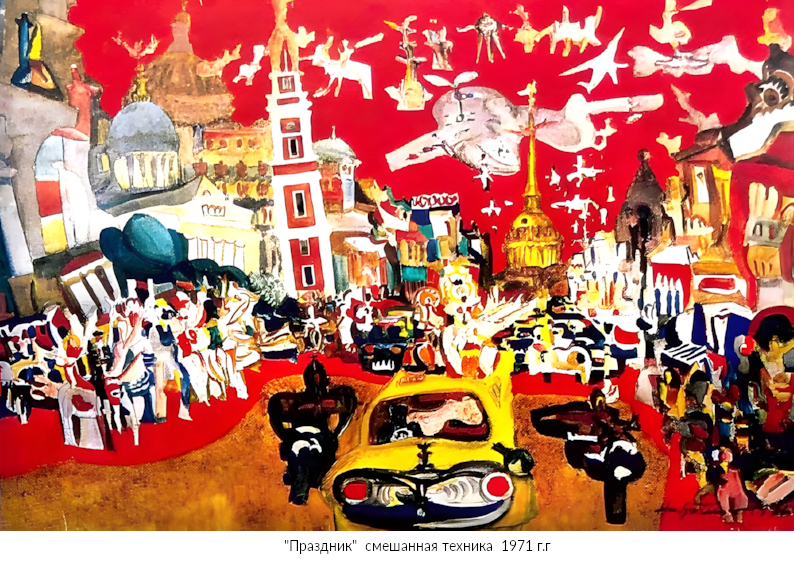
It is no coincidence that among his urban motifs, special attention is paid to depictions of cars. He endowed them with astonishing images, filling every detail with symbolic meaning. They transform into bug-cars, turtle-cars, and even insect-cars. These images, though sometimes eliciting a smile, nonetheless carry a poignant subtext. On the other hand, a dark side of mechanization also appears in his works—shark-cars or sinister mechanisms that begin not to help but to pursue humans, emphasizing their vulnerability before impersonal technology.
Over time, Gritsyuk's art becomes increasingly fantastical. In his world, master-machines, slave-machines, and monsters that displace humans from their lives emerge. These images are not merely reflections of technology but also embodiments of fears associated with the changing human essence under conditions of urbanization. Gritsyuk skillfully blends the visible and the invisible, dreams and reality in his works, creating a metaphysical fabric where the machine landscape presents itself as both support and threat.
The artist masterfully absorbed everything around him, creating metaphorical images that served as projections of his inner world. In his urban works, he effortlessly soaked up impressions and transformed them into unique visual constructions. Streams of cars, diverging streets, and the city's bright lights became associative images, reminiscent of wolf packs or clots of energy ready to seize the mind. In his interpretation, the helmet-like domes of churches resembled the metal spheres of high-voltage transformers, and highways seemed to stretch into cosmic distances, linking the past with the present.
Введите подпись
With the accumulation of experience and the expansion of his creative horizon, the inanimate objects in his works began to acquire new forms and meanings. Hrytsyuk created images that balanced on the edge of reality and fantasy, weaving the living and the non-living into astonishing combinations. Nature and technology, antiquity and modernity, light and darkness intertwined in his metaphors, creating a complex symbiosis that touched entire eras and cultural layers. Church domes, factory chimneys, shop windows—all were reflections of the real world and, simultaneously, of the hidden, tense pulse of life in the artist's consciousness.
Each new work absorbed a mosaic complex of feelings and thoughts, offering the viewer an opportunity to try to comprehend what lies beneath the surface. Hrytsyuk did not merely depict the space around him; he skillfully provoked a dialogue with it. His works became a kind of space where a comparison of human essence and machine mechanics, self-destructive reason and faith in a new human, took place. The novelty of his approach made the city not just a backdrop, but a living being with which the artist communicated as an equal, asking questions about the future and humanity's place in this rapidly changing world.
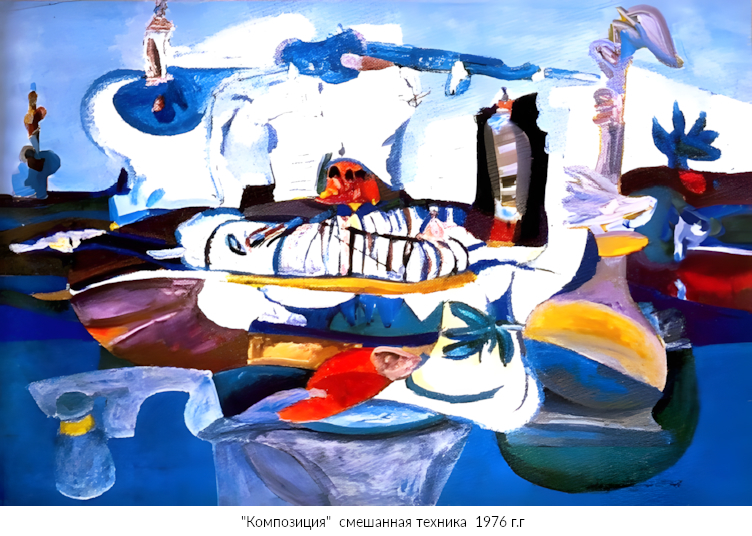
Hrytsyuk infused his works with personal experiences and societal questions, creating multifaceted portraits of the metropolis. His painting became a place of collision between a person's inner world and the reality encountered by everyone who lives in the city. He realized that every line on his canvases was not just a stroke, but a rhythm of life dictating its own terms. In every mark, one could hear the echoing footsteps of passersby, the passing of cars, and someone's subtle romantic dreams, captured in the sultry rays of sunlight. The artist reinterpreted and reworked these nuances, creating a unique symphony that reflected the massive reality of urbanization.
Введите подпись
Gritsyuk skillfully combined elements, creating intriguing and sometimes opposing images. With each work, he armed himself with new ideas, exploring his place of existence at the center of an urban symphony. His watercolors astonishingly accurately conveyed the persistent rhythm of city life—they were not just images but an emotional response to the dynamism that enveloped every person in this multifaceted and often anxious world.
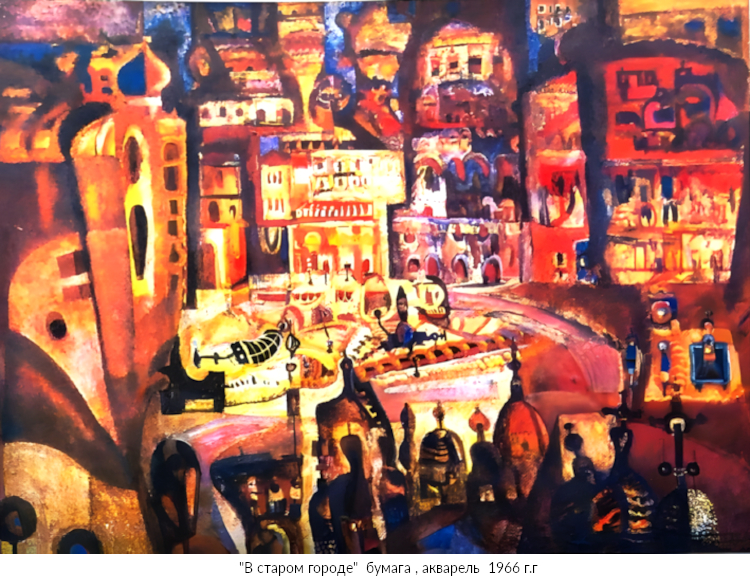
In later years, the artist began to "connect," "collide," and "reforge" in his mind not just individual objects, but entire historical epochs and national traditions. In his creative process, elements of various cultures and times were mixed, leading to the creation of works in which events from several centuries could coexist in a single composition, as, for example, in the work "In the Old Town." Despite criticism directed at him regarding formalism, Gritsyuk not only did not abandon experiments but also grew bolder in moving away from nature, striving for a bright, non-objective-decorative, and color-saturated creativity.
There is an opinion that it was precisely the artist's "provincial" registration that played a significant role in such an unusual direction of his artistic development. While in Moscow, he might have involuntarily sought to communicate with already well-known and recognized contemporaries, imitating their style and approaches. In Novosibirsk, however, he found himself in a different cultural environment, where he interacted with scientists from Akademgorodok—some of whom he was already acquainted with at that moment. This interaction with minds possessing abstract and associative thinking resonated within Gritsyuk himself. "I find it interesting to be with physicists," he said. "They think independently and are not afraid to say what they think." Like his scientific comrades, he sought to overcome the boundaries of his understanding, combining synthesis and analysis as his primary tools with which he tried to comprehend the surrounding world.
In art, Gritsyuk approached the task as scientists do in laboratories, breaking down living matter into its constituent parts and trying to penetrate to the essence—to the organ, cell, or even nucleus. And after he completed his contemplations in the studio, he would go out onto the city streets, listening to its breath and immersing himself in the dynamic, sometimes anxious reality.
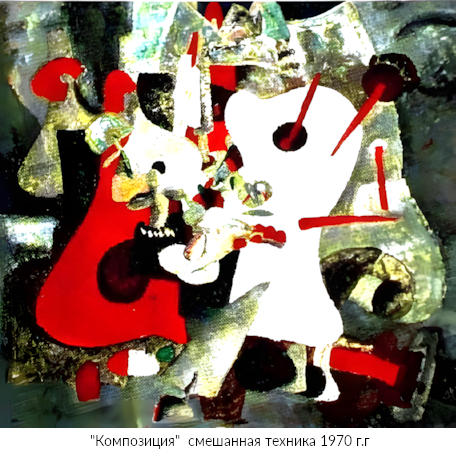
In the artist's later works, the image of a woman became terribly significant—it symbolized passion, creative impulse, and a thirst for knowledge, which stayed with him until the end of his days. For Gritsyuk, acquiring mastery meant the ability to be different. Several artists coexisted in his work: a realist, a fantasist, and a storyteller. He perceived the world in a three-dimensional, multi-faceted, and multi-layered way, with every aspect and slice of life finding its expression in his works.
Введите подпись
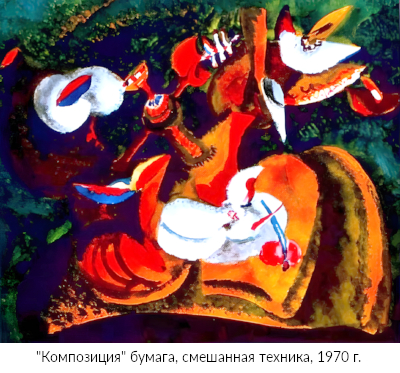
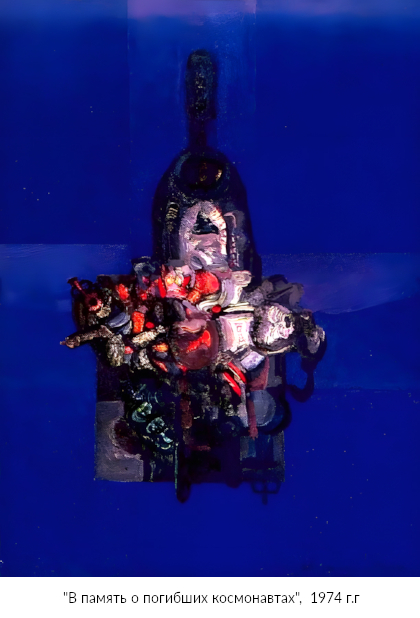
Gritsyuk became not just an observer, but an active participant in the artistic process, allowing his internal dialogues to shape works that significantly enriched the cultural context of his time. His paintings reflected not only the individuality of the artist but also the powerful social currents permeating contemporary society. And every stroke, every form became an embodiment of sincere feelings, emotions, and reflections. Anxieties and sorrows, sadness and injustices found a response in the very heart of Nikolai Demyanovich Gritsyuk, as he himself was always a responsive and sensitive artist. Tragic events, such as political unrest in Chile or military conflicts on other continents, could not leave him indifferent. The heavy burden of disasters occurring in remote corners of the planet weighed on his soul. He was particularly deeply affected by the sad news of the death of the Soviet cosmonauts, which prompted him to create a powerful and touching work in their memory. The crashed space capsule was for him not just a flying machine, but a symbol of immeasurable grief and the many lives that were no more. It became an image into which the fates of people from different historical periods were woven. From the damaged shell of the aircraft, rising into the void, souls seemed to burst forth, striving to comprehend infinity and eternity. Along with them, the strange creatures, objects from different eras, and mysticism full of unknown symbols depicted on the canvas departed. The capsule in weightlessness seemed to be supported by a large, strong hand, instilling confidence that even in chaos there is meaning and order. The sadness and grief expressed in this work were juxtaposed with the artist's persistent desire to comprehend a world in which each generation suddenly disappears, leaving only a trace behind. Nikolai engaged in attempts to overcome earthly gravity, striving for a state of weightlessness as a metaphor for the pursuit of the eternally important—the awareness of time and space in their true infinity. With the accumulation of experience and skill, particularly from the mid-1960s, Gritsyuk increasingly moved away from plein-air painting, showing an interest in mysterious objects and fantastic images. The creative sheets acquired a character of the extraordinary; here, extraordinary things appeared, creating an atmosphere of mystery and novelty. In his works, he masterfully played with color combinations, appealing to the deep emotional side of creativity. Every stroke not only emphasized but also conveyed the rhythm and mood of the painting; the combination of nervous, unearthly lines with soft and light forms turned into an amazing dance of colors and shapes. Color became for the artist a medium through which he expressed any ideas, feelings, and thoughts. He could convey to the viewer the mood of each of his works, giving it a dynamism full of internal energy and life.
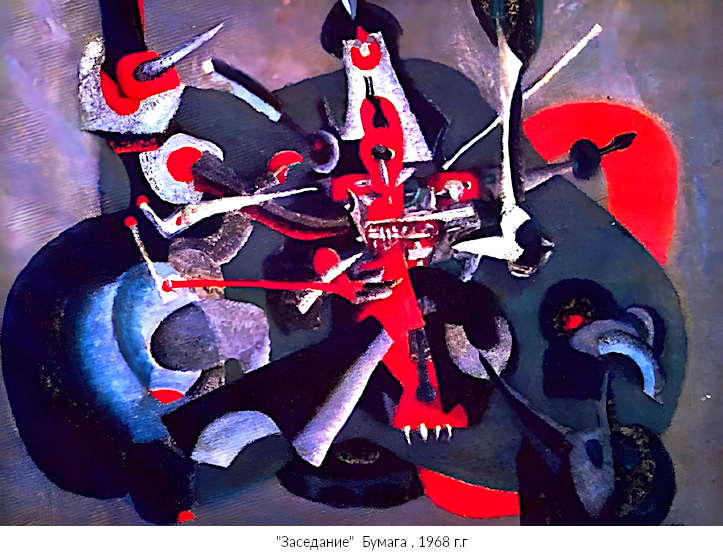
When a bright worldview became tinged with intensifying dramatic tones, the images turned utterly somber. The compositions were perceived as unbalanced and unsettling, and the rhythms of figures and color patches grew restless and nervous, adding a special depth and meaning to the works.
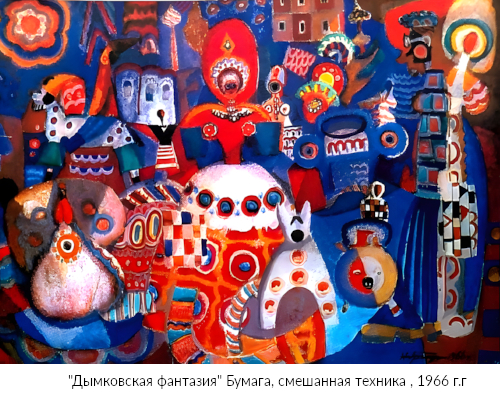
Simultaneously, Gritsyuk was able to convey a festive perception of the world, so characteristic of Russian folklore and cultural traditions. In his works, marked by folk motifs and traditional household objects, joy and a bright, unusual vision manifested, transforming his paintings into true feasts for the eyes. These compositions were distinguished by vivid, fantastical imagery and an expressive rhythmic structure, filling the viewer with a sense of light and happiness.
Each of his works became a living dialogue with the surrounding world, reflecting not only his personal inner experiences but also broad social and cultural aspects. By posing questions about humanity and its place in the universe, about how it interacts with the surrounding space, Gritsyuk created deep mosaics of the human soul, artistic equivalents of diverse emotions and feelings.
The artist rarely turned to portrait painting, did not depict specific faces, yet by deeply penetrating human nature, he was able to convey the richness of inner experiences. Behind each of his phantasmagorias lies a real person, with all their aspirations, impulses, and internal conflicts. The creative work of Nikolai Gritsyuk would undoubtedly find resonance in the modern world. The rapid change of events, social shifts, and emotional highs of our time would become a true litmus test, revealing the many nuances and peculiarities of human existence.
Each of Gritsyuk's works is filled with deep meaning, allowing the viewer to contemplate life, its multifaceted nature, and complexities. He seems to engage in a dialogue with the individual, prompting them to ponder what lies behind familiar forms, behind the everyday. Behind the apparent simplicity of the images lies great depth, so his creations become not merely a visual perception but also a kind of guide into the world of emotions and psychological states.
Введите подпись
Addressing contemporary questions and problems, Gritsyuk would most likely reflect not only individual experiences but also societal changes, penetrating to the core of social contradictions. His expressive style has the potential to highlight such moments as the fragmentation of life, the rift between the conventional and the innovative, and the internal conflict surrounding the individual. In his works, one can see not only individual dramas but also mass sentiments, showcasing the vicissitudes of human destinies within the context of globalization and stress, and the shift to leading positions in society.
How would he interpret the noise and bustle of modern cities, the unpredictability of the flow of life, internal challenges, and endless possibilities? Perhaps he would use his familiar expressive means, transferring urban panoramas onto the canvas, saturated with dynamism and multifacetedness, allowing each viewer to feel themselves a part of this boiling world. Ordinary details, such as cars, streets, and buildings, would become not just a background, but living objects, each carrying its own history and emotional weight. Gritsyuk would likely become a bridge between different generations, an artist capturing current realities, making them noticeable and significant. Importantly, his attention to details would allow him to create not just a beautiful picture, but a memorable moment—that instant when the viewer realizes that they, too, are part of this "mechanism." His art would lack neither harshness nor indifference; moreover, it would be imbued with warmth, a quest, and a striving for understanding.