
"Porcelain" Pushkiniana
The Pushkin theme has occupied an important place in art for over one hundred and fifty years. Interestingly, with each new round anniversary associated with the poet's name, this interest acquires ne

The Pushkin theme has occupied an important place in art for over one hundred and fifty years. Interestingly, with each new round anniversary associated with the poet's name, this interest acquires new shades.
The lifetime portraits of Alexander Sergeyevich Pushkin, created by the artists Vasily Tropinin and Osip Kiprensky in 1827, despite their differences, became the model and standard for representing the poet in that period. Also well-known are the reproduced portraits of Pushkin made in the last years of his life—the watercolor by Pyotr Sokolov and the graphic work by the Englishman Thomas Wright. It is believed that the latter was commissioned by the poet himself for his collected works. These images reflect somewhat different features: in one case, the poet appears in a more secular role, in the other—in a more official character.
Введите подпись
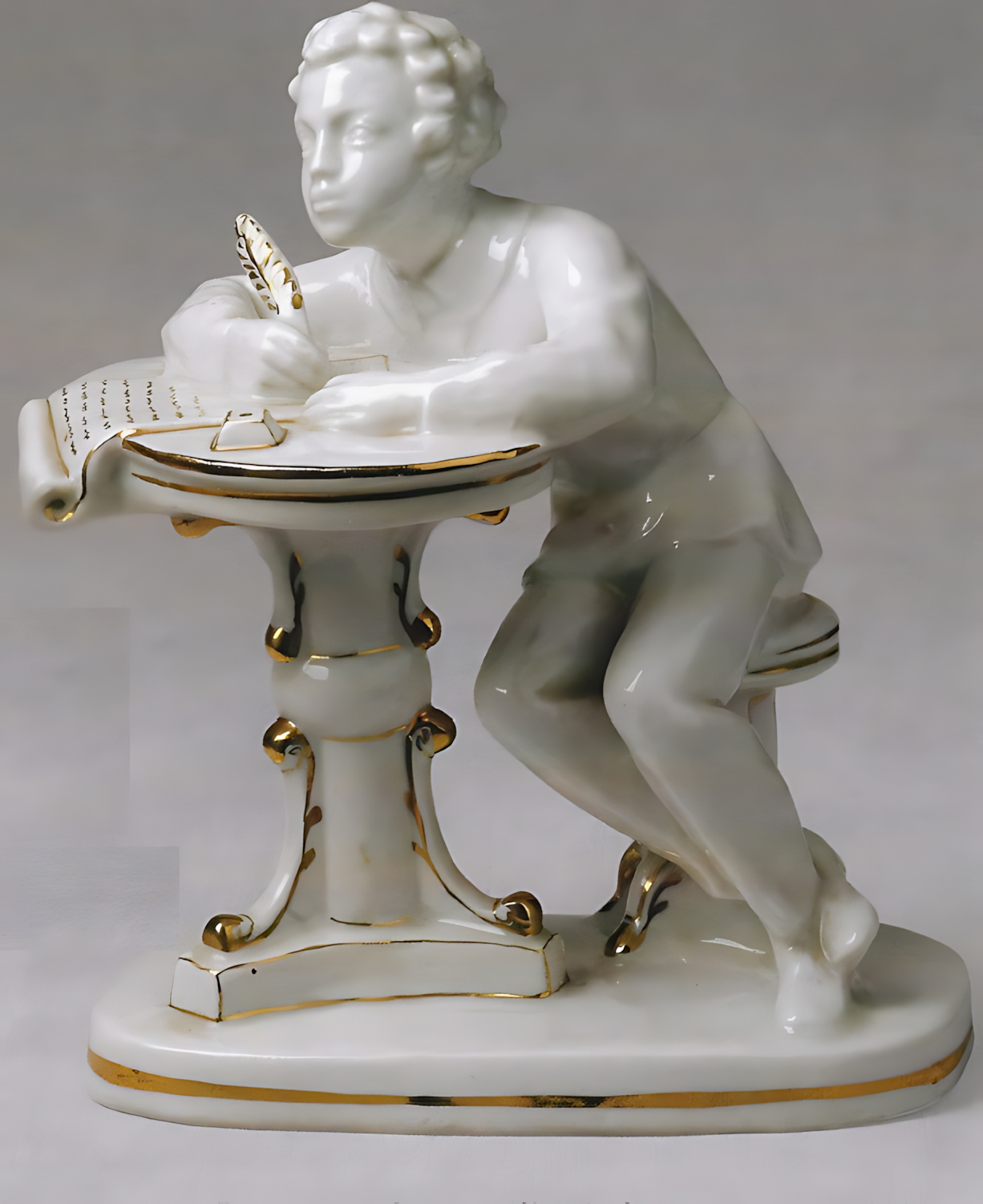
"Pushkin the Lyceum Student" figurine, Lomonosov Porcelain Factory, 1949
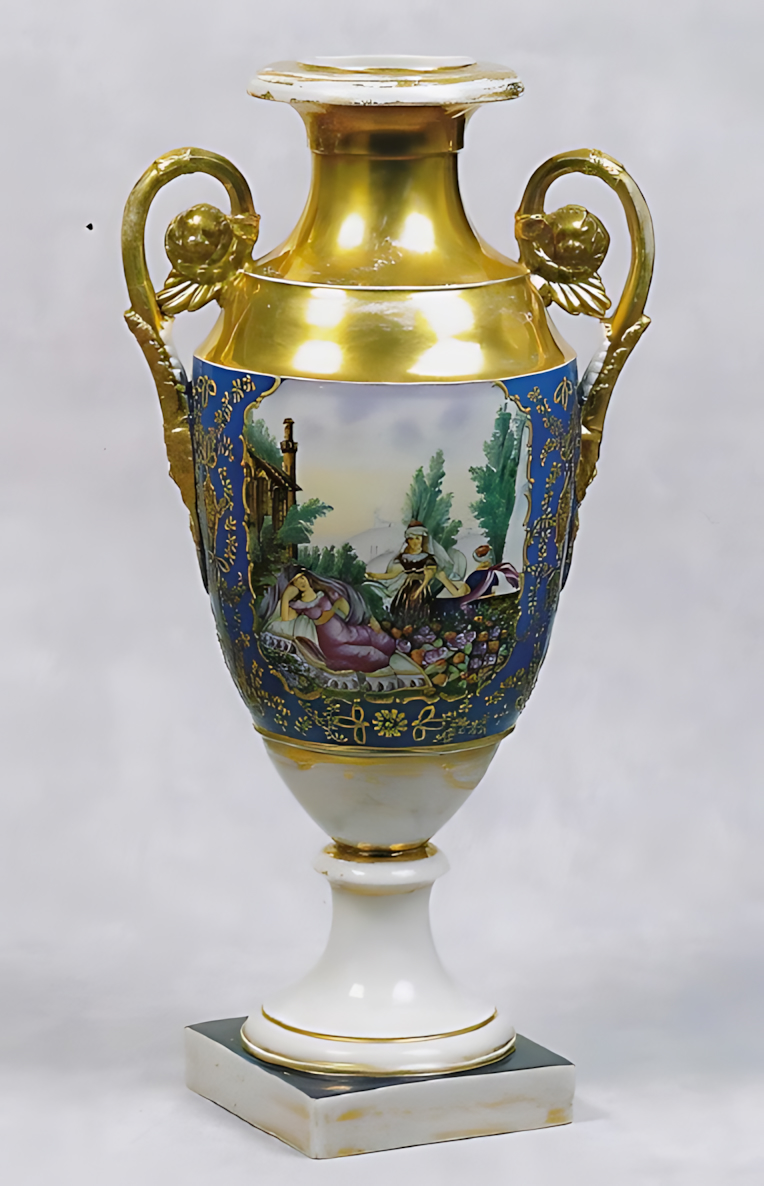
Nineteenth-century porcelain Pushkiniana, keeping pace with contemporary painting and graphic trends, did not use portrait images. One of the first known porcelain illustrations of Pushkin's works was a scene from the poem "The Fountain of Bakhchisaray," executed on a decorative vase in the late 1830s to early 1840s. This precious, possibly lifetime, example of porcelain painting is touching, although it is not distinguished by high artistic quality.
Введите подпись
Vase with painting on the theme of "The Fountain of Bakhchisaray," Russia, Safronov factory, late 1830s - 1840s
The vase is made in the shape of an amphora on a once-gilded round foot, resting on a square base. Two handles end in scrolls with molded lion masks, and at the base, one can see bearded mascaron. It is decorated with small floral patterns on a blue background. The traditional classical form of the vase combines with a primitive depiction in large cartouches: on one side—an architectural landscape, on the other—a polychrome reproduction of an engraving.
The free interpretation of the scene, based on the 1826 engraving by S.F. Galaktionov, shows the garden of the Crimean ruler with flowers in the foreground and distant hills in perspective, where the main characters of the poem are placed. However, in the multi-figure composition, both the lively dynamism of the original and some of the characters are lost. In the end, only the three main ones remain: the sleeping Maria, Zarema, and Khan Giray, sitting with his back to the viewer, admiring the fountain.
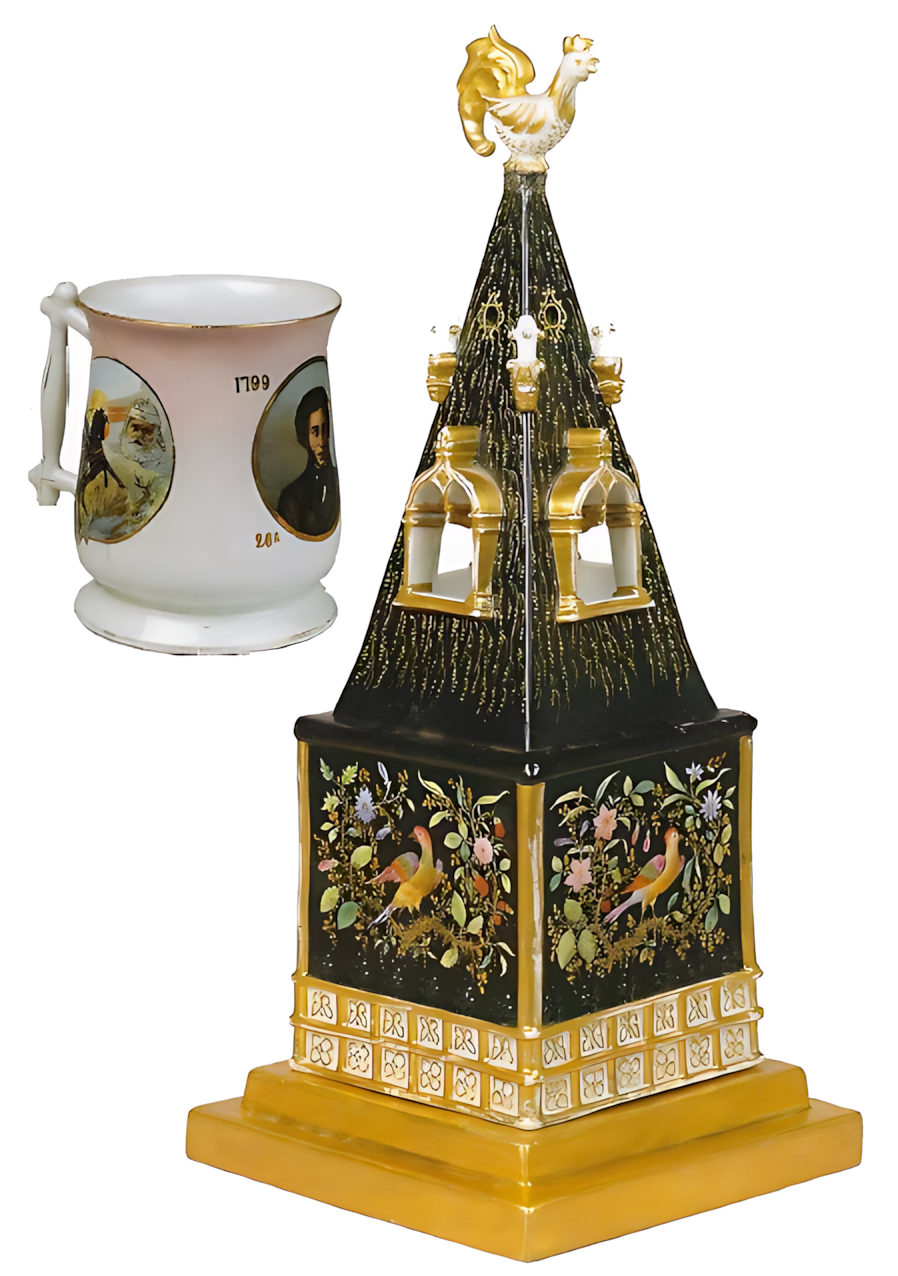
The theme of Pushkin in porcelain from the second half of the 19th century spread to decorative arts, including motifs from his fairy tales. The St. Petersburg factory of the Kornilov brothers created a unique example of a table nightlight in the form of a little tower, decorated with elegant ornamentation and a figurine of a golden cockerel at the top. The architectural image of the turret harks back to ancient Russian bell towers and attic towers, placed on a cubic base with dormer windows on the facets of the four-pitched tented completion. This nightlight was undoubtedly close to domestic traditions.
Введите подпись
Anniversary mug, Dulevo 1899, Nightlight based on "The Tale of the Golden Cockerel", Kornilov brothers factory, 1850s
A brightly painted tower-case, painted on a black, lacquer-like background, was placed over the gilded stepped base which contained the lamp. Large birds with bright plumage sitting on flowering branches and thin golden twigs streaming down the tent create a magnificent compositional ensemble, outlined in gilding.
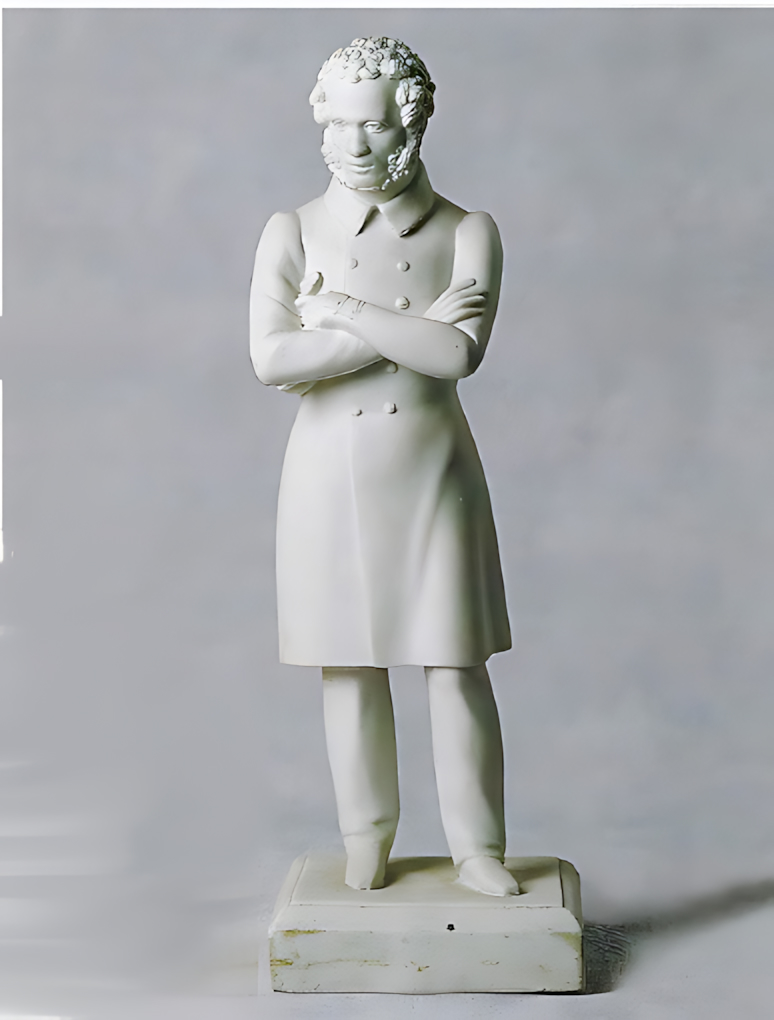
In 1837, immediately after Pushkin's death, work began on his sculptural image. The figurine, created by A.I. Terebenev, depicts the poet at full height, with his arms crossed on his chest, in his favorite pose. This work was undoubtedly commissioned by his closest friends. However, during that period, the classical version—an antiquized bust with cut-off shoulders—was particularly valued. I.P. Vitali in Moscow and S.I. Galberg in St. Petersburg created such official portraits, generalizing the poet's image, which became a kind of monument.
By the end of the 19th century, artists' interest in Pushkin increased, which was associated with competitions held in 1873–1875 for creating designs for a monument to the poet. The committee settled on the model by A.M. Opekushin, who created a figure reflecting the rich inner world and significance of the image. A revival of illustrative activity and the creation of portrait images of Pushkin in small porcelain sculpture and anniversary souvenirs occurred on the eve of the celebration of the poet's 100th anniversary.
Введите подпись
A.I. Terebenev, model for the monument to A.S. Pushkin, 1937
Among the anniversary products of 1899, the M.S. Kuznetsov factory in Dulevo near Moscow produced a large decorative plate with painting on the theme of "The Tale of the Fisherman and the Fish" based on drawings by A.F. Afanasyev. The field of the plate consists of six fragments, each illustrating key moments of the famous fairy tale. In the center, an image of an old man with a fish in his hand is engraved, enclosed in an olive-colored mark resembling a church dome. The character in a sacred outline, a simple old man, listens to the miraculous fish, holding his hand to his ear.
The composition of the painting is subordinated to a circular format, which not only enlivens the scenes but also unites them into a single narrative sequence. The Old Slavonic font style chosen by the artist, along with the characteristic color palette of the painting—olive, brown, and red—evokes traditional imagery of Old Russian painting.

Введите подпись
At the Dulevo factory of M.S. Kuznetsov, souvenir glasses of simple and laconic form, figured goblets, dishes, and lids dedicated to the Pushkin anniversary were also produced. Their decoration was achieved through a combination of printed engraved portraits and colorful compositions related to the poem "Ruslan and Lyudmila," filled in with a delicate pastel background and inscriptions. These pieces recalled elements of book illustrations for fairy tales or Russian artistic broadsheets, connecting individual scenes with ornamental garlands.
The most striking souvenir item created for the anniversary date was a tall, truncated cone-shaped cup for pencils and brushes, produced at the M.S. Kuznetsov factory. The painting on its surface imitated an ornamental style based on the stylization of medieval patterns. The use of mixed techniques creates a decorative effect through the combination of a pastel background and saturated local spots, enamel, and printed designs.
After the 1917 revolution, attention to Pushkin's work and persona increased. The period of the new state's formation coincided with two commemorative dates—the 100th anniversary of the poet's death and the 150th anniversary of his birth. The porcelain industry responded to these events with a series of small figurines and miniature busts made of unglazed porcelain. These pieces stand out for their laconicism and classically clear form, emphasizing the "ideal" image of the poet. Traditional 19th-century models created by sculptors I.P. Vitali and A.I. Terebenev were used.
During this same period, a new approach to genre and narrative compositions emerged. At the Petrograd Porcelain Factory in 1921, V.V. Kuznetsov created the group "The Gossips," where characters from "The Tale of Tsar Saltan" are presented with unexpected sharpness and grotesquery. This small pyramidal composition of three figures on an oval base, with characteristic genre details, anticipated the appearance of colorful illustrations for Russian fairy tales in the 1930s–1950s.
The exquisite painting on the teapot, executed by M. Moch in 1929 at the same, but now Leningrad, Lomonosov Porcelain Factory in a "postmodern" style, draws on traditional themes from "Ruslan and Lyudmila." The scenes of Lyudmila's abduction and Ruslan's battle with the Head, covering the surface of the teapot, are distinguished by flexible, fluid, generalized forms and a cold color palette. The free pictorial composition sharply contrasts with decorative techniques that emphasize the vessel's structure—the black color imitating a metal spout tip and the elegant floral garlands on the shoulders. In 1937, in a more traditional manner, M. Moch painted the "Bakhchisarai Fountain" tea service.
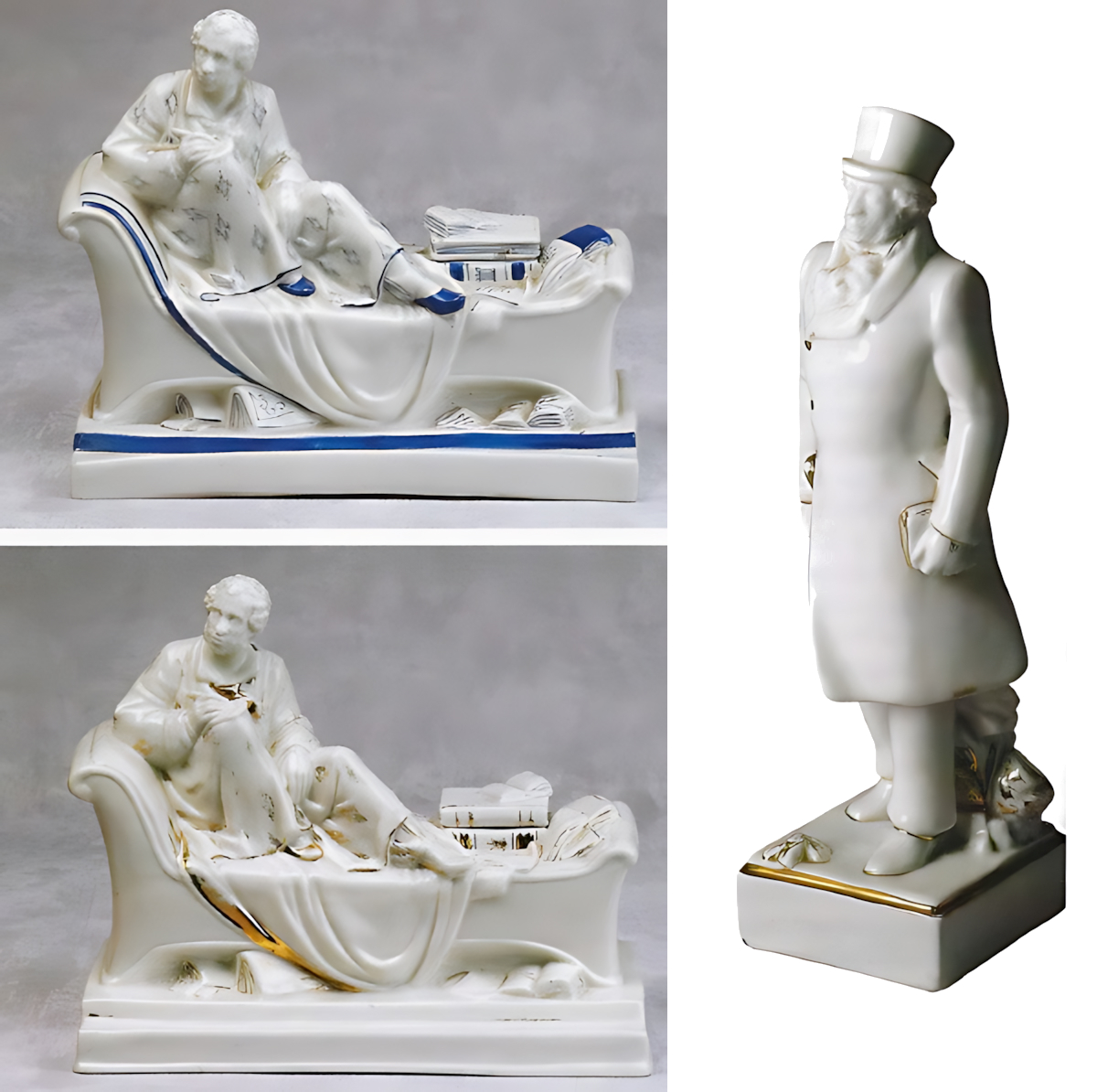
The talented student of V.V. Kuznetsov, N. Ya. Danko, who replaced him as head of the sculpture workshop at the Leningrad Porcelain Factory in 1919, repeatedly turned to the image of the poet. Her sculptural portraits and decorative works dedicated to Pushkin's oeuvre became classics. In 1936, in connection with the approaching 100th anniversary of the poet's death, she created the figurine "A.S. Pushkin on a Walk" from glazed white porcelain, only slightly accentuating details with gilding. This figure, in the poet's bold pose and reaching 30 cm in height, embodies optimistic and bright moods, looking toward the future.
Введите подпись
**N.Ya. Danko, inkwell set "Pushkin at Work", Lomonosov Porcelain Factory, 1939, N.Ya. Danko "Pushkin on a Walk", 1936
**
The decorative inkwell "A.S. Pushkin at Work," better known as "Pushkin on a Sofa," enjoyed particular popularity. The painting shows the poet reclining on a sofa with a pen in his hands, composing verses, while a stack of books at his feet serves as the inkwell's lid. This image of Pushkin in a small, intimate work, filled with warmth, appears almost monumental. Over time, the poet became a cult figure, elevating culture to a new level, enriching it with life-affirming ideas.
The period from the mid-1930s to the 1950s was marked by the increased role of statuary sculpture at the Leningrad Lomonosov Porcelain Factory, as well as at the Dmitrov and Dulevo factories. Among the diverse genre sculptures, special attention was paid to fairy-tale subjects. Turning to this theme in art has always proven fruitful and allowed for the creation of sculptures with folkloric motifs that authentically reflect the closeness of fairy-tale characters.
Введите подпись
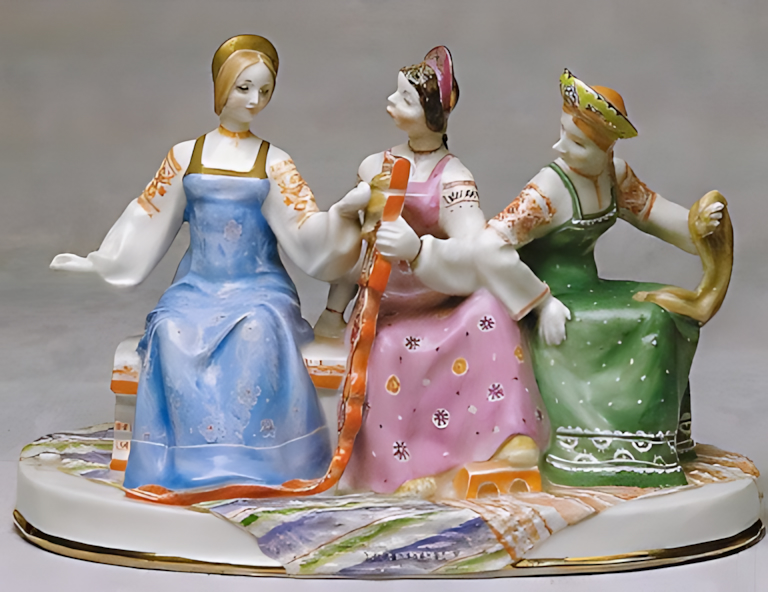
G.D. Chechulina "Three Maidens", Dulevo Porcelain Factory, 1950s
A new generation of porcelain artists has begun a series of figurines and compositions based on the works of Pushkin, actively using bright color schemes, glaze, and luster. These works, stylistically similar to folk toys and Christmas cards, attract attention due to the spectacular properties of the sparkling material and unconventional compositional solutions.
Введите подпись
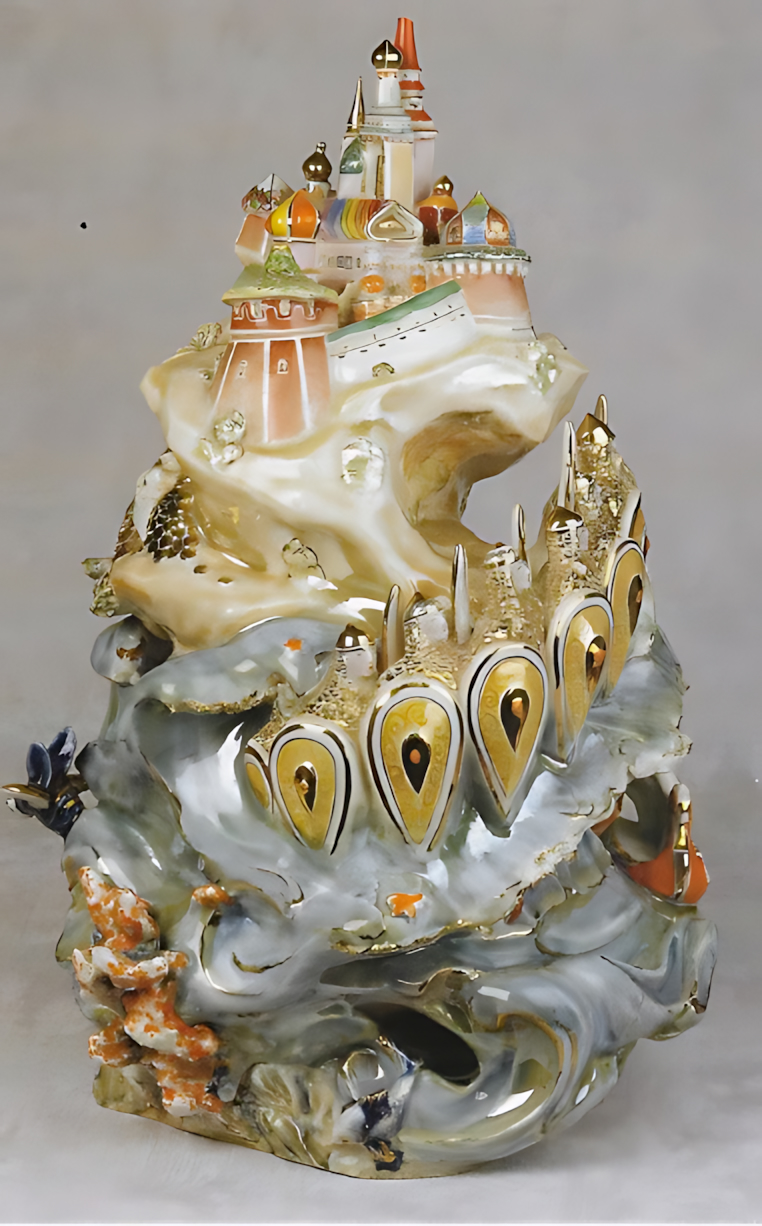
G.D. Chechulina "Buyan Island", Dulevo Porcelain Factory, 1950s
In the 1950s, small figurines were popular — "The Swan" from "The Tale of Tsar Saltan", "The Tsarevna with a Dog" based on "The Tale of the Dead Princess and the Seven Knights", "The Old Man and the Fish" based on "The Tale of the Fisherman and the Fish". These pieces attract with their intimacy and soft forms, but compositions of two or three parts also appear, showcasing the theatricality of porcelain illustration.
Введите подпись
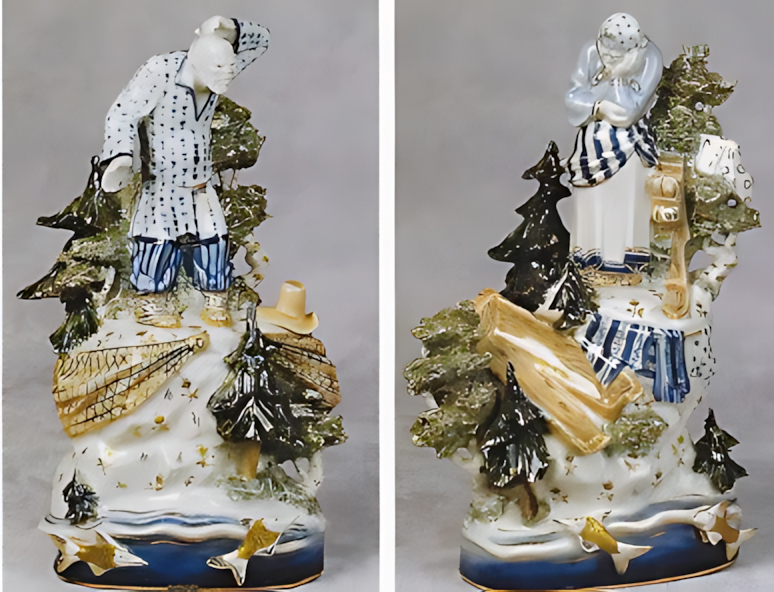
S.M. Orlov "The Tale of the Fisherman and the Fish", two parts of a triptych, Dulevo Porcelain Factory, 1949
Genre scenes with silent communication between characters, created by G.D. Chechulina at the Dulevo factory, are interesting. Their details are studied with curiosity, trying to decipher the role of each figurine. The sculptural group "Three Maidens" based on "The Tale of Tsar Saltan" continues the tradition of V.V. Kuznetsov's "Gossips", thanks to the sharp characterization of the characters.
In "The Tale of Tsar Saltan", whose characters are placed on the magical island of Buyan, G.D. Chechulina uses a unique compositional technique. A slightly deformed shape, likely due to firing, forms a spiral densely populated with characters from the fairy tale. Past the rising curves, little ships descend, knights march in formation, bumblebees fly around, a squirrel hides in the dense branches, and in the center — mountains of gold with sacks.
The triptych on the theme of "The Tale of the Fisherman and the Fish", created by S.M. Orlov at the Dulevo factory in 1949, is distinguished by sharp and prickly forms. Tension is felt here, yet the main characters seem softened, demonstrating helplessness and pliability.
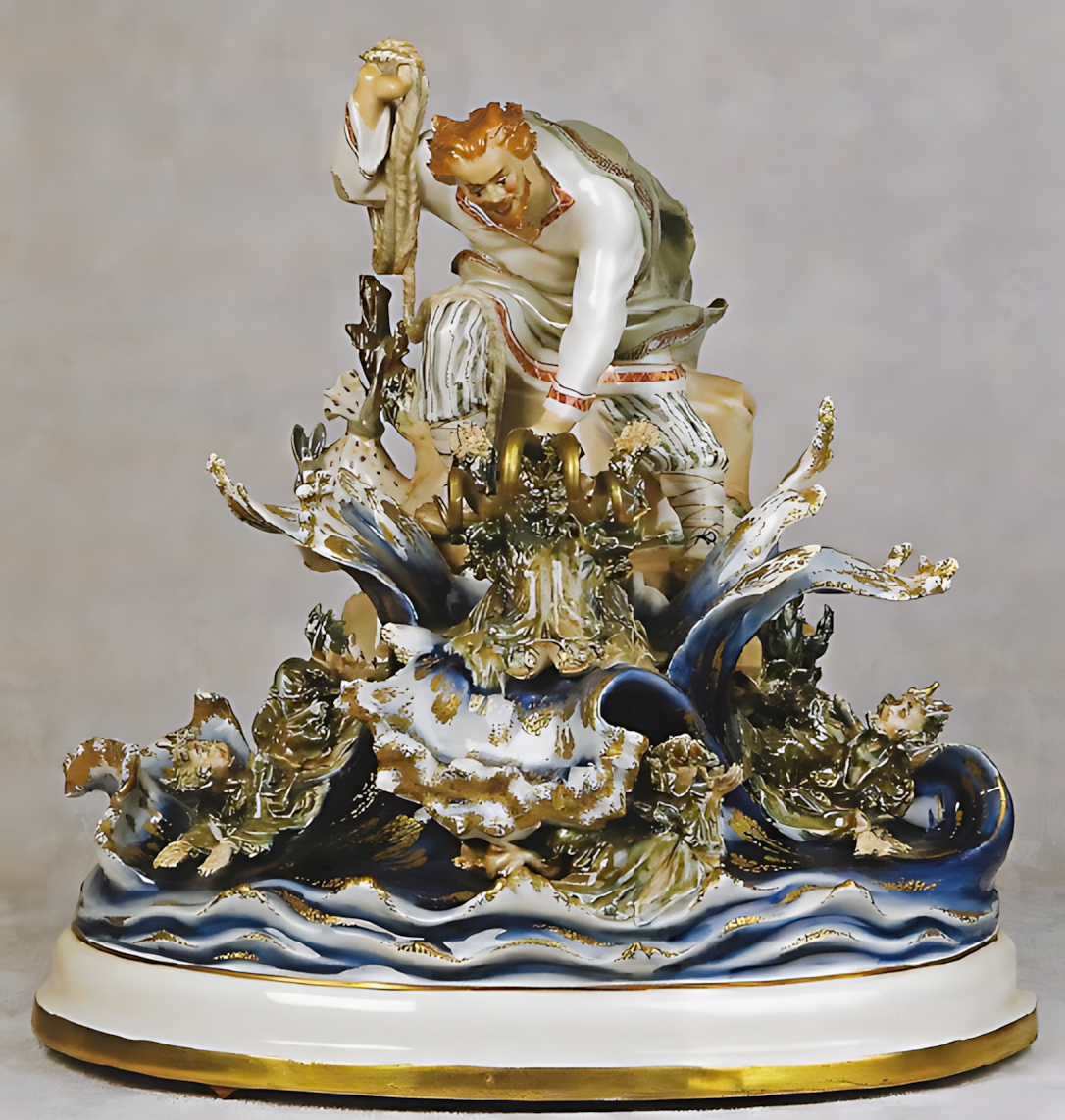
Unique for its theatrical execution and complex detailing is the three-part sculptural composition based on "The Tale of the Priest and His Worker Balda" by A.P. Zavalov, where the main heroic image is presented as a mighty bogatyr. His figure imposingly towers over the composition, which is watched by other characters: some with supplication, some with admiration. Beneath him, a fountain of waves and spray twists, raising the old demon begging for mercy.
The dynamics of the action's development and the characterization of the figures do not leave one indifferent. Fairy-tale realism, the author's powerful fantasy, vibrant paper art, and capricious images — all this matures in the composition with a hint of social perception. Like other works of the time, the triptych helps to imagine an ideal world that raised high standards.
The late 1950s was a time when knitwear was featured in a composition based on "The Tale of the Golden Cockerel," created by O.M. Bogdanova. On one platform, three characters are placed—the Shamakhan Tsarina, the Astrologer, and Tsar Dadon—small figurines that easily connect with each other, adorned with delicate blue painting.
Введите подпись
A.P. Zavalov "The Tale of the Priest and His Worker Balda", triptych, 1950s
In the late 1950s and 1960s, increased interest in Pushkin as a romanticized figure became noticeable among young artists. New research and publications about the poet's life, especially his lyceum years, inspired A.M. Nenasheva, who created a series of figurines "Pushkin the Lyceum Student" and "Young Pushkin." These works strive to combine genre elements in sculpture, while emphasizing the whiteness of the porcelain with light gilding. Such is the style of the "Pushkin the Lyceum Student" figurine, where the young poet is thoughtfully paused over a manuscript, as well as the figure of a lyceum student with a hand behind his back by an unknown artist.
The theme of Pushkin remains difficult: multifaceted and in its own way popular throughout the centuries. Creating one's own vision of the poet is no easy task. Each era perceives his genius in a special way. In the works of A.D. Brzhezitskaya, there are many compositions that reflect the subtlety of conveying Pushkin's characters. "Tatyana's Dream" based on "Eugene Onegin," executed by the artist, is filled with lightness and elegance, freedom of movement, and vivid emotionality.
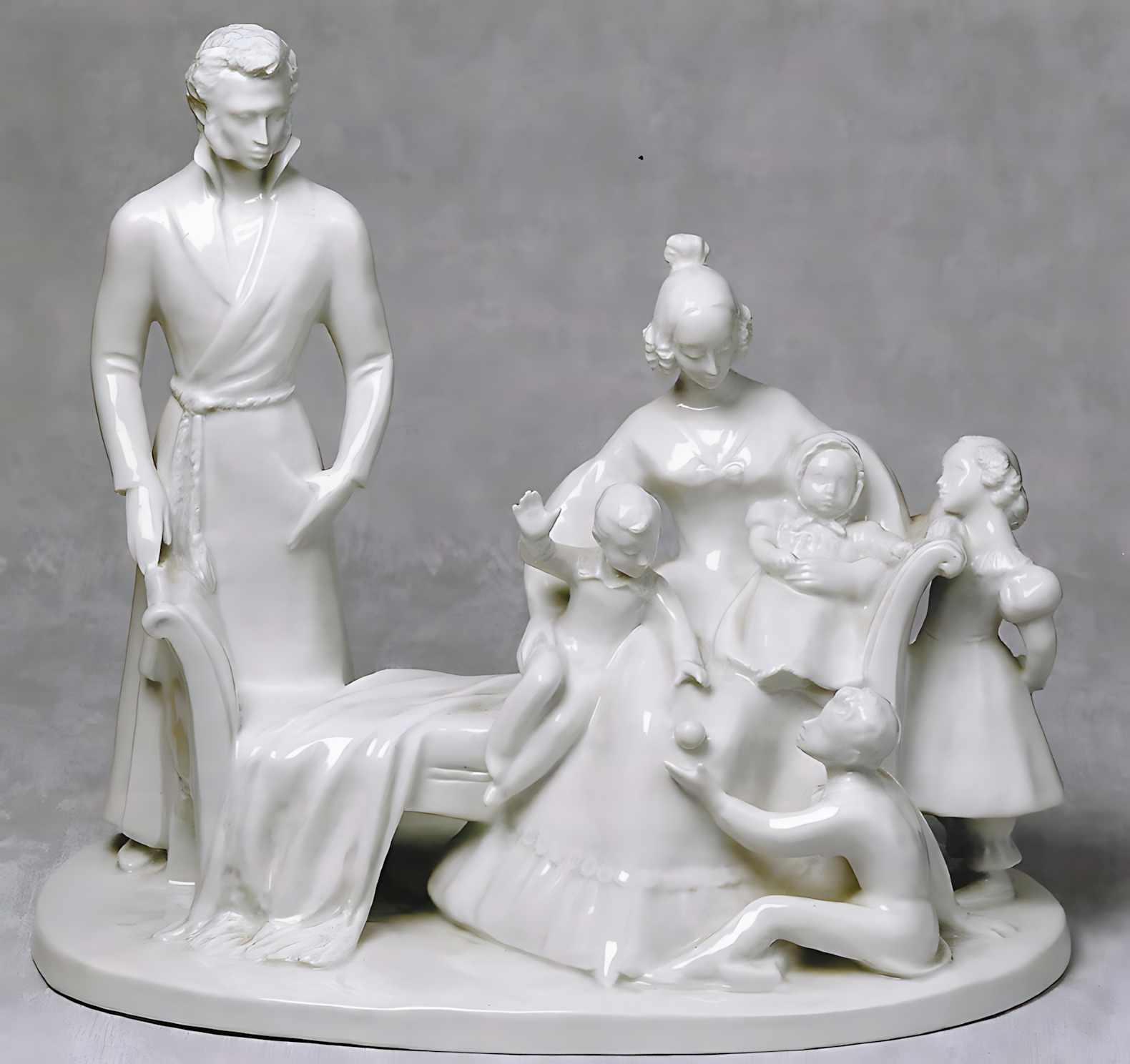
The multi-figure composition depicting Pushkin's family in an interior delights with its balance of figures and restrained colors. The snow-white glazed porcelain elevates the "holy family" to an idyllic height, allowing one to contemplate timeless harmony.
Введите подпись
**

Введите подпись
**
A.D. Brzhezitskaya "Pushkin with His Family", composition, 1984, Dulevo Porcelain Factory
As history shows, at a time when large-scale sculpture was seeking expressive means, its porcelain equivalent was already replicating familiar models. For the 200th anniversary, the Leningrad Porcelain Factory produced a series of goblets with saucers painted with motifs from Pushkin's works. Bright silhouette compositions successfully contrasted with the neutral background.
However, items created for the anniversary often reveal a petty interpretation of the theme, highlighting the ambiguity of Pushkin's image in the visual art of the late 20th century.