Danish Artist Who Delivered Blank Canvases Ordered to Repay Museum
222March 29, 2023
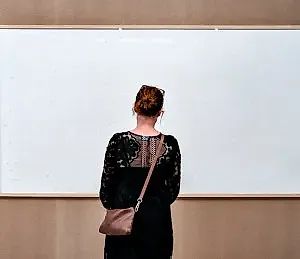
Danish artist Jens Haaning, who accepted a $76,000 commission (about 534,00 kroner) from the Kunsten Museum of Modern Art, has been ordered to repay the Aalborg, Denmark institution roughly $70,000 aftersubmitting a pair blank canvasesrather than the expected artworks. The museum had asked Haaning to recreate two of his earlier works for a 2021–22 exhibition titled “Work It Out,” which examined people’s relationship to labor. Dating to 2007 and 2010, respectively, the original works illustrated via sheaves of Danish currency occupying a larger frame and Austrian currency contained within smaller one the respective average annual incomes of the two named countries. Contending that the amount offered by the museum was not enough to cover the cost of the works’ making, and protesting what he termed the “miserable working conditions” to which artists are routinely subjected, Haaning instead produced two canvases whose sizes corresponded to those of the original works, but whose surfaces were notably bare, titling them collectivelyTake the Money and Run.RelatedHELEN FRANKENTHALER FOUNDATION SUED FOR “DESTROYING” PAINTER’S LEGACYBMA CREATES PAID INTERNSHIPS HONORING VALERIE MAYNARD “The work is that I have taken their money,” he told Danish public radio showPI Morgen, explaining that that “breach of contract is part of the work.” Kunsten CEO Lasse Andersson told NPR, “I actually laughed as I saw it.” The museum placed the work on view for the duration of the exhibition, where it garnered a terrific amount of attention and gained both Haaning and the institution broad international coverage. “Take the Money and Run.
. . is inscribed into an art history that leaves materials as a trace left behind or a framework for an idea or an action,” the museum’swebsitetrumpeted, comparing the canvas to works by Banksy and by noted Danish artist Bjørn Nørgaard. “The work can therefore both be seen as a critique of mechanisms within the art world, but also points to larger structures in our society. All as an item that can be calculated in monetary unites.
Even the lack of money in the work has a monetary value when it is designated as art and thus shows how the value of money is an abstract quantity.” Once the exhibition closed, the museum sued for the return of a very concrete quantity, as Andersson had promised it would. The court allowed Haaning to keep about $6,000 as payment for allowing the museum to exhibit the work..