Yoshio Taniguchi (1937–2024)
174Dec. 31, 2024
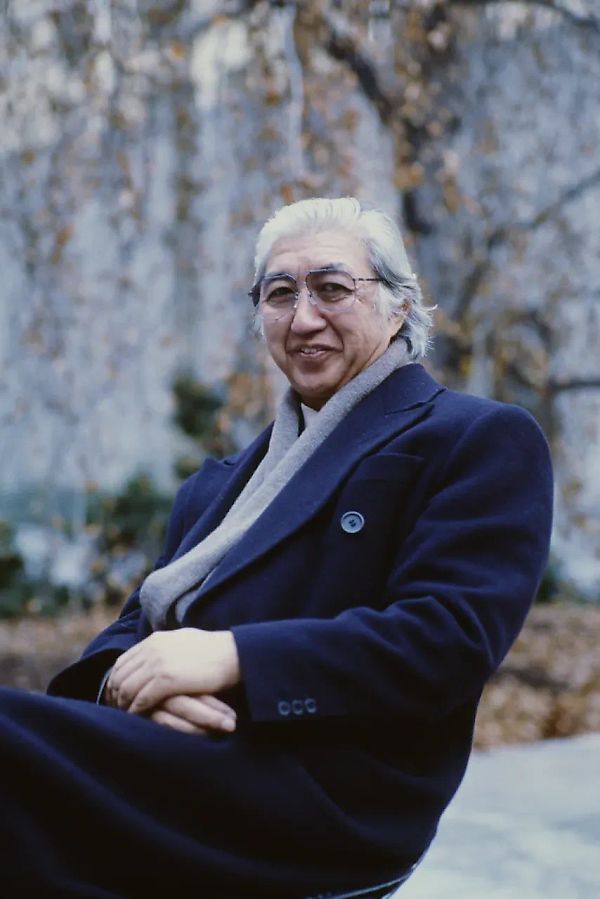
Japanese architect Yoshio Taniguchi, whose unexpected and airy 2004 renovation and expansion of the Museum of Modern Art doubled the New York institution’s gallery space and, in less than a decade, its attendance, died on December 16 at the age of eighty-seven. His death was announced by his company, Taniguchi & Associates, which confirmed pneumonia as the cause. Taniguchi was not widely known internationally when, in 1997, at the age of sixty, he beat out a number of up-and-coming young starchitects for the MoMA commission. His design sparked controversy, with detractors deriding what they deemed its vast, bland spaces, and supporters lauding its refined simplicity. Among the latter wasNew York Timesarchitecture critic Nicolai Ouroussoff, who praised it as “a serene composition that weaves art, architecture and the city into a transcendent aesthetic experience” and “one of the most exquisite works of architecture to rise in this city in at least a generation.”
Yoshio Taniguchi was born October 17, 1937, in Tokyo. His father was Yoshiro Taniguchi, the architect responsible for the design of Tokyo’s National Museum of Modern Art. After studying engineering at Keio University in his hometown, he moved to the United States to study architecture at Harvard University’s Graduate School of Design. Upon his graduation in 1964, he worked briefly for architect Walter Gropius, whom he later named as a major influence, before accepting a position with noted modernist architect Kenzo Tange’s studio. He remained with the Tange office through 1972 before spending several years teaching architecture at the University of Cape Town, in South Africa, and then at the University of California, Los Angeles.
In 1975, Taniguchi returned to Tokyo to launch his own office. Heeding his father’s advice not to take on too many projects at once, he quickly gained renown for his elegant, streamlined designs, evident in such projects as theKen Domon Museum of Photography(1983),Tokyo Sea Life Park(1989),Marugame Genichiro-Inokuma Museum of Contemporary Art(1991), and theToyota Municipal Museum of Art(1995), all in Japan.
In 1997, despite being largely unknown outside of Japan, and though he’d never participated in a competition, Taniguchi was one of ten international architects selected by MoMA to compete for the commission to expand its West Fifty-Third Street home. Among the younger, more avant-garde architects he beat out were Herzog & de Meuron, Steven Holl, Rem Koolhaas, and Bernard Tschumi. Taniguchi’s design—his first in the US—unified the museum’s original 1939 International Style building as well as Philip Johnson’s 1964 addition, including the sculpture garden, which Taniguchi recast as MoMA’s hub. On the east and west sides of the garden rose two identical structures, clad in black granite and dark gray glass; on the south side, he covered the façade of the extant residential building, designed in 1984 by Cesar Pelli and Associates, with milky white glass, extending through the seventh floor. The effect, for the visitor standing in the garden, was one of calm uniformity.
Completed in 2004, Taniguchi’s design divided audiences: Joseph Giovannini, writing in theLos Angeles Review of Booksin 2019 called it “godforsaken,” while Jim Frederick, writing inTimesome years earlier, pronounced it “extraordinary.” Some spurned its enormous, borderless galleries as inappropriate forums for many of the intimately scaled works in the museum’s collection, and scoffed at its lobby, whose large size and tendency to attract churning throngs delayed easy access to the art beyond. Others lauded its dramatic atrium, natural-light-flooded spaces, and multiple gallery entrance points, which invited wandering and discovery on the part of the visitor. The expansion underwent changes in 2014, with a Diller Scofidio + Renfro extension that, in addition to demolishing the American Folk Art Museum next door, added an angular metal canopy to call attention to the Fifty-Third Street entrance, in Taniguchi’s design a subtle aperture.
Following the MoMA commission, Taniguchi designed just one other US museum, the Asia Society Texas Center in Houston. Completed in 2012, the 40,000-square-foot limestone, cherry wood, and glass building is the architect’s only freestanding structure in the US. Among his other more recent works are anincinerator plantin Tokyo (2004), whose glass walls encourage visitors to reflect on their own production of waste; theD. T. Suzuki Museumin Kanazawa, Japan (2011), which is centered around a large, rectangular pond; and theHeisei Chishinkanin Kyoto (2014), which neatly contrasts with the Kyoto National Museum’s 1897 redbrick Meiji period building.
Throughout his career, Taniguchi remained guided not by a desire for critical acclaim but by the experiences of those entering his buildings. “In big European museums it is easy to get lost. You get tired visually and physically,” he told the Los Angeles Times’s Suzanne Muchnic in 2004. “I intentionally created places where people can locate themselves. This is a modern way of thinking—expressing function, not hiding.”