Pippa Garner (1942–2024)
169Jan. 3, 2025
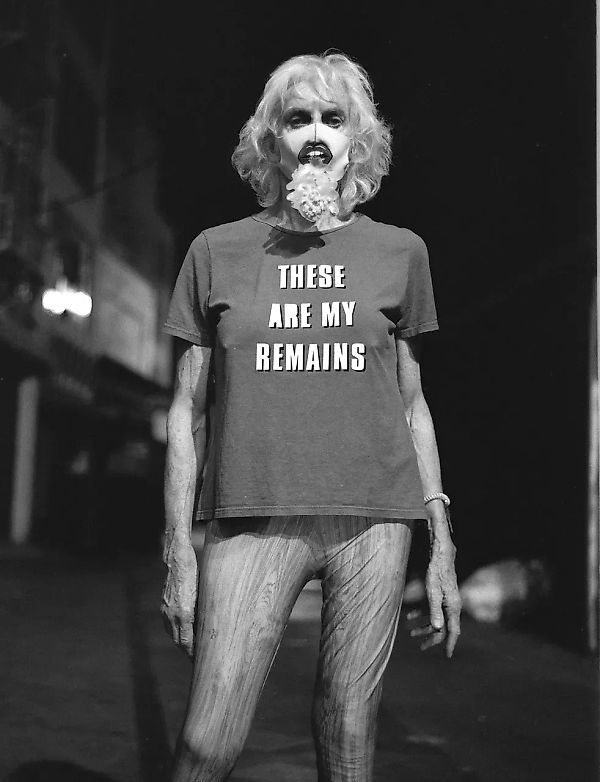
Pathbreaking multi-hyphenate artist Pippa Garner, known for her powerful, witty send-ups of consumer culture, died in Los Angeles on December 30 at the age of eighty-two after suffering from leukemia. A combat artist during the Vietnam War, Garner became an art world provocateur, modifying appliances, automobiles, and her own body to skewer American consumerism and traditional notions surrounding gender. Though her work remained comparatively unknown until the mid-2010s—she had just one solo show between 1986 and 2014—Garner remained not only undeterred but inspired by being relegated to the shadows. “This peripheral, outsider vantage point is essential for my work,” she toldSpikemagazine in 2018. “If I get too comfortable, there go the ideas.”
Pippa Garner was born in Evanston, Illinois, in 1942, to a mother whom she characterized as a “frustrated housewife” and father who sold ads to car companies. The glossy ads shaped Garner’s enduring fascination with automobiles at an early age. “I thought they were alive,” she toldFriezein 2023. “I would burst into tears when I saw the smashed up front-end of a car.” In the 1950s, her family relocated to Detroit, whose manufacturing industry was booming thanks a post–World War II surge in the demand for consumer goods. Following a brief stint working on the assembly line at the Chrysler factory there, Garner “flunked out of a couple of art schools.” With the Vietnam War raging, she was drafted into the US Army’s 25th Infantry, where she was assigned as a combat artist, photographing and sketching the conflict before returning to the US, where she attended the ArtCenter College of Art and Design in Los Angeles.
In 1969, while still in school, she made the sculptureKar-Mann (Half-Human, Half-Car), a diminutive fiberglass replica of a Volkswagen Karmann Ghia whose rear end comprised the lower half of a squatting human being. The car-centric work presaged her output of the next two decades, which included the remarkableBackwards Carof 1973, a 1959 Chevy modified so that it faced backward when driven forward. “It’s a tribute to the American automobile,” Garner toldEsquireof the Chevy, which took 250 hours to convert. “Also to the American public, whose demand for the unique makes such things possible.”
Other automobile-focused works followed, among them the drivableLong Time No Sea, 1986, a ’68 Buick LeSabre onto whose roof is grafted the windshield of a 1967 Datsun, giving the effect of a speedboat’s flying bridge. Garner for fifteen years contributed illustrations toCar and Drivermagazine, often depicting magnificently absurd inventions. Household appliances and other consumer goods, too, caught her gimlet eye, resulting in such interventions asproposalsfor children’s Harley-Davidsons, a jack-in-the-box-style globe and a ladder made from an escalator, andNeopop Businesswear, 1980–81, a men’s fashion line that included a suit from which the lower two-thirds of the jacket, shirt, and tie had been cut away to expose the wearer’s midriff.
Then there was her body. Garner began transitioning—or, as she referred to it, “gender-hacking”—in the mid-1980s, first taking black-market estrogen and then, in the 1990s, undergoing gender affirmation surgery. The change was motivated not by the feeling that she had been born in the wrong body, she said, but by a desire to make art. “A lot of the work I did at that time involved consumer appliances and automobiles, which I would modify to change their functions,” she toldFrieze. “Then, I looked in the mirror and thought: ‘I’m an object too.What can I do to play with my body?’I had the opportunity to get breast implants at a reasonable price, so I went ahead and did it. I went to Brussels in 1992 and came home with a vagina.” Later modifications included a knee-high tattoo of wood grain on her left leg and a permanently inked G-string, in the appropriate area, with hundreds of dollars in Monopoly money spilling from its strap.
Though Garner was a prolific artist and her oeuvre diverse, it was not until the mid-2010s that she finally received a spate of solo gallery exhibitions in Los Angeles and New York. Institutional solo shows included a 2022 exhibition at the Kunstverein München in Munich and 2023 outings at the Kunsthalle Zürich and Art Omi in Ghent, New York, the latter of which was memorably titled “$ell Your$elf.” Garner wasfeaturedin the Made in L.A. biennial at the Hammer Museum, Los Angeles, that same year, and saw the publication of the first-ever comprehensive monograph devoted to her work,Act Like You Know Me. The following spring, she participated in theWhitney Biennial.
In 2022, Garner was diagnosed with leukemia, which she believed was triggered by her exposure to Agent Orange in Vietnam. By the time of her passing, she was legally blind. “She wanted a trans president, universal healthcare, the end of testosterone toxicity overload and pet-troll-eum, hormones for all, lusty living to the very end,” wrote her friends in an Instagram post announcing her death. “For her, heaven was not in the sky but deep in Mother Earth. She will have a green burial in Marin County.”
Though the exact site of Garner’s final resting place has not been publicly revealed, she hinted at it in a conversation with curator Fiona Alison Duncan earlier this year. “I just want to make sure my body ends up where it belongs when I die,” she told Duncan: “in the junkyard with the appliances I’ve made fun of throughout my career.”