Plan to Open Leonora Carrington’s Home as a Museum Is Scrapped
153Oct. 24, 2024
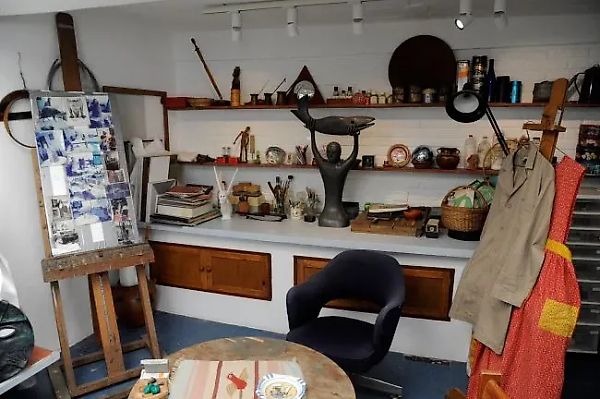
The Mexico City residence of surrealist painter and novelistLeonora Carringtonwill no longer open to the public as a museum as announced in 2021, but will instead be transformed into a research center, according to Spanish dailyEl País.The scuttling of the original plan, announced in 2021, is said to hinge on a dispute between the Universidad Autónoma Metropolitana (UAM), which owns the house, and its workers’ union.
Carrington, who is credited with feminizing surrealism, has in the past decade gained tremendous art-world acclaim: Her 1945 canvasLes distractions de Dagoberthammeredfor a record $28.5 million at auction this past spring. Though the artist was born in England, she lived largely in Mexico City for more than sixty years before her death in 2011. Her son Pablo Weisz Carrington sold her home on Chihuahua Street in the city’s Roma neighborhood to UAM for $500,000 in 2017, on the condition that it be turned into a museum, loaning the school some 8,000 objects. UAM’s vision for the transformation involved the display of forty-five anthropomorphic sculptures by Carrington, donated by Weisz, and visitor access to her living room, kitchen, and studio.
Rodolfo Pérez, a onetime general secretary of the UAM workers’ union, told El País that school officials had decided to open the house as a research center after refusing to create seventeen jobs at the museum, as requested by the union, and “violating the collective labor agreement.”
Yissel Arce Padrón, the general coordinator of outreach at UAM, refuted the notion of a dispute between the school and its unionized workers, explaining that Carrington’s home would become a “documentation center, because the university’s interest is basically investigative.” David Sánchez, director of academic and cultural liaisons at UAM, noted that the project “is more about documentation than about openness to the public, to recover the themes that were important to Leonora Carrington in her work in Mexico.”