Alicia Henry (1966–2024)
146Oct. 23, 2024
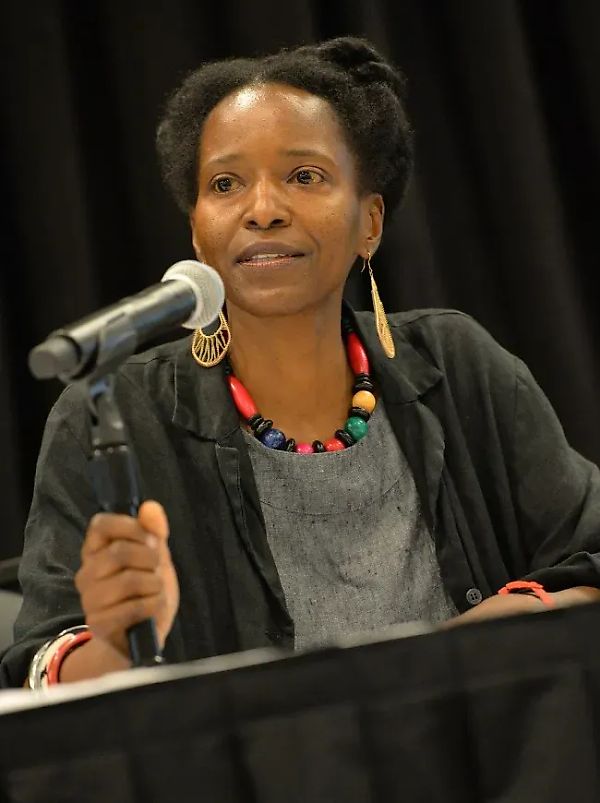
Multimedia artist Alicia Henry, who fashioned modest materials such as fabric, paper, and wood into portraits that powerfully evoked her subjects’ inner lives, died on October 16. She was fifty-eight. Henry’s gallery, Liliana Bloch in Dallas, said that the artist had been battling cancer for two years. Through figurative works that she made by layering fabric and hand-embroidery, Henry explored themes of isolation, interaction, family connection, identity, beauty, and the body. A chief concern was the tension between the physical, psychological, and social self, which she often revealed behind the quiet form of a seemingly expressionless mask. “The delicacy of [her work]—the kind of soft, quiet, methodical, silent aspect of it—not only does that reflect her personality so well, but also talks to the history of making things in silence, which was the way of survival of Black culture,” curator and artist María Magdalena Campos-Pons told theNashville Scenein 2023. “Part of the hidden power of her work resides in that modesty of gesture that, by consistency and commitment, becomes heroic.”
Alicia Henry was born in 1966 in Illinois. She earned her BFA from the School of the Art Institute of Chicago and her MFA from Yale University, attending the Skowhegan School of Painting and Sculpture in between obtaining her degrees. In the early 1990s, after graduating from Yale, she spent two years in Provincetown, Massachusetts, as a fellow at the Fine Arts Work Center. “The residency gave me space to take risks and experiment without the pressure to fit into some other mold—to be who I was becoming,” she told theProvincetown Independentin 2023. Following two years spent in Ghana teaching art with the Peace Corps, she returned to the US and taught art on the Pine Ridge Reservation in South Dakota. In 1997, she took a role as a professor in the Language and Arts Department at Fisk University in Nashville, one of the oldest HBCUs in the US, to which she was drawn by its deep collection of works from the African diaspora, and where she remained on staff for twenty-seven years.
Henry counted among her influences American minstrelsy, European clowning traditions, and her own collection of African masks. Many of her works conjured faces or masks, and a number of them interrogated the female form, for example Untitled, (13 female figures), 2019, which presents among other Black female figures a towering, goddesslike woman flanked by a diminutive pair of silhouetted girls; a group of women of various ages who appear to be related but emotionally and physically close to one another in varying degrees; and a featureless young girl who blankly faces the viewer, her smock or apron suggesting labor. “I’ve always had the feeling that behind that work there is pain,” Mark Scala, chief curator of Nashville’s Frist Art Museum, told the Nashville Scene. “I don’t know if it’s personal pain or cultural pain, probably both. But I can’t look at the work quickly—I have to spend time with it.”
Henry exhibited widely, participating in the Havana Biennial and the Atlanta Biennial, both in 2019, and in group and solo shows at institutions including the Carnegie Museum of Art, Pittsburgh; the Pennsylvania Academy of Fine Arts, Philadelphia; the Whitney Museum of American Art, New York; the Aldrich Contemporary Art Museum, Ridgefield, Connecticut; and the Museum of Contemporary Art, Sydney. She received her first solo Canadian exhibition, “Witnessing,” at the Power Plant, Toronto, in 2019, hanging dozens of two-dimensional masks cut from leather in various shades of red on the gallery’s white wall. Collectively titled Analogous II, 2019, the drooping, depthless visages at once read as comprising a watchful throng and a total vacuum. “[Henry’s] textural approach to portraiture eschews physiognomic mimicry in favor of generational inheritances, where Henry’s durationally processed materials give the appearance of multiple faces superimposed onto each other like masks,” wrote Magdalyn Asimakis, reviewing the show for Artforum. “The individual components appear to oscillate between abstract cutouts and images of heads, arms, and legs, but they never compose a single body. In insisting on this level of fragmentation within portraiture, Henry seems to question the relationship between visibility and identity and, as the artist has emphasized, explore what it is to see and to be seen.” Henry’s first solo UK exhibition, “Alicia Henry: To Whom It May Concern,” took place at Tiwani Contemporary, London, in 2021.
Asked by curator Daina Augaitis in a 2022 interview for the Art Gallery of Nova Scotia what she wanted viewers to take away from her work, Henry was succinct. “Live your life fully and don’t take things for granted,” she said. “Live it with joy and love and when there’s something that’s not right,” she concluded, “speak up and act on it.”