Rebecca Horn (1944–2024)
160Sept. 11, 2024
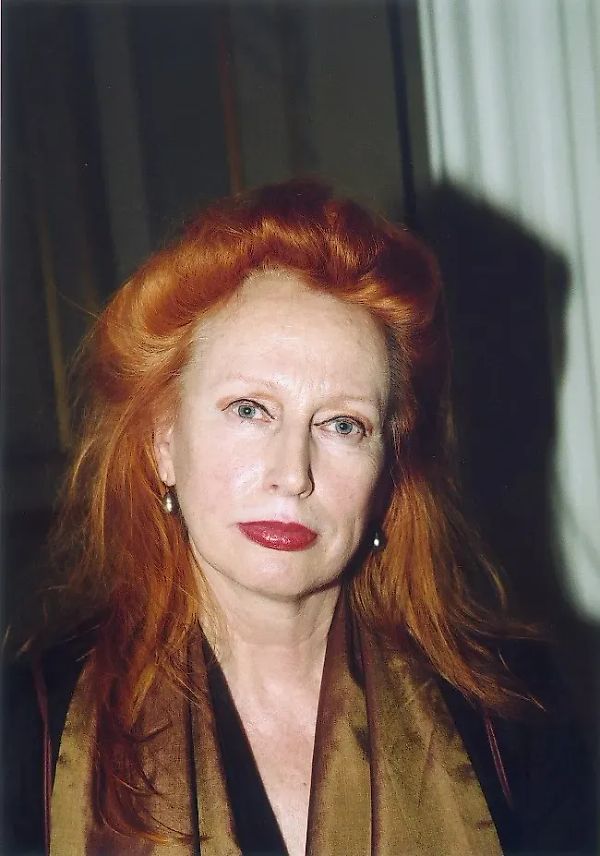
Transformative German artist Rebecca Horn, whose machinic installations, dreamy films, and phantasmal body art pushed at physical and psychological boundaries, died September 6. She was eighty. Horn had exited the public eye in 2015 following a stroke that postdated a career spent creating a multifaceted oeuvre that seethed with energy. “With the work of Rebecca Horn one must pay attention to the references to the conditions of her own life without losing sight of the symbolic role of such visual communication,” wrote Germano Celant in a 1984 issue ofArtforum. “Her strength lies in her recognition of both the primacy of experience and the interdependence between a relationship with the self and a relationship with the world. She demonstrates that art needs to be understood not only in terms of formal and historical structures, but also in terms of the subject matter itself.”
Rebecca Horn was born in Michelstadt, Germany, to Jewish parents at the close of World War II, on March 24, 1944. The family moved frequently. “We could not speak German. Germans were hated,” toldThe Guardianin 2005. “We had to learn French and English. We were always travelling somewhere else, speaking something else. But I had a Romanian governess who taught me how to draw. I did not have to draw in German or French or English. I could just draw.” The practice would become essential for Horn during a bout with tuberculosis, which she contracted as a teen. In 1963, she enrolled in the Hochschule für bildende Künste Hamburg; shortly thereafter, while living in Barcelona, she was forced to abandon her studies and enter a sanitorium after contracting a lung infection from working with fiberglass, with whose deleterious properties she was not familiar. During the year she spent there, her parents died. “I was totally isolated,” she toldThe Guardian. “That’s when I began to produce my first body-sculptures. I could sew lying in bed.”
On her release, Horn turned in earnest to these sculptures, which were themed around the contact between the individual and their environment. Celant described these body-worn pieces as “elaborations of the self, envelopes which give meaning to the fluctuations and pleasures that occur between the self and the outer world. Through them, Horn is reflected.” One of her most recognized works of this nature isEinhorn(Unicorn), 1970–72, a single prosthetic horn of remarkable size, strapped to the head of an otherwise nude or semi-nude female performer. Horn exhibited the work at Documenta 5 in 1972, becoming the Kassel quinquennial’s youngest-ever participant at the age of twenty-eight. Other notable works involving body modification includePencil Mask, 1972, a cagelike headdress made of fabric straps, to which are attached pencils, their points protruding outward, allowing the wearer to mark surfaces by moving her head about; andFinger Gloves, 1972, a pair of wood-and-fabric prostheses meant to be slipped over the hands, giving the wearer eerie, rigid, clacking, three-foot-long phalanges.
As the 1980s dawned, Horn, who had recently moved from New York to Paris, found herself in Italy, making a film that was to show, among other things, the fanned-out tail of a peacock. After her avian subject lost his tailfeathers ahead of his star turn, the artist built a stand-in,Pfauenmaschine(Peacock Machine), 1982, a metal semicircle to which were attached a series of white metal rods in a fan shape, mimicking the titular bird’s tail, that slowly waved forward and back, courtesy of a droning motor. The work presaged her turn to machinic installations, which gradually took the place of body art. Horn, who said she was interested in “the soul of a thing” and “not the machine itself,” described these kinetic works as “hav[ing] a soul because they act, shake, tremble, faint, almost fall apart, and then come back to life again.”
The artist’s installations became larger, grander, in the 1990s, as typified for example by 1999’sConcert for Buchenwald, a massive installation incorporating heaps of broken string instruments such as guitars, mandolins, and violins, and featuring 130-foot-long glass walls behind which were trapped layers of ashes, or “archives of putrefaction,” as Horn described them. By now living in Berlin, she also began making films, including the 1990 featureBuster’s Bedroom, a tribute to comedian Buster Keaton, whose slapstick physical comedy fascinated her.
Coincident with her practice, Horn maintained a teaching career at Berlin’s Hochschule der Künste, beginning in 1989 and finishing in 2004. She retired fully from teaching in 2009, after which she moved her studio to her grandfather’s former textile factory in Bad König, Germany, establishing the Moontower Foundation there, which includes a museum and artist’s studios. Her work is held in the collections of numerous global art institutions, including the San Francisco Museum of Modern Art; the Museum of Contemporary Art, Los Angeles; the Walker Art Center, Minneapolis; the Museum of Modern Art and the Solomon R. Guggenheim Museum, both in New York; Tate London; the Centre Pompidou, Paris; the Stedelijk Museum, Amsterdam; the Van Abbemuseum, Eindhoven, the Netherlands; the Zentrum für Kunst und Medientechnologie, Karlsruhe, Germany; the Castello di Rivoli, Turin; and the Art Gallery of New South Wales, Australia. Aretrospectiveof her work is on view through October 13 at the Haus der Kunst, Munich.
Though Horn’s work grew increasingly intricate in its construction and remained always so in its expression, its premise was enduringly simple. “I use my body, I use what happens to me,” Horn told The Guardian, “and I make something.”