Jackie Winsor (1941–2024)
143Sept. 6, 2024
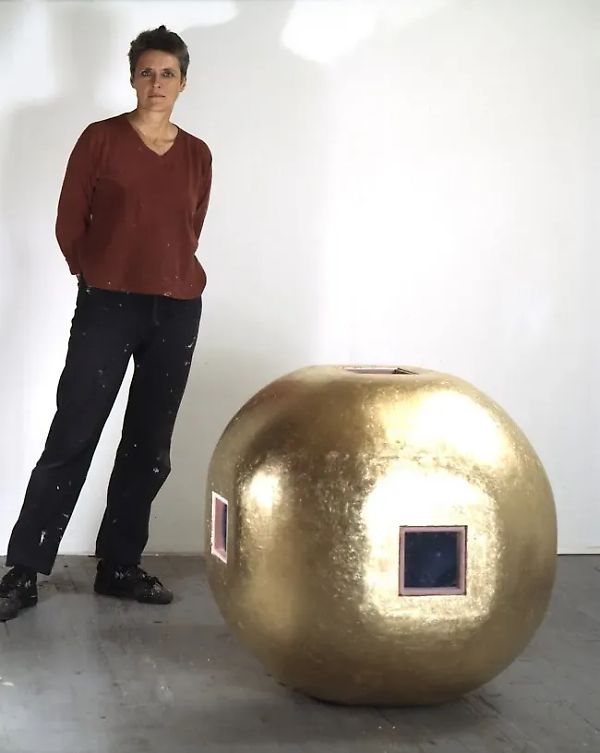
Canadian American sculptor Jackie Winsor, who gained renown in the 1970s for her spare, process-based works wedding geometry to inchoate warmth, died following a stroke on September 3. She was eighty-two. Shaped by her childhood on the rugged, windswept coast of Newfoundland, Winsor brought to her practice an abiding concern with scale, nature, and density. Often created through a long, laborious procedure from organic materials such as hemp, copper, wood, and even entire trees, her careful, cogent works possess a grounding evidence of their facture that sets them apart from the typically sleek, industrial-looking work of her Minimalist peers.
“Jackie Winsor’s sculptures are so sober, deliberate, and palpably saturated with experience that it is not surprising to learn that her artistic output to date has been relatively small,” wrote James Yood in a 1992 issue ofArtforum. “[Her] sometimes extraordinary interventions come not from a desire for spectacle, but, rather, from an obsession with her experiential interaction with her objects—with incorporating the process while nevertheless retaining their quite palpable holistic essences. Winsor selectively burns, explodes, braids, paints, wraps, knots, piles, gilds, coils, nails, and gouges her sculptures, all the while maintaining, and even enhancing, their inherent dignity and integrity.”
Vera Jacqueline Winsor was born on October 20, 1941, in Saint John’s, Newfoundland, the second of three daughters descended from ship captains and farmers. Her father, an engineer, harbored architectural aspirations, and Winsor spent her youth helping him build houses, being given the job of straightening old nails at the age of eight. “In my childhood I was as familiar with a plumb and square as I was with oatmeal,” she toldOxford Art’s Whitney Chadwick. In 1952 the family moved to Boston. Winsor studied painting at the Massachusetts College of Art and Design before earning her MFA at Rutgers University, where she turned her attention to sculpture. Shortly thereafter, she moved to New York with classmates Joan Snyder and Keith Sonnier, whom she married in 1966 (the couple divorced in 1980).
Winsor’s early New York works, many of them made of rope—which the artist linked back to her seafaring heritage—dipped in polyester resin or latex, are characterized by an anti-formal bent. Exemplary of her work of this time wasRope Trick, 1967–68, a six-foot length of rope standing vertically on its unraveled end, supported by a concealed metal rod. Harkening back to her own personal history,Nail Piece, 1970, consisted of seven-foot lengths of board so densely nailed together that their top surface appears paved with nails. “I wanted the wood to be solid with nails . . . to compress the planks so tightly and so densely as to almost make it one piece of wood,” she toldAvalanchein 1972, “but mostly I was interested in a feeling of concealed energy.” HerBrick Domeof 1971, which debuted at the Lucy Lippard–curated “Twenty Six Contemporary Women Artists,” mounted at the Aldrich Contemporary Art Museum in Ridgefield, Connecticut, and comprised bricks jutting lengthwise into a concrete hemisphere, evoked both heft and the repetitive action of its making: Winsor constructed the work on-site over the span of three thirteen-hour days.
The artist continued to work in her preferred slow, routine mode throughout the 1970s, creating an average of three sculptures a year. Chief among her influences was the work of choreographer Yvonne Rainer, whose incorporation into her dance pieces of mundane, everyday moves Winsor admired. “What interested me was that these abstractions had a physical presence because they were acted out withbodies,” she told theLA Times’s Cathy Curtis in 1992. Winsor in the mid-1970s turned from construction to destruction, and from organic shapes to the cube, working with mirrors, wood, and concrete, which she variously exploded, lit on fire, or dragged behind a car. The 1980s brought an interest in the pyramid and a hitherto unexplored fascination with color, while the ’90s found her turning to wall-inset pieces, open, pigmented cubes set within slightly larger cubes that appeared to act as frames for the colored interiors once the sculpture was set into the wall.
Winsor participated in four Whitney Biennials between 1973 and 1983 and in 1979 was the subject of the first retrospective awarded a female artist at the Museum of Modern Art, New York, since 1946. Her work was included alongside that of Lynda Benglis, Eva Hesse, Ana Mendieta, and Dorothea Rockburne in the 1996 survey “More than Minimal: Feminism and Abstraction in the ’70s” at the Rose Art Museum at Brandeis University in Waltham, Massachusetts, and she enjoyed solo exhibitions at museums including the Milwaukee Art Museum; the Museum of Fine Arts, Boston; and P.S.1 Contemporary Art Center, New York. Winsor’s work is held in the collections of institutions including the San Francisco Museum of Modern Art; the Carnegie Museum of Art, Pittsburgh; the Museum of Modern Art, New York; the National Gallery of Australia, Canberra; and the Fonds National d’Art Contemporain, Paris.