Kasper KÖnig (1943–2024)
180Aug. 13, 2024The names
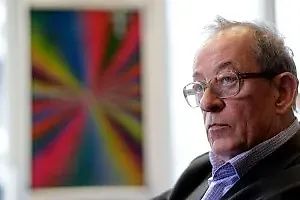
German curator and educatorKasper König, a cofounder of Germany’s Skulptur Projekte Münster, the founder of Frankfurt’s Portikus, and a onetime director of Cologne’s Museum Ludwig, died in Berlin on August 9. He was eighty. In the course of a career spanning sixty years, König consistently elevated contemporary art to new heights, continually presenting novel forms in fresh sites. In directing its presentation, he also shaped its reception, and his keen awareness of this fact underscored his talent in bringing cutting-edge work to a broad array of viewers. “My job is to make [art] attractive to people but not to lure them in under false pretenses,” he toldArtforum’s James Hall in 2000. “A museum can’t compete with soccer or pornography.”
Kasper König was born Rudolf König in Mettingen, Germany, in 1943; he would adopt the name Kasper some twenty years later. Though the details of his youth remain nebulous—he may or may not have joined the merchant marine—he is widely believed to have begun his career as an intern at Galerie Rudolf Zwirner in Cologne in the early 1960s before taking a job as a courier for Robert Fraser Gallery, for whom he delivered a pair of Francis Picabia paintings to New York. Taken with the city’s burgeoning art scene, he moved there and began working for Andy Warhol at the Pop artist’s Factory. During this time he served as a representative for Moderna Museet and curated exhibitions for the Stockholm institution, including those of Warhol and Claes Oldenburg. In 1968, with his brother Walther König, he cofounded an art publishing house that would eventually becomeWalther König Verlag, which remains well known today.
In 1977, alongside Klaus Bussmann, König established Skulptur Projekte Münster, a sculpture-themed international exhibition of public artworks taking place once every ten years in the Westphalia city. Among the notable works contributed by artists to the show over the decades are Claes Oldenburg’sGiant Pool Balls, 1977, three massive concrete spheres that seemed to render the grassy park in which they were set a Goliath’s playing field; Keith Haring’s 1987Red Dog for Landois, an oversize red Cor-Ten steel sculpture of a barking dog seeming to erupt from the ground outside a former zoo; Pawel Althamer’sŚcieżka [Path], 2007, a roughly half-mile-long path trampled in a grassy meadow; and Pierre Huyghe’s 2017After ALife Ahead, for which the French artist transformed an ice rink into a green and hilly landscape through which peacocks strutted. Roughly three dozen works stemming from the decennial remain on permanent view throughout the city.
In 1981, König and critic Laszlo Glozer organized the pathbreaking exhibition “Westkunst” in Cologne, with the aim of limning the history of European and American art since 1939 through roughly eight hundred works by two hundred artists. In 1987, in Frankfurt, he founded Portikus, a contemporary art kunsthalle affiliated with the city’s Städelschule, which quickly gained renown for its exhibition program featuring both international and emerging artists, a number of them students at the Städelschule, where König taught from 1988 to 2000, and where he served as rector beginning in 1989.
In 2000, he accepted the position of director of Cologne’s Museum Ludwig, a role to which he brought his usual appetite for experimentation. “There are so many museums in Germany that show exactly the same art—say, a Long, a Merz, and a Kiefer in a big room,” he toldArtforum’s Hall. “I want to emphasize that Cologne is a particular place with its own collections and traditions.” During his tenure there, which ended in 2012, he oversaw the organization of roughly 140 exhibitions and led the institution’s renovation. In 2023, he donated fifty works from his own collection to the museum, including works by Jeremy Deller, Isa Genzken, Dan Graham, Thomas Hirschhorn, and Jenny Holzer.
Among the other exhibitions König curated were the Austrian Pavilion at the Fiftieth Venice Biennale in 2003 andthe peripatetic European biennial Manifesta 10 in St. Petersburg, Russia, in 2014. He is survived by his wife, artist Heidi Specker, and by two daughters and two sons from previous marriages. Both his sons are dealers, with Leo König operating out of New York and Johann König running galleries in Berlin, Seoul, Munich, and Mexico.