BrÂncusi Sculptures Join Unesco World Heritage List
191Aug. 1, 2024
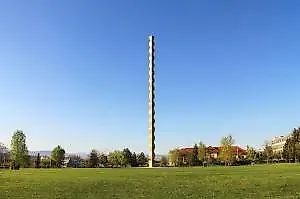
A set of outdoor sculptures by Romanian artist Constantin Brâncusi is among twenty-four sites added by Unesco to its World Heritage list. The works, dating to 1937–38, pay tribute to the country’s soldiers killed in World War I and occupy a roughly mile-long axis of the Avenue of Heroes in the southwestern Romanian town of Targu Jiu, near the sculptor’s birthplace of Hobita. Among the newly protected Brâncusi works is the iconicEndless Column, seventeen brass-clad cast-iron rhomboids stacked in a roughly hundred-foot-high pillar. Also included are the artist’sTable of Silence, a limestone table surrounded by a dozen stools, or backless chairs, of the same material, andGate of the Kiss, a marble gate bearing a kiss motif.
“The remarkable fusion of abstract sculpture, landscape architecture, engineering, and urban planning conceived by Constantin Brâncusi goes far beyond the local wartime episode to offer an original vision of the human condition,” said Unesco in a statement.
“The granted recognition forces us to protect the monumental ensemble, to keep it intact for future generations and for humanity’s cultural memory,” said Raluca Turcan, Romania’s culture minister, in a statement.
Established in 1972, the Unesco World Heritage List aims to identify and preserve sites of outstanding cultural or natural importance to the global common heritage of humanity. The list currently comprises 1,200 sites including a variety of historical, cultural, and natural landmarks in more than 160 nations.
New entrants to the list this year additionally included Italy’s Appian Way, an ancient highway linking Rome to the southern city of Capua and later to Brindisi; the abandoned Kenyan city of Gedi, which between the tenth and seventeenth centuries was one of the most important Swahili cities on Africa’s East Coast; the Hegmataneh archaeological site in northwestern Iran, which contains crucial evidence of the Medes civilization of the seventh and sixth centuries BCE; and Phu Phrabat in Thailand, an example of the Sima stone tradition of the Dvaravati period, which spanned the seventh to eleventh centuries.