Ben Vautier (1935–2024)
240June 6, 2024The names
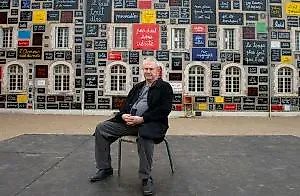
Self-taught French artist and provocateurBen Vautier, a cofounder of the Fluxus movement known for his humorous text-based paintings, took his own life June 5 at his home in Saint-Pancrace, France, hours after his wife, Annie, died of a stroke. Vautier—who frequently went by the mononym Ben—was eighty-eight. The couple’s children, Eva and Francois, confirmed his death. Beginning in the 1950s, Ben was a vocal proponent of the idea that “everything is art,” not only incorporating the phrase into many of his works (tout est art), but embracing life itself as inseparable from art. Indeed, his text works, often scrawled in white paint on a black background, wormed their way into the national consciousness of France, if not the world. “On our children’s pencil cases, on so many everyday objects and even in our imaginations, Ben had left his mark, made of freedom and poetry, of apparent lightness and overwhelming depth,” said French president Emmanuel Macron in a statement addressing the artist’s death.
Ben Vautier was born in Naples in 1935, the great-grandson of renowned Swiss genre painter Benjamin Vautier (1829–1898). His parents divorced when he was young, and he spent an itinerant childhood with his mother, living in Turkey, Egypt, and Switzerland before finally settling in Nice, near his mother’s native Antibes. “I was very sad because my father went away with my brother who was one year older than me, and I was separated from my brother,” he toldForbes’s Y-Jean Mun-Delsalle in 2023. “I think I must have been traumatized because I made a kind of wall. . . . I never talk about my childhood.”
A poor student, Ben was removed from school by his mother and put to work in a bookshop, Le Nain Bleu, where he discovered art within the pages of the volumes intended for sale. Drawn to the abstractions of Picasso, Serge Poliakoff, and Pierre Soulages, he cut out the pictures he liked best and tacked them to the wall of the attic in which he was then living, hoping no one would notice. Before he was twenty, he had embraced the concept that “art must be new”: The sentiment would soon align him with the Fluxus movement.
In 1958, Ben opened a record store in Nice called Laboratory 32 (Le Magasin), which he would run through 1973; in its top floor, a space so tiny that visitors couldn’t even stand up in it, he opened a gallery called Galerie Ben Doute de Tout. Through the shop and gallery, which together functioned as a kind of salon, he met Yves Klein and gained an interest in Nouveau Réalisme; he also met Fluxus cofounder George Maciunas, who introduced him to the work of French dadaist Marcel Duchamp and the music of John Cage, both of which proved of shattering importance to Ben.
His wide-ranging practice would soon encompass mail art; performances, which he called “Gestes” and which were frequently crude in nature; and the black-and-white cursive word paintings for which he became most widely known. Many of these celebrated life, while still others queried the human condition or took aim at the egotism of artists (from which he himself was not immune). All were intended to provoke thought; some were meant to spark fights. His text works in particular anticipated the work of artists such as Jenny Holzer, Barbara Kruger, and Richard Prince. “Vautier,” wrote Bary Schwabsky in a 1999 issue ofArtforum, “is an artist of relentless volubility.”
Characteristic of Ben’s irreverent nature were works such as boxed editions of God; wineglasses in limited editions of twenty, accompanied by certificates verifying that he had drunk the contents in sequence;Flux missing card deck, 1966, a deck of playing cards from which he had removed the ace of spades; and so-called appropriation works, found objects that he branded art by writing on themBen, je signe(I, Ben, sign). HisKUNST IST ÜBERFLÜSSIG(Art is Superfluous), 1972, took the form of a banner proclaiming the titular sentiment, strung provocatively across the top of the Fridericianum in Kassel at Harald Szeemann’s Documenta 5. As Ben had intended, his work leaked outside the walls of the museum, becoming enmeshed in the fabric of everyday life, as embodied for example by hisLe Mur des Mots (The Wall of Words),1995, a group of plaques bearing brief texts relating to art, life, and philosophy and covering a 100-by-40-foot exterior wall of the art school in Blois, France. Too, it lent itself well to reproduction, appearing on the pencil cases referenced by Macron, as well as school bags, notebooks, and the steps of the tramway in Nice.
In recent years, Ben was awarded retrospectives at the Musée d’Art Contemporain in Lyon, France; the Museum Tinguely, Basel; and the Museo Universitario Arte Contemporáneo in Mexico City. His work is held in the collections of major arts institutions around the world, including the Walker Art Center, Minneapolis; the Museum of Modern Art, New York; the Museo Nacional Centro de Arte Reina Sofía, Madrid; and the National Gallery of Victoria, Melbourne. His record shop, which by the end functioned as a kind of evolving sculpture, was reassembled inside the Centre Pompidou, Paris, where it remains today.