Marc Camille Chaimowicz (1946–2024)
296May 24, 2024The names
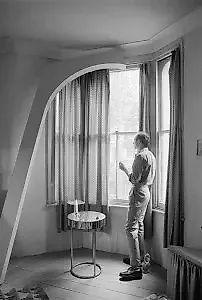
Paris-born artist Marc Camille Chaimowicz, whose work interrogated the boundary between art and design, has died at the age of seventy-seven. News of his death was announced May 23 by contemporary art center Wiels, in Brussels. Chaimowicz was known for uncategorizable and often gloriously chaotic room-size installations. Often incorporating work by other artists, these environments argued against the suppressed emotions and clean lines of Minimalism, their wall coverings, textiles, furnishings, objects, and artworks harmonizing to create in the viewer the sense of occupying a waking dream and erased the boundary between public and private life.
“The sexually ambivalent sensibility that suffuses his environments, installations, and performances seduces the viewer into reflection and reverie,” wrote Michael Archer in a 2004 issue ofArtforum. “Visually rich and precisely observed, the objects and images he designs, makes, and gathers from elsewhere propose connections, set up oppositions, and trace narratives in a dense play of puzzle, metaphor, and interpretative possibility.”
Writing inOculanearly twenty years later, Joe Bobowicz was more succinct. “Often described as an ‘artist’s artist,’” he asserted, Chaimowicz was “responsible for pioneering installation art long before the term ‘immersive’ became a press release cliché.”
Marc Camille Chaimowicz was born in postwar Paris in 1946, the son of a Polish Jewish father and a Roman Catholic mother. The family lived in Montparnasse until Chaimowicz was eight, when they decamped for England and the suburban town of Stevenage, the first of the new towns created by the country to house those displaced by World War II bombings. The move proved stressful for the young artist, who spoke only French at the time. “[My parents had] heard that the English education system was very good,” Chaimowicz told Gaby Wood of theNew York Times’T Magazinein 2018. “They hadn’t heard about the class system.” The experience would forever mark his practice, which explored family, memory, and concepts of place and home.
Chaimowicz enrolled in Ealing Art College at the age of sixteen, then went on to attend the Camberwell School of Art before entering the postgraduate program at London’s Slade School of Fine Art. Following a visit to Paris, during which Chaimowicz experienced first-hand the protests of May 1968, the artist returned to London, torched all his undergraduate paintings, and turned his focus to installations that challenged the idea of art, décor, and design as separate from one another.
“[My desire to do so] came out of an early engagement with feminist theory,” Chaimowicz told theArt Newspaper’s Louisa Buck in 2023. “Because it was so male-driven, and black and white, the dominant left-wing ideology seemed as alienating as what it was contesting. Color was seen as decadent and pleasure as reactionary, and for me that had to be recalibrated. And so domesticity became a sort of metaphor for me. I was also questioning the very function of visual art practice and its implicitly elite role in the canon.”
Chaimowicz created his breakout work, Celebration? Realife, in 1972. Inspired by the aforementioned protests of May 1968, the installation, at Gallery House in Kensington, conjured a disco from which revelers had recently vanished, complete with a glitter ball rotating high overhead in the former ballroom, and objects of the type one might find in a flea market strewn about. Viewers were invited in an adjacent room to discuss the work over coffee; the artist himself slept in the gallery at night for the duration of the exhibition. A few months later, at London’s Serpentine Gallery, he presented Enough Tiranny, another “scatter environment” filled with art-historical references, illuminated by colored lights, and featuring a contemporary glam-rock soundtrack.
A 2003 installation found the artist exploring Jean Cocteau, through a reimagining of the French artist’s apartment furnished in part with his own belongings and works by others, conjuring “a sort of fantasy about that which is Parisian,” he told Artforum’s Archer in 2004, citing his childhood uprooting and the French pleasures he feared he had missed as a result. Though his typical concern was with human habitats, he expanded his purview to include canaries in one 2014 exhibition, for which he variously created and commissioned objects, ranging from ceramic vases to metal bike racks to a newspaper-covered stepladder, around which forty of the colorful birds flitted, singing cheerily.
As his work gained broader acclaim over the years, particularly for its prescience in predicting the porous public/private boundaries of the internet, as suggested by Hans Ulrich Obrist, Chaimowicz frequently re-created older works for exhibitions at galleries and institutions.
“One thing I wonder about is whether the work still has a degree of radicality,” he told Artforum’s Lauren O’Neill Butler in 2009. “It was shown several years ago in Zurich, where no one had heard of me. It was interesting because art students were asking about this ‘new young artist.’ They presumed youth behind the work, which implies, perhaps, that there is still a critical urgency.”
Among the solo exhibitions Chaimowicz enjoyed recently were those at London’s Serpentine Gallery in 2016; the Triennale di Milano in 2016–17; the Jewish Museum, New York, in 2018; and Wiels in 2023. His work is held in the collections of institutions including the Museum of Modern Art, New York; Tate Modern and the Victoria & Albert Museum, both in London.
Though memory and the mists in which it necessarily resides formed the glowing core of his oeuvre, Chaimowicz in later years hinted that recollection for him might also have been a kind of prison. Pressed by T magazine on the topic of his exit from a dwelling of forty years in favor of new digs, the artist expressed joy at escaping that very personal environment. “It’s the purest pleasure,” he said, “partly because I’m able to break free from my past.”