Pro-Palestine Protest at Venice Biennale
205April 20, 2024
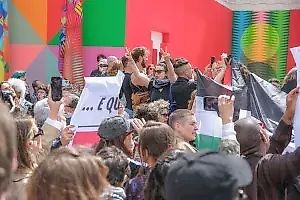
A Pro-Palestinian protest greeted visitors to the SixtiethVenice Biennale’s inaugural preview day, held Wednesday, April 17. The demonstrators—reportedly numberingupward of a hundred—made their initial stand outside the Israeli and US pavilions, which are proximate, where they scattered and handed out red fliers reading “No Death in Venice—No to the Genocide Pavilion.” Some demonstrators entered the US pavilion, which ishosting an exhibitionby Jeffrey Gibson, the first Native American artist to represent the nation. From there, the protesters continued on to the French, British, and German pavilions, stopping in front of each to call out the relation between the sponsoring nation and Israel,drawing attentionto the roles of Germany and the US in exporting weapons. Though a discreet police presence was noted, no official attempt was made to halt the demonstration, and a number of visitors are said to have joined the effort, which ended after about an hour, with participants leaving the Giardini.
Organization of the demonstration was credited to the Art Not Genocide Alliance (ANGA), a coalition of artists, activists, and cultural workers that had earliercalledin anopen letterfor Israel to be barred from the Biennale. Ruth Patir, the artist representing Israel, and curators Mira Lapidot and Tamar Margalit, who organized her exhibition,announcedon April 16, the Biennale’s media preview day, that their country’s pavilion would not open until ceasefire and hostage-release agreements were in place. ANGAslammedthe gesture as “empty and opportunistic” and “timed for maximum press coverage,” noting that a video by Patir remained on view through the shuttered pavilion’s window.
As of April 15, according to the health ministry in Gaza, nearly 34,000 residents have been killed in Israel’s assault on the region, launched in retaliation for the October 7 Hamas attack on Israeli soil in which 1,200 were killed and 250 taken hostage.