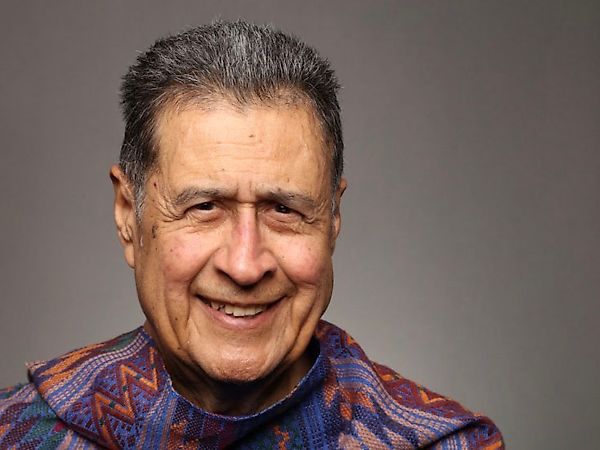
Gilberto Cárdenas, one of the country’s top collectors of Latinx art and a leading scholar of Latino studies, died on July 26 at his home in Austin, Texas. He was 79 years old. With his wife Dolores Carrillo García, Cárdenas, a sociologist and professor emeritus at the University of Notre Dame, built up a collection of some 20,000 of works of Chicanx and Latinx art, with an emphasis on elevating photography and prints to the same level of the other objects they amassed over several decades. “I’m a bottom-up collector,” he told ARTnews in a 2024 feature that labeled him a “true believer collector.” Related Articles Czech Artist and Museum Director Milan Knížák, Once Imprisoned as an 'Enemy of the State,' Has Died at 86 Betye Saar, Pioneering Assemblage Artist Who Powerfully Tackled Racism, Dies at 99 The couple’s collection featured a who’s who of Latinx artists, with iconic pieces by artists like Yolanda M. López, Malaquías Montoya, Carmen Lomas Garza, Ester Hernandez, Delilah Montoya, John M. Valadez, as well as works by younger artists like Artemio Rodríguez, Dulce Pinzón, Vincent Valdez, and Margarita Cabrera. In 2023, Cárdenas and García donated more than 5,000 works to the Blanton Museum of Art at the University of Texas, Austin, the institution he first taught at after receiving his PhD and where he spent nearly 25 years. (At the time of his death, Cárdenas also served on the Blanton’s ambassadorial council.) The gift, which eventually totaled more than 7,000 objects, was part of the Blanton’s move toward focusing on Latinx art, with the museum soon hiring Claudia Zapata as its first associate curator of Latino art to catalog the Cárdenas/García Collection. “We have lost a uniquely beautiful and inspiring leader, advocate, and friend of the Blanton. Gil was a lifelong champion of artists, a pioneering voice in the field of Latino and Chicano art, and an inspiring mentor to countless students, scholars, and cultural professionals,” Blanton director Simone Wicha told ARTnews. “It is thanks to Gil and his wife Dolores that our Austin and University of Texas campus communities have the opportunity to discover works of art he so lovingly collected over the years. We are profoundly grateful for Gil’s friendship, his unwavering commitment to the arts, and the enduring legacy he leaves at the Blanton.” Gilberto Cárdenas was born in San Gabriel, California, on April 19, 1947. He often described himself as “a troubled brown kid from the barrio,” according to an obituary written by Eduardo Díaz, the former director of the Smithsonian Latino Center, on behalf of Cárdenas’s family. But his mother, Tomasa Álvarez Cárdenas, and his teachers and mentors encouraged him to pursue his education at a time when few opportunities existed for Mexican Americans in the US. “From this he learned that every opportunity he received carried with it the responsibility to create opportunities for others,” Díaz added. In the 1960s, he became interested in documentary photography as a way to chronicle the social activism that he was involved in at the height of the Chicano Movement. He was a college student at the time, first at East Los Angeles College ELAC, and then the California State University, Los Angeles, where he became an early member of ELAC’s chapter of Mexican American Student Association (MASA) and the Cal State LA’s United Mexican American Students (UMAS) chapter. After receiving his bachelor’s from Cal State LA, Cárdenas received a tuition waiver to pursue graduate studies in sociology at Norte Dame. “I was the only Mexican American graduate student admitted that year at Notre Dame,” he recalled in the ARTnews interview. As a student at Norte Dame, he also helped establish the student-activist group Movimiento Estudiantil Chicano de Aztlán (MEChA) on the campus. He would receive both his master’s and PhD from the university, studying under Julián Samora, one of the few Mexican American sociologists at the time. With Samora and Jorge Bustamante, Cárdenas cowrote Los Mojados: The Wetback Story (1971), which Díaz characterized as “a landmark publication that helped redefine the study of immigration and Mexican American experiences in the United States.” After receiving his PhD, he moved to Austin to join the faculty at the University of Texas, where he helped build up its Mexican American Studies department. He would eventually become a tenured professor, with his research focusing on immigration, labor, race, ethnicity, and border communities. His work was cited in the 1982 Supreme Court decision Plyler v. Doe, which affirmed the constitutional right for undocumented children to receive a public education. “Gilberto Cárdenas was indispensable to the development of Latino studies across the United States,” Alex E. Chávez, a Norte Dame associate professor who studied under Cárdenas, said in a statement. “He devoted his life to building institutions in order to advance scholarship in the U.S. Latinos, expand opportunities in education and the arts, and further civil rights causes.” Around this time, his interest in the arts began to mature. “I got suddenly interested in art,” he told ARTnews, noting that, as a sociologist, he appreciated “the way [artists] depicted the culture and the social relations, whether it be cultural relations or class relations.” He soon came into contact with Self Help Graphics & Art, the Los Angeles–based print studio founded in 1970, and he joined its board in 1980. In a 2020 interview with the Blanton, he recalled the organization’s early days, saying, “I mean, I wanted to buy everything they ever produced.” In a statement, Self Help Graphics board chair Endy Bernal wrote, “Gilbert Cárdenas will be dearly missed, and we are deeply grateful to him. We honor the support that he gave to Self Help Graphics over decades of dedication as a Board Member and as a collector. Self Help Graphics and the collective self determination of our global Chicanx art community will continue to be strengthened by his support for many generations into the future. ¡Qué Viva Gilbert Cárdenas!” His interactions with Self Help Graphics founder Sister Karen Boccalero led him to open Galería Sin Fronteras in Austin in 1986 as a commercial gallery “to represent artists who were not paid much attention by some of the major galleries,” he said in the ARTnews interview. “I was very fortunate to meet a lot of artists at that time who were really doing a lot but were not getting sufficient attention.” He would often buy what he showed at the gallery. In the 1990s, Cárdenas’s focus on institution building came into full force. Early in the decade, he became a member of the Smithsonian Task Force on Latino Issues, which is best known for its landmark 1994 report Willful Neglect: The Smithsonian Institution and U.S. Latinos, which found that despite the estimated 25 million Latinos in the US at the time, the Smithsonian Institution “almost entirely excludes and ignores Latinos in nearly every aspect of its operations” from its staff to its exhibitions and programming. The Task Force followed that report with Towards a Shared Vision (1997), both of which led to the creation of the Smithsonian Latino Center in 1998, which for nearly three decades helped diversify the Smithsonian by supporting the appointment of Latinx curators and staff at its various museums who in turn helped diversify their respective institution’s collections. Cárdenas would serve as board chair of the Smithsonian Latino Center prior to its subsummation into the National Museum of the American Latino. Beyond the art world, Cardenas also led important organizations focused on highlighting the Latinx experience, for both the general public and within academia. He became the founding executive director of NPR’s Latino USA program in 1994. The following year, he became executive director of the Inter-University Program for Latino Research (IUPLR), serving in that role until 2013. During his tenure, Cárdenas helped shape IUPLR into “a powerful national platform for interdisciplinary Latino scholarship” that “fostered collaborative research, trained new generations of scholars, and amplified Latino voices in higher education and public discourse,” the organization wrote in a remembrance on him. In 2000, he helped facilitate a gathering of printmakers from across the country that ultimately led to the creation of the Conséjo Gráfico Nacional, which currently includes Self Help Graphics, El Nopal Press, Coronado Print Studio, and Taller Boricua as its members. “For more than five decades, Cárdenas devoted his life to expanding educational opportunity, advancing scholarship, and supporting artists and their work,” Diaz wrote. “He dedicated himself to ensuring that future generations of artists, scholars, and community leaders would recognize the richness and importance of Latino history, culture, and the institutions that reflected them. And he deeply understood that Latino art, scholarship, and community activism were inseparable—each strengthening the other, and together giving voice to the aspirations and hopes of the Latino community.” Several Latinx art organizations also credited Cárdenas as a guiding light in how they operate. In an email, Arlene Dávila, an anthropology professor at NYU and the founding director of the Latinx Project, wrote, “He mentored and inspired generations, and we are honored to follow in his legacy.” In an email to ARTnews, Josh T Franco, the executive director of the US Latinx Art Forum, wrote that in helping to build out the scholarship for Latinx art, USLAF looks to “our now ancestor’s visionary leadership” of IUPLR. He added, “While the scale of Gil’s significant library, primary source records and art collection can be quantified (with much effort due to their spectacular scale), there are aspects of his legacy that cannot be counted, but only felt. The impact Gil had on many of us is recalled through meals and visits to his home during which he passed along the history and chismes that weave us together as a community around Latinx and American art. … We will continue to support art and artists on a national and institutional scale in Gil’s honor, as he modeled for us so powerfully.” Diaz echoed Franco’s sentiment, writing, “Those who knew Gil remember a man whose curiosity never diminished and whose joy was infectious. He moved effortlessly between worlds, equally at home in a university seminar, an artist’s studio, a museum gallery, a community center, or around a kitchen table where ideas, friendships, and movements were born. He possessed an extraordinary memory for people and stories, and he had a gift for making those he met feel like they belonged.” In addition to the Blanton, Cárdenas also donated works to institutions like the Smithsonian American Art Museum, which received around 70 prints from his holdings in 2019, as well as Norte Dame’s Snite Museum of Art and the National Museum of Mexican Art (NMMA) in Chicago. Over the past decade, thanks in part to his work, he saw that the art world had shifted to more fully embrace Latinx art. “There is a greater appreciation, greater understanding, and greater location of this art as American art,” he told ARTnews. At the core of Cárdenas’s life, be it his scholarship, institution building, or collecting and patronage, was the dedication to creating greater visibility for the Latinx experience in the US. In a statement, NMMA president and CEO José Ochoa said, “Gil believed in the stories and personal experiences that made us uniquely individual, but he also understood that our collective culture is what develops the core of our intrinsic values. He believed art reflected both the individual and the community, and he wanted the mirror facing the Mexican and Latino communities to be held high for all to see.”