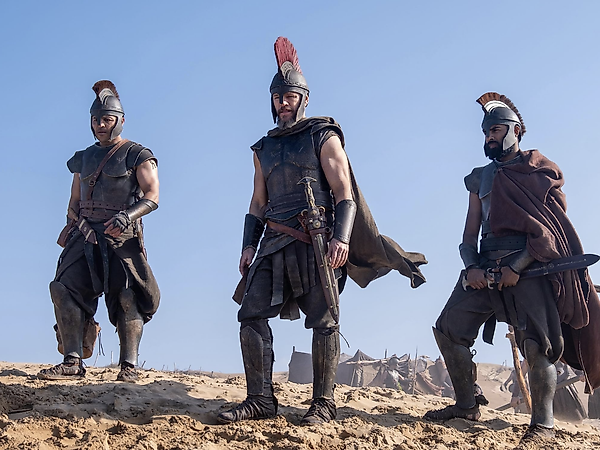
Months before Christopher Nolan’s The Odyssey hit theaters, many on the internet had seemingly already reached a conclusion. The armor was wrong. Agamemnon’s black, plasticky helmet looked, one widely shared post complained, was like something out of a Batman movie. Odysseus’s ship was a Norse longship, from the wrong civilization and the wrong era. Most of the costumes belonged to the classical period, a good thousand years after the Bronze Age world the poem supposedly describes. But despite these obvious anachronisms, the scholars who actually study the poem and the Mycenaean civilization it is based on see the question of accuracy differently. For many, the argument over whether Nolan got the Bronze Age “right” betrays a misunderstanding of what the Odyssey is, and always was. Related Articles Zendaya Gets an Earful of 'Orientalist' Complaints for Wearing Ancient Iranian Earrings to 'Odyssey' Promo Amid US-Iran War See the Trailer for Steven Soderbergh's New Film About an Artist and an Art Forger “I think it kind of misses the point,” Dimitri Nakassis, a professor of classics at the University of Colorado Boulder and a MacArthur fellow who specializes in the Greek Late Bronze Age, told ARTnews. “The point of myth is that it’s supposed to feel timeless. The Greeks messed around with myths all the time, including those around the Trojan War… [Myths’] flexibility is part of their power, because for a myth to have value in the present day, it has to speak to the present day.” The accuracy critiques are not strictly wrong, and none of the scholars I spoke to pretended otherwise. Katerina Zacharia, a professor of classics at Loyola Marymount University whose work focuses on classical antiquity in visual and performance culture, was blunt about the armor featured in the film. “These are broadly Archaic and Classical silhouettes—Corinthian-derived crested helmets, bronze cuirasses—worn by heroes who belong to a Bronze Age world of boar’s-tusk helmets and Dendra-style full-body plate, some five centuries earlier,” Zacharia told ARTnews in an email. “Agamemnon’s blackened, faceted helmet belongs to no ancient workshop at all.” But the deeper misconception, Zacharia and other scholars say, is that there exists a single, correct ancient world the film could have reproduced. As Nakassis explained, the Iliad and the Odyssey are part of very old oral poetic tradition, and, while there is debate about how old, most scholars agree that the poems were written down hundreds of years after the works were first crafted and perhaps nearly a millennium after the era it depicts. There are some details in those poems that comport with the archaeological record, like Homer’s description of a boar’s tusk helmet, which we have Bronze Age examples of—as well as depictions of in Bronze Age art—but which were no longer used during Homer’s time. However, Homer’s description of the Trojan War bears little resemblance to the war as described in a series of Hittite records, the only existing documentation of a political dispute at that time involving Troy. “If there was a Trojan War in the late Bronze Age,” Nakassis said, “it almost certainly didn’t look very much like how Homer describes it.” Zacharia similarly argued that the Iliad and the Odyssey are already the result of an “anachronistic layering” at the core of the oral tradition. Nolan’s film then simply continues that tradition. “Homer fused dimly remembered Bronze Age objects with the Iron Age world of his own audience, and every era since—the Attic vase painters, Renaissance tapestry weavers, Hollywood—has armed these heroes in its own imagination,” she said. “When Nolan dresses Odysseus in the armor of the vase painters’ era rather than his own, he is doing precisely what the vase painters did.” The more interesting question, Zacharia continued, is not whether Nolan accurately portrays the Bronze Age, but rather what his depiction of antiquity says about the current era. “A desaturated, blackened, gritty Homer says a great deal about ours,” she said. By way of example, Zacharia pointed to the film’s stand-in for Troy, the Moroccan Ksar Aët Benhaddou, used as backdrop in sword-and-sandals pictures dating to the 1960s, from Pier Paolo Pasolini’s Oedipus Rex (1967) to Gladiator (2000), Alexander (2004), and Prince of Persia (2010). The ksar looks nothing like what the archaeological record at Hisarlik, Turkey—the established site of ancient Troy—tells us. The record there shows us a circle of 15-foot-high limestone walls with towers and ramparts on a verdant coastal plain, not a desert city of earth and clay. “Edward Said taught us that the Orient functions as an imaginative geography, a stage the West dresses to play its own other, and the film’s map performs the operation neatly: Greece is shot in Greece—Messenia, the homeland playing itself—while Troy, the enemy city of the East, is conjured from a Maghrebi,” Zacharia said. “The film orientalizes a city the tradition itself refused to orientalize,” she added, noting that Homer’s Trojans “speak, pray, mourn, and die like the Achaeans,” and that the poem’s deepest sympathies extend to Hector. Nakassis, who has spent his career studying the archaeological record of the Mycenaean and other early Greek civilizations, is sympathetic to the practical challenge a film production depicting the ancient world faces. He pointed to the Dendra panoply—a complete bronze suit of armor excavated from a tomb and dated to roughly 1400 BCE. “If you make a movie and everybody’s dressed in armor like that, maybe it looks kind of crazy to a modern audience,” he said. And where does one draw the line, he wondered. Bronze Age frescoes depict women wearing flounced skirts and open bodices, with their breasts bared. Depicting that dress faithfully would likely be distracting to a modern audience and leave the film unmarketable. The question that matters, he added, is not whether the objects are correct but “whether it’s in service to the story Nolan is trying to tell.” While Nolan appears to strive towards realism, Zacharia described the film after seeing it as a “realism of texture,” mud, bronze, and grime that trades the resplendent color that conservation science has more recently restored to that era’s palaces and statues for “a desaturated, earth-toned antiquity” that represents the dominant 21st-century cinema style, not the ancient world. Ryan Platte, a professor of classics at Northwestern University who studies the cinematic reception of Homer, sees the film’s closest touchpoint as Wolfgang Petersen’s Troy (2004), a film derided at release that many internet users have recently pointed to, somewhat dubiously, as being of higher historical fidelity than The Odyssey. Notably, Nolan’s film hews closer to the epic tradition than Troy due to its inclusion of the supernatural and the gods, which were excised from Peterson’s film. What struck Platte most after seeing the film was how it ties Odysseus’s story to the real end of the Mycenaean Bronze Age, “as if the war and the Greek actions therein somehow led to the end of that era.” That causal link, he told ARTnews in an email, “is, to my knowledge, new and is really intriguing.” Further, such a framing of the epic seems to echo its actual creation, in that the poem is Iron Age Greek culture’s remembrance of the Mycenae hundreds of years after a major civilizational collapse. And while many have argued that Nolan’s casting of Odysseus’s plight as a story about a veteran’s trauma and guilt is anachronistic to how those Greeks understood the world, Nakassis argued that aspect is latent in the poems because nearly all ancient Greek men were veterans. For his 1995 book Achilles in Vietnam, psychiatrist Jonathan Shay read the Iliad with Vietnam War veterans to better understand post-traumatic stress syndrome; the veterans in that book recounted numerous parallels between their experience and that of the soldiers in the poem. Nakassis posited that Greek veterans would have understood the subtext of Odysseus’s 10-year journey home from the war. Questions about the film’s treatment of race sparked by the casting of Lupita Nyong’o as Helen of Troy and Clytemnestra are largely beside the point, according to Zacharia. “Race as we understand it is a modern concept; the ancient world did not organize humanity by our categories, and the Homeric heroes have been recast in the image of every era that told their story—the vase painters gave them Archaic armor, the Renaissance gave them Italian faces, and the nineteenth century gave them a marble whiteness the painted originals never had,” she said. Nolan’s film imagines the poem “as more encompassing of race and gender than earlier retellings did, and that is not a departure from the tradition; it is the tradition doing what it has always done, absorbing the self-understanding of the audience in front of it.” That film focuses considerable screentime on the drama involving Penelope in Ithaca—more a framing device in the original poem—similarly reflects the current moment’s impulse to reread the epics through its women. Much of the online ire has been directed at Emily Wilson’s 2017 translation of the Odyssey, which Nolan has said he used as the backbone of his telling. Wilson’s translation has come under fire for her decision to render Homeric Greek into a direct, colloquial English. But Zacharia, Nakassis, and Platte largely praised Wilson’s work, with Platte noting that both the translation and the film privilege “well-crafted but more regular speech” that “leans into the immediacy of the Homeric style.” Earlier this week, after seeing the film, Wilson told the Associated Press that while she was celebrating that so many people were being introduced or reintroduced to the epic, she felt that Nolan “was trying to pack everything in while missing themes that were essential to the poem.” Wilson’s critique largely echoed that of Zacharia, who noted that Nolan’s film largely removes the poem’s core theme, that it is a “performance about performance.” Instead, the story becomes about a solitary mind retelling a story to himself, akin to a patient on the therapist’s couch, a fitting image for an Odysseus of our contemporary age.