Dinh Q. LÊ (1968–2024)
204April 10, 2024The names
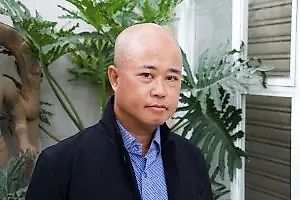
Vietnamese-born multimedia artist Dinh Q. Lê, whose work explored the trauma wrought by the Vietnam War, died of a stroke April 6 at his home in Ho Chi Minh City, Vietnam. He was fifty-six. His death was confirmed by New York gallery P.P.O.W. In a practice that encompassed photography, video, sculpture, and installation, Lê explored the experiences and perspectives of his forebears as well as his own as a Vietnamese American gay man to create work of tremendous emotional power. Much of his art critiqued the American take on the Vietnam War—or the American War, as it was known in his own country—and addressed the issues of identity and history that arose from the conflict, including stereotyping, censorship, migration, and exploitation. “The continued systematic erasure of the history of Southern Vietnam by the current government, the lack of analysis of our cultural resources, strict governmental control of the flow of information, and the self-censorship that is so deeply ingrained in current Vietnamese society have together led us to a point at which we know very little about either who we were or who we are,” he told theGuggenheim’s Zoe Butt in 2013. “There is an urgent need for expressions of collective memory freed from restraint; many people are actively engaged in building these narratives—I chose to do so through art.”
Dinh Q. Lê was born in 1968 in Hà Tiên, Vietnam. As a boy, he witnessed, alongside his father, US planes bombing his home country. Following the fall of Saigon in 1975 and the 1978 invasion of Vietnam by Cambodia’s Khmer Rouge, Lê and his family escaped to Thailand by boat, eventually settling in Los Angeles, where he and his six siblings were raised by his mother. In the mid-1990s, having earned his BFA from the University of California, Santa Barbara, and his MFA from New York’s School of Visual Arts, Lê returned permanently to Vietnam. “When I was in America, I never really fit in, and kept harboring this romanticized image of Vietnam,” he told Singapore online art publicationBakchormeeboyin 2023. “When I went back, it was completely different from my memory, but somehow deep down I knew it’s where I’m supposed to be.”
Lê’s early work comprised large-scale photomontages that he made by weaving together strips of photographs, deploying the method used by his aunt in creating grass mats. Art historian Lucy Lippard described Lê’s work of this nature as “a uniquely disciplined collage form, [wherein] he illuminates the complex interactions of his two homelands—Vietnam and the United States. Apparent contradictions are transformed into visual ebb and flow, cultural give and take.” Among the photographs Lê used were pictures of Vietnamese art and architecture, documentary images from the war, and stills from Hollywood Vietnam War films such asApocalypse Now, all of which might be glimpsed peering out from within the larger image formed by the collage. “So much depends on the observer’s viewpoint here,” wrote Barry Schwabsky in a 1999 issue ofArtforum.
In other works, such asCrossing the Farther Shore, 2014, photographs stood in for those his family had not been able to carry away with them when fleeing Vietnam. The artist purchased hundreds of black-and-white photos at second-hand stores in his home country, hoping to find images of his family; he strung these together into large webs resembling the mosquito netting under which Vietnamese people frequently sleep, inscribing on the backs of various photos snippets of text collected from interviews conducted by the Vietnamese-American Oral History Project as well as fragments from the epic poemThe Tale of Kieu, by Nguyên Du (1766–1820), about a beautiful woman who entered a miserable marriage to save her impecunious family but was ultimately reunited with them. An earlier work, 2011’sErasure, is similarly composed of postwar family photographs, but in this instance they are scattered about, and viewers are invited to select one to be scanned and archived on a website in an exercise meant to recover the lost identities of refugees. Other notable works includeThe Farmers and the Helicopters, 2006, which looks at the American helicopters flown into Vietnam during the war from the point of view of locals there, rather than from the heroizing vantage of the West codified in American movies. Comprising a three-channel video installation featuring Vietnamese farmers’ recollections of the sight, it also includes a helicopter built by one of them, Tran Quoc Hai, a self-taught mechanic.
In 2007, alongside Tiffany Chung, Tuan Andrew Nguyen, and Phunam Thuc Ha of the Propeller Group, Lê co-founded Sàn Art in Ho Chi Minh City. Originally an artist-led nonprofit art space, library, and cultural center providing support for experimental Vietnamese artists, the concern has grown into one of the country’s leading arts organizations.Lê enjoyed solo exhibitions at the San Jose Museum of Art, California; the Asia Society and the Museum of Modern Art, both in New York; the Musée du Quai Branly-Jacques Chirac, Paris; Mori Art Museum, Tokyo; and Hiroshima City Art Museum, Japan. As well, he participated in the Carnegie International, Documenta, the Singapore Biennale, the Asia-Pacific Triennial of Contemporary Art, and the Venice Biennale, among other events. His work is held in the collections of major art institutions around the world, including the San Francisco Museum of Modern Art; the Hammer Museum and the Los Angeles County Museum of Art, both in Los Angeles; the Bronx Museum and MoMA, both in New York; the Israel Museum, Jerusalem; the Mori Museum; and the Fukuoka Asian Art Museum, Japan.
In 2010, Lê was honored with the Prince Claus Award for his outstanding contribution to cultural exchange. In 2021, he regained his Vietnamese citizenship.
“Growing up as an immigrant, you were always told to study something that was viable in order to earn a living. Art didn’t fall into that category, and as much as I tried, I never saw any other Vietnamese artists out there as a role model to aspire to be,” Lê told Bakchormeeboy. “Now I guess I’ve become the role model to the next generation of artists, and to show them that if I can do it, they can somehow make a career out of their art too.”