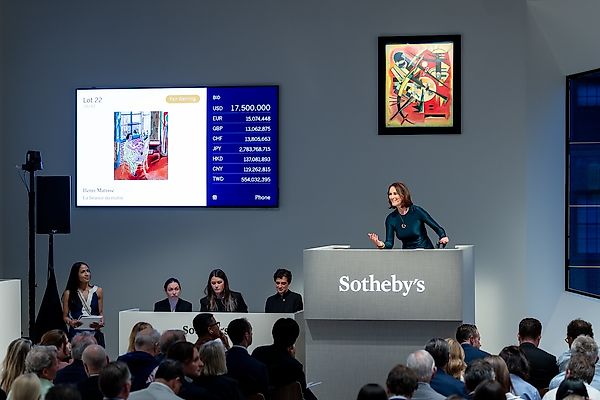
Sotheby’s reported record first-half consolidated sales of $4.4 billion on Tuesday, up 58 percent from the same period last year, fueled by gains across auctions, private sales, and its growing luxury businesses. Auction sales rose 59 percent to $3.4 billion, while private sales climbed 52 percent to a record $826 million. The company also posted its highest sell-through rate since at least 2010 and a record 4.9 bidders per lot sold. The numbers are undeniably strong. But the more interesting story is the one Sotheby’s is telling the world about itself. Related Articles Sotheby's $50.1 M. T. Rex Sale Sets New Record as Scientists Scowl Dinosaur Dealer Sal Aaron Discusses the Fossil Market as Sotheby's Sells T. Rex for Record $50 M. Read closely, and this doesn’t feel like an auction-results release. It reads more like an update from a diversified luxury company. Rather than simply celebrating blockbuster sales, Sotheby’s is arguing that its future rests on a business that now stretches well beyond the auction room—with private sales, lending, luxury categories, hospitality, and real estate commanding as much oxygen as any Klimt, Pollock, or Rembrandt. That tone runs through nearly every section of the press release. Instead of focusing on individual trophy works, Sotheby’s repeatedly highlights major single-owner collections, private transactions, and Sotheby’s Financial Services. The message is that the company is becoming less dependent on evening sales and more reliant on long-term relationships with wealthy clients. While the pictures and sculptures recede almost into the background, Sotheby’s repeatedly returns to provenance, celebrating the Robert Mnuchin Collection, the Lewis Collection, Jean and Terry de Gunzburg’s collection, and the upcoming Magnum Opus sales. In the release, Madeline Lissner, the company’s head of global fine art and major collections, described today’s market as one driven by “quality, rarity and provenance.” The release also reinforces a trend that has become increasingly apparent this year. Auction houses aren’t simply benefiting from rising prices—they are competing to secure ever-larger estates and single-owner collections, suggesting that fresh property, not just stronger bidding, is driving much of the market’s momentum. Perhaps the most revealing detail is the metrics Sotheby’s chooses to emphasize. Yes, the house brought in $4.4 billion in sales, but the points of pride appear to be its 90 percent sell-through rate and record average of 4.9 bidders per lot. Over the past five years, much of the conversation around the art market has centered on guarantees, withdrawals, and unsold works. Instead, Sotheby’s wants readers focused on sell-through and bidder participation—two metrics that suggest confidence and competitive demand without dwelling on the financial engineering that increasingly underpins the top end of the market. Private sales tell a similar story. At $826 million, the division has grown large enough that it’s presented almost matter-of-factly, rather than as an auxiliary business. Alongside auctions, the company now highlights lending, securitizations, luxury real estate, restaurants, and cultural programming as core parts of its strategy. The result is a company that resembles an investment bank or private wealth adviser as much as it does an auction house. That impression is reinforced by the space devoted to finance. Sotheby’s highlights an $825 million bond refinancing and a $900 million securitization completed through Sotheby’s Financial Services, and says its recent performance has strengthened both profitability and its capital position. Those details aren’t aimed primarily at collectors, but lenders, investors, and anyone still watching the company’s balance sheet following owner Patrick Drahi’s debt-heavy acquisition strategy. Sotheby’s appears to want readers to conclude that its finances are strengthening alongside its auction business. The Breuer receives similarly prominent treatment. Sotheby’s says visitor numbers at its Madison Avenue headquarters have more than doubled compared with its former York Avenue location, while highlighting Marcel restaurant and expanded exhibition programming. Ever since Sotheby’s committed hundreds of millions of dollars to the Breuer, observers have questioned whether the investment would justify its cost. The company is now making the case that it has, not simply as a headquarters, but as a destination that attracts visitors, clients, and business. Luxury provides another illustration of the company’s evolving identity. Watches were up 64 percent during the first half, RM Sotheby’s posted record sales, and Concierge Auctions grew 18 percent. Rather than treating those businesses as complements to fine art, Sotheby’s increasingly presents them as equal pillars of its growth strategy.