Marian Zazeela (1940–2024)
224April 3, 2024The names
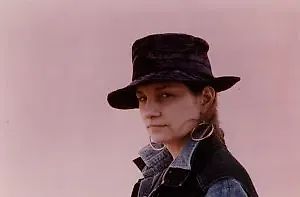
Light art pioneer Marian Zazeela, whose vibrant illuminated environments profoundly influenced Andy Warhol’sExploding Plastic Inevitable, died March 28 in New York. She was eighty-three. A member of the 1960s avant-garde collective Theatre of Eternal Music, Zazeela is widely recognized for her collaborative work with her husband, minimalist composer La Monte Young. The couple’sDream Houses, long-term immersive installations comprising Young’s sine-wave compositions cycling continuously in a spare environment bathed in glowing cobalt or magenta light designed by Zazeela, for more than five decades have provided visitors with respite from the hustle and bustle of everyday life, offering an immediate transcendent experience. Zazeela, whose practice additionally encompasses painting, graphics, and film, is also known for her wild, abstract calligraphy, which, like her environments and light sculptures, evoke dreamy otherworlds.
Marian Zazeela was born April 15, 1940, in New York to Russian Jewish parents and raised in the Bronx. After graduating from New York’s Laguardia High School of Music & Art and Performing Arts, she attended Bennington College in Vermont, studying under painter Paul Feeley, art historian Eugene Goossen, and sculptor Tony Smith and graduating in 1960 with a BA in art. While still in school, Zazeela began creating paintings, drawings, and prints centering the calligraphic stroke. Such marks figured heavily in her 1960 debut exhibition, at the 92nd Street Y in New York, where she exhibited a set of massive canvases placing calligraphic forms against fields of undiluted color.
Having settled in New York immediately following her graduation from Bennington, Zazeela became involved in the city’s burgeoning downtown scene, acting and modeling for Jack Smith, and providing the cover for his 1962Beautiful Book, in which she appeared in a number of photographs. Set to star in his pathbreaking experimental 1963 filmFlaming Creatures, she wound up contributing just a cameo. “Although Jack had writtenFlamingaround me as the leading lady, invited me to create the calligraphy for the film titles and credits, and even painted the backdrop for it at my studio, my focus in life had changed abruptly in June when La Monte Young and I fell in love and began our lifelong partnership,” she wrote in a 1997 issue ofArtforum. “It became impossible for me to play the role Jack had originally intended.”
Zazeela joined Young’s Theatre of Eternal Music, contributing vocals alongside Angus MacLise, Billy Name, and, later, John Cale, Tony Conrad, and Terry Riley. She also began producing light shows for the experimental group. The form was then in its infancy, and Zazeela’s works of this nature are thought to be some of the first, created at a time when Dan Flavin, who would come to be far more celebrated, was also beginning to work with light. Zazeela drew on her earlier calligraphic work to create light shows that relied on slow dissolves of still-image slides and colored gels. The resulting effect was frequently psychedelic, often conjuring Op art. Meant to be projected in accompaniment with a three-hour performance, these works were dubbedOrnamental Lightyears Tracery, and varied each time they were presented. Glenn Branca, writing inForced Exposure, and David Sprague, writing inYour Flesh, have posited these light shows as the progenitor of Warhol’s 1966–67Exploding Plastic Inevitable.
As the ’60s wore on, Zazeela became increasingly interested in light sculpture and immersive environments and fascinated by duration and saturation. She and Young created their firstDream Housein 1969, presenting it at Munich’s Heiner Friedrich Gallery. Later iterations included those at Moderna Museet, Stockholm; Kunstverein, Cologne; and, in 2015, at Dia Center in New York. This last version featured an expanse of white-carpeted floor upon which visitors were invited to crouch as they took in a performance by Zazeela and Young paying tribute to late Hindustani classical singer Pandit Pran Nath, of whom Zazeela had been a devotee since beginning to study with him in 1970. ADream Housethat has occupied a loft at 275 Church Street in New York since 1993 remains open to the public under the aegis of the MELA Foundation, which Zazeela and Young established in 1985.
Zazeela’s decades-long exploration of light saw her create numerous works in collaboration with Young, who survives her, but also apart from him. “She transforms material into pure and intense color sensations, and makes a perceptual encounter a spiritual experience,” wrote Ronny H. Cohen in a 1981 issue ofArtforum, describing the experience of viewing Zazeela’sMagenta Lightsat New York’s Dia Art Foundation. Zazeela also continued to make her graceful, freewheeling calligraphic works. She has characterized some of these as “borderline art,” explaining, “With this approach I sought to create an art form that ‘borders’ and challenges the conventional distinction between decorative and fine art by using decorative elements in the fine art tradition. Concurrently, I also created drawings in which borders become the actual content of the works themselves.”
During her lifetime, Zazeela’s work was presented at institutions around the world including the Solomon R. Guggenheim Museum, New York; Tate Liverpool; Centre Pompidou, Paris; Kunstverein, Cologne; and Ruine der Künste, Berlin. She participated in the 2005 Lyon Biennale and the Forty-Fourth Venice Biennale. An exhibition of her calligraphic works is on view at Artists Space, New York, through May 11.