Ownership of a Van Gogh in the Orsay’s Collection Is In Dispute
41June 30, 2026
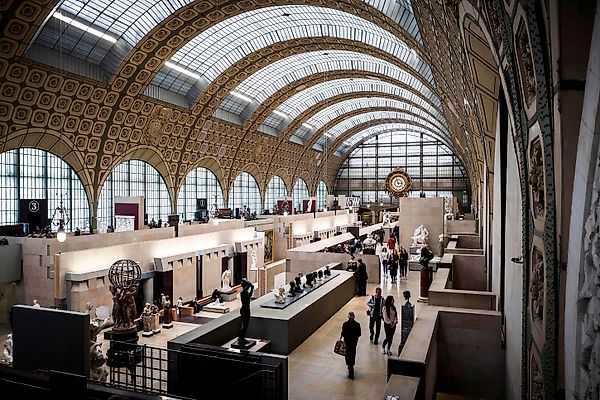
Ninety-eight-year-old Klaus Kallmann, the grandson of Felix Kallmann, a lawyer and art collector has for the past nine years, waged a legal battle involving Paris’sMusée d’Orsay. Kallmann is in pursuit of the ownership ofHôpital Saint-Paul à Saint-Rémy-de-Provence,1889, a painting byVincent van Goghthat’s currently part of the institution’s core collection. Kallmann claims that he has childhood memories of the painting hanging in his grandfather’s villa; he also claims that the artwork was later looted from his family by Nazis and thatHôpital Saint-Paulrightfully belongs to him, per a new report fromLe Monde.
In May of this year, the Commission for the Compensation of Victims of Spoliation (CIVS), which determines if artworks were Nazi-looted, failed to reach a definitive conclusion. The difficulty in tracking the painting’s movements stems from a gap in the artwork’s recorded history.
Felix Kallman, who in his lifetime managed two companies—the lightbulb company Deutsche Gasglühlicht and the film company Universum Film AG of Babelsberg—lived in a villa in the Westend district of Berlin. According to the case file regarding the dispute, Kallmann sent two letters in June of 1932 which document his attempts to sell Hôpital Saint-Paul to Staatsgalerie in Berlin. However, Staatsgalerie turned down Kallmann’s offer on the grounds that it had “already acquired several Van Goghs,” per Le Monde.
There’s then no record of the painting until February of 1934, when Hôpital Saint-Paul appeared in a Parisian art gallery owned by art dealer Paul Rosenberg. Rosenberg was a prominent figure whose high-profile clients made him a target for the Einsatzstab Reichsleiter Rosenberg, a Nazi art-looting operation.
While the Kallmann family had “certainly been victims of anti-Semitic persecution and suffered spoliation in this context,” David Zivie, the director of the CIVS, told Le Monde, it was “difficult to establish with certainty whether the Van Gogh painting was among the looted property sold under duress.”
What’s not clear in this instance is the question of how the painting got to Rosenberg: did Kallmann manage to sell the painting between 1932 and 1934?
“Must a sale made by a German Jew at the very beginning of 1933 necessarily be considered forced? This is the first time we have encountered this type of situation in France,” Zivie continued to Le Monde.
For his part, Klaus Kallmann also claims that his father, Hartmut Kallmann, always said that their family’s art collection was fully intact when the Nazis came to power and that the collection subsequently looted. In September, the Kallmann family’s case will be heard before a panel that now includes Ministries of Culture and Foreign Affairs officials.
“For Klaus Kallmann, every week is the equivalent of a year,” Mel Urbach, the Kallmanns’ lawyer, told Le Monde. “He has been infinitely patient. Now, we believe it is time for this painting to return to the family.”