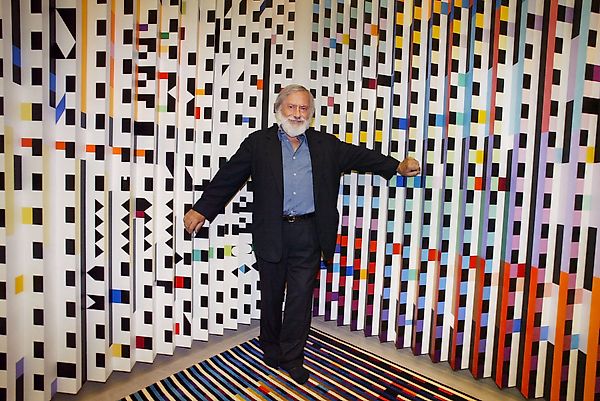
Israeli artist Yaacov Agam, known for his optical and kinetic artworks, has died at 98. The news was reported by outlets including the Times of Israel, Haaretz, and the Jerusalem Post. The son of an Orthodox rabbi, Agam was born Yaacov Gipstein in Rishon LeZion, Palestine (now Israel), in 1928. After studying art in Jerusalem, he traveled to Zurich in 1949 to study with artist Johannes Itten, who introduced him to Bauhaus ideas on color and abstraction; he was also influenced by Vasily Kandinsky’s 1911 treatise, On the Spiritual in Art: And Painting in Particular. In 1951, he moved to Paris, where he was still living at the time of his death. Related Articles David Hockney, Painter Who Captured the Sensibility of '60s Los Angeles, Is Dead at 88 Duane Michals, Maker of Enigmatic Sequences of Images That Defied Photography's Conventions, Dies at 94 Agam’s first solo exhibition was in 1953 at Galerie Craven in Paris, where he presented two series of works. One series displayed different images depending on the viewer’s position relative to the piece. Such artworks would become something of a signature for the artist, who dubbed them “Agamographs.” He also showed “Transformable Pictures,” whose elements spectators could manually rearrange. In 1955, Agam showed with other practitioners of Kinetic art in the “Movement” exhibition at Galerie Denise René, and in 1964, he was included in the Museum of Modern Art’s show of optical art, “The Responsive Eye.” In subsequent years, Agam completed a number of public commissions, including the world’s largest menorah, designed in 1977 and installed each year on the corner of Fifth Avenue and 59th Street in Manhattan during Hanukkah, and a kinetic Star of Peace to commemorate the peacemaking efforts between Anwar el-Sādāt and Prime Minister Menachem Begin in 1979. Agam was the subject of solo exhibitions at the Musée national d’art moderne in Paris (in 1972); the Tel Aviv Museum (1973); the Jewish Museum in New York (1975); and the Guggenheim Museum in New York (1980), among other institutions. In 1996, he was given UNESCO’s Prize for Arts Education and the Jan Amos Comenius Medal for his “Agam Method” of visual education of young children. Earlier this year he was awarded the Israel Prize for Visual Arts.