David Hockney, Master Painter of Modern Life, Dead at 88
50June 13, 2026
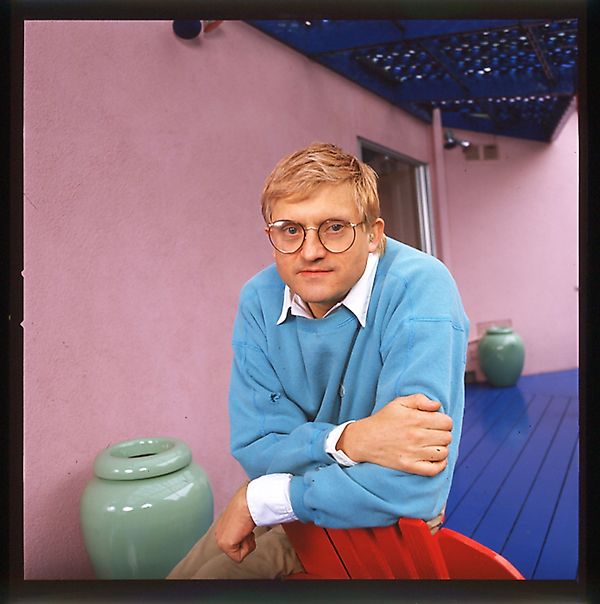
British painterDavid Hockney, known for his bright, pleasure-suffused paintings of 1960s and ’70s Los Angeles, died in London on June 11. He was eighty-eight. His death was announced by his publicist, Erica Bolton. Hockney in the 1960s recuperated figurative painting and, more specifically, the human form, both of which had been previously rejected by the abstraction then ascendant. His penchant for unexpected painterly modes would consistently mark the artist’s practice, culminating in his recent and gleeful adoption of the iPad and his embrace of immersive digital art.
“I’m interested in ways of looking, and trying to think of it in simple ways,” said Hockney, speaking in a 2014 documentary of his life. “Everybody does look; it’s just a matter of howhardthey’re willing to look.”
David Hockney was born on July 9, 1937, in Bradford, West Yorkshire, the fourth of five children. His father was an avowed pacifist and a repairer of baby carriages; his mother, with whom he was very close, would become a frequent subject of his work. Showing an early talent for painting, Hockney sold his first canvas, a depiction of his father, in 1957 for £10.
In 1959, he moved to London to study at the Royal College of Art, where he established a lifelong friendship with American artist R. B. Kitaj and encountered visiting artists Francis Bacon and Peter Blake. Openly gay several years before the 1967 decriminalization of homosexuality in England, he not only consistently and tenderly depicted queerness—as for example in the 1966 series “Illustrations for Fourteen Poems from C. P. Cavafy,” a group of etchings portraying “the vicissitudes of queer existence,” as Sasha Frere-Jones described it in a 2019 issue of Artforum—but publicly denounced the censorship of gay imagery.
Following a 1962 group show at the Institute of Contemporary Arts, London, Hockney was awarded his first solo show, at Kasmin Gallery, in 1963. The following year, he moved to Southern California. There, he abandoned oil paint in favor of vibrant acrylics, whose flat aspect lent his works a cartoonish affect that seemed to welcome in the viewer. His career burst into full flower in LA, thanks to his louche, hot depictions of SoCal life, characterized by lazy poolside afternoons, aquatic-hued skies, towering palm trees, and brightly clad loungers and bathers.
One could almost feel the cool blast of the air-conditioner that must surely have been laboring inside the contemporary cabana depicted in American Collectors (Fred and Marcia Weisman), 1968, or feel the invigorating spray of A Bigger Splash, 1967. Sexual tension, too, rippled through these works, as in Christopher Isherwood and Don Bachardy, 1968, in which the American artist Bachardy levels a direct and admiring gaze at his British novelist partner; or the 1972 Portrait of an Artist (Pool with Two Figures), in which a sportily attired man anticipates the gliding, underwater approach of a swimsuit-clad counterpart.
Hockney in the 1980s began experimenting with Polaroids, producing single images composed of many photographs, and with photocollages, producing panoramic vistas of the American Southwest, with which he was enamored. Among the other contemporary techniques he explored around this time were early computer graphics programs, office printers, and the fax machine, the last of which he used to deliver his contribution—a wall-size print—to the 1989 São Paulo Bienal.
In the 1990s, drawn home to England by the failing health of his mother, who died in 1999, Hockney returned his attention to his homeland, and to the more traditional watercolor and oils, painting monumental canvases illustrating the country’s natural wonders, as embodied for example by the forty-foot-wide Bigger Trees Near Water of 2007 and the somewhat smaller May Blossom on the Roman Road, 2009. Trees and timber would remain a theme across the ensuing decades, most recently in his large-scale digitally drawn works depicting Yorkshire logging operations in unusual hues, such as magenta.
Though he was not without his detractors—writing in Artforum in 1982, Stewart Knoedler characterized his work as “banal” and possessing a “sheer lack of finish”; The Guardian this past March slammed his colossal 2021 A Year in Normandie, the artist’s take on the Bayeux Tapestry, as “a 90-meter vision of nature that only looks great on your phone”—Hockney enjoyed more than four hundred solo exhibitions over the course of his career. Among these were a 1970 retrospective at London’s Whitechapel Art Gallery, while he was still in his early thirties, and a 2017 retrospective at Tate Britain, which traveled to the Centre Pompidou in Paris, the Metropolitan Museum of Art in New York, and the Los Angeles County Museum of Art. A 2024 retrospective at the Fondation Louis Vuitton in Paris served as the largest exhibition of his work to date, attracting 917,000 visitors.
Hockney’s work is held in the collections of numerous institutions around the world, a small sampling of which includes the J. Paul Getty Museum, Los Angeles; the Art Institute of Chicago; the Metropolitan Museum of Art, New York; the Hirshhorn Museum & Sculpture Garden, Washington, DC; the British Museum, London; the Centre Georges Pompidou, Paris; and the Benesse Art Site, Naoshima, Kagawa, Japan. A solo show of his work is on view through August 23 at London’s Serpentine North.
The artist is survived by his partner, Jean-Pierre Gonçalves de Lima, and by two brothers, Philip and John. A heavy smoker, he suffered a stroke in 2012 and was wheelchair bound at the end of his life. Still, Hockney continued to paint right up through his last days, thrilled with the opportunity to do so. “I just thought I probably wouldn’t be here,” he told the BBC’s Katie Razzall in 2025. “I’m just laughing. I mean, we made it!”