Photographer-Provocateur Duane Michals Dies at 94
92June 12, 2026
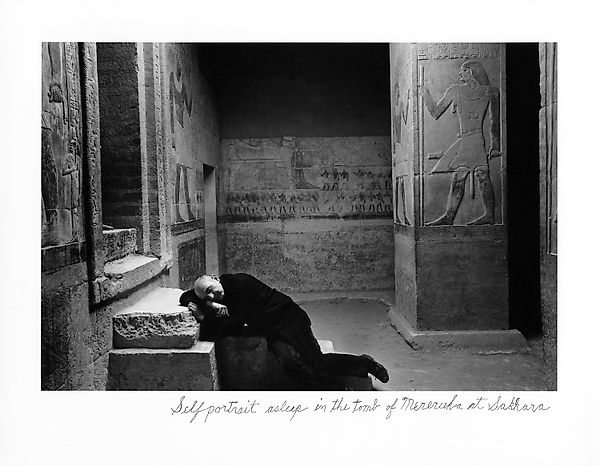
Self-taught photographerDuane Michals, known for unconventional and deeply personal narrative image sequences incorporating handwritten text, died in Manhattan on June 9 of pneumonia. He was ninety-four. His death was announced by New York’s DC Moore Gallery, which represented him. Mystical, metaphysical, and frequently touched by whimsy, his boundary-breaking work reflected his abiding interest in Surrealists such as Joseph Cornell, Giorgio di Chirico, and René Magritte. Michals supported his artistic practice with commercial and portrait photography, for which he gained fame owing to his uncanny ability to capture his subjects’ innermost thoughts and feelings. These photos, too, bore traces of Surrealism, as evidenced by his portrait series of Magritte, whose iconicity reflects that of the artist himself.
“I am moved by my work,” Michals toldAperture’s Jesse Dorris in 2022. “The deep contentment of having written a really good sentence or having taken a really good picture, knowing that I’ve done it, is very sweet. It makes me melancholy . . . in a nice way.”
Duane Michals was born on February 18, 1932, in McKeesport, Pennsylvania, a descendant of Slovakian immigrants. His father was a steelworker and his mother a live-in domestic who saw Michals and his brother only on weekends. Having taken classes in drawing at the Carnegie Museum in nearby Pittsburgh as a boy, Michals won a scholarship to the University of Denver, where he earned a bachelor’s degree in graphic design. Following a two-year stint with the army in Germany, he moved to New York in 1955, working in graphic design for magazines including Sports Illustrated and Time.
Michals turned to photography in 1958, after borrowing a camera from a friend for a trip to the Soviet Union. Proving naturally adept with the instrument, he began shooting for publications including Vogue, Mademoiselle, and Esquire. His earliest artistic works were unpeopled, as exemplified by the 1964–65 series “Empty New York,” shot at desolate hours of the early morning and chronicling the city’s diners, laundromats, subways, and streets in a state of abandonment.
Shortly thereafter, he began his sequential works, frequently utilizing multiple exposures, and, in a step away from traditional photography, handwritten text, often oblique or poetic, that augmented the visuals. A number of his initial forays into this format dealt with death, among them The Spirit Leaves the Body, 1968, a seven-panel sequence showing a nude man lying prone, his ghostly form appearing to rise from his body and exit the room. The four-frame Death Comes to the Old Lady, shot the following year, shows a spectral form approaching an elderly woman in a rocking chair and spiriting her away.
Unabashedly gay in a time when being so was not widely accepted—he shared a home with his partner and later husband, architect Frederick Gorree, in Gramercy Park for decades before Gorree’s 2017 death—Michals brought queerness to bear in works such as 1973’s Things Are Queer, its Alice in Wonderland-esque title recuperating a word that was at the time a slur. The nine-panel series begins and ends with the same photo, with the seven intervening panels taking the viewer on a mind-bending journey that renders the last picture profoundly more meaningful than he first. “The queer experience of being out of step and scale with the straight world folds back in a Borgesian loop of self-reflection,” wrote Evan Moffitt in a 2020 Frieze article describing the work. The Unfortunate Man, from 1976, showed a nude young man with shoes on his hands, the caption reading, “The unfortunate man could not touch the one he loved. / It had been declared illegal by the law. / Slowly his fingers became toes and his hands gradually became feet. / He began to wear shoes on his hands to disguise the pain. / It never occurred to him to break the law.”
Concurrent with Michals’s artistic practice were his commercial works, which included commissions as diverse as those for the Gap and the 1968 Olympics, and his portrait practice. Among his best-known portraits are the 1965 series of Magritte, commenting on the Surrealist’s 1946 masterpiece The Son of Man, and his depiction of Johnny Cash, which finds Michals collapsing the multiple-exposure process typical of his sequential works into a single frame. His photographs of Sting graced the cover of the Police’s landmark 1983 Synchronicity album, while other subjects ranged from Robert Rauschenberg to Nancy Reagan. In the 2010s, he began making short films, starring in many of these himself.
Michals saw more than forty books of his work published, including Homage to Cavafy (1978), The Essential Duane Michals (1997), and Foto Follies / How Photography Lost Its Virginity on the Way to the Bank (2006). Having received his first solo exhibition in 1970 at the Museum of Modern Art, New York, he was the subject of many more, among them a 2019 retrospective at the Morgan Library and Museum in New York. His work is held in the collections of major institutions including the J. Paul Getty Museum, Los Angeles; the Metropolitan Museum of Art and the Museum of Modern Art, both in New York; the Philadelphia Museum of Art; the Moderna Museet, Stockholm; the Israel Museum, Jerusalem; and the National Museum of Modern Art, Kyoto. His archive is housed at the Carnegie Museum of Art in Pittsburgh.