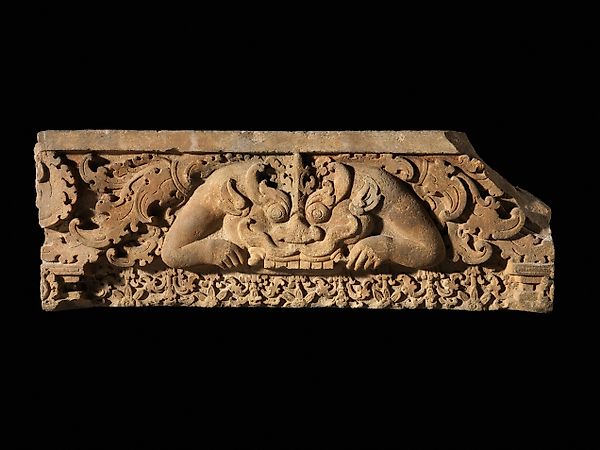
The Metropolitan Museum of Art has repatriated two sandstone sculptures in its collection to the people of Cambodia: an Angkor period guardian deity (rākṣasa), dating to c. 921-945, and a lintel featuring a carving of an anthropomorphic dragon from the mid-7th century. The returns, which were reported by both the Met and the Manhattan District Attorney’s office, follow on D.A. Alvin Bragg’s ongoing investigation into Doris Wiener, a New York gallery dealer and known trafficker who died in 1981, and her daughter Nancy Wiener, who in 2021 pled guilty to her own role in trafficking looted artifacts. Related Articles 1,200-Year-Old Limestone Lintel was Inadvertently Repatriated to Mexico Instead of to Guatemala New York's Neue Galerie to Merge with Metropolitan Museum of Art in Major Expansion The Met has previously repatriated looted objects to Cambodia, once in 2013 and again in 2023, subsequent to investigations into Douglas Latchford, a British-Thai businessman indicted by federal prosecutors for alleged antiquities trafficking before his death in 2020. The statue of the guardian deity, or rākṣasa, once flanked the entrance of the Prasat Chen temple at Koh Ker, a UNESCO World Heritage site in Cambodia, where its feet and pedestal are still visible. Representing a fierce mythical demon or gatekeeper, the bulky figure would have warded off evil and protected the temple’s sacred space. Koh Ker was extensively looted in the 1970s, and at least a dozen such sculptures were smuggled out of Cambodia and sold by Latchford. The statue was sold to Doris Wiener in 1972; in 1987, she gifted it to the Met, where it remained on display until this year, when it was seized by the DA’s office. The sandstone lintel, showing a fearsome dragon with human arms emerging from lush foliage, once adorned the entrance to an early Khmer sanctuary. It is a type of protective Hindu icon called a kirtimukha (“face of glory) and one of the earliest to be found in a Southeast Asian context. In 1981 the piece was smuggled out of Cambodia and into New York by Doris Wiener. Weiner subsequently sold it to a private collector who donated it to the Met in 1985. It was also seized by the DA’s office this year. The two sculptures were formally transferred to the Kingdom of Cambodia at a ceremony yesterday, along with a third sandstone sculpture depicting the head of the Hindu deity Harihara. Dating to the 7th century, this artifact was smuggled out of Cambodia into Thailand, where it was purchased by an American collector; the purchaser ultimately surrendered it to the D.A. office’s Antiquities Trafficking Unit in 2025. “These sculptures have been in New York City illegally for decades, and thanks to the work of our prosecutors, analysts and investigators, they are finally being returned to Cambodia,” said D.A. Bragg. “The Met is committed to the responsible collecting of art and the shared stewardship of the world’s cultural heritage,” said Max Hollein, the Met’s Director and Chief Executive Officer. “As part of this effort, the Museum has significantly expanded its provenance research work and continues the proactive review of its collection. We are grateful for our longstanding relationship with colleagues in Cambodia and for the constructive engagement with the authorities and experts whose work helped clarify the histories of these objects.” The D.A.’s Antiquities Trafficking Unit has now convicted 18 individuals of cultural-property-related crimes; recovered more than 6,350 cultural treasures, including rare books, works of art, and antiquities, valued at more than $490 million; and returned almost 6,000 of those so far to 38 countries. The extradition of another seven alleged traffickers is pending.