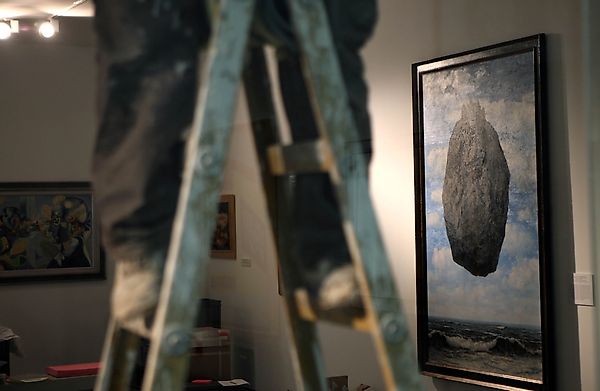
René Magritte’s The Castle of the Pyrenees (1959) has gone to the conservation lab at the Israel Museum in Jerusalem after being accidentally damaged by a young museum visitor. A boy visiting the museum with his family punctured the painting with a pinecone before a museum guard could stop him, museum staff told The Times of Israel. Sharon Tager, head of conservation at the museum, told Ha’aretz that repairs would take several weeks. “We’re experienced in conserving paintings and objects that arrive in poor condition, including works that have been stored since the Holocaust period,” Tager told Ha’aretz. “The first stage is treating the base itself because the hole caused the canvas to sag. We first restore the canvas to its original level, then stitch it and treat the layers of oil paint.” Related Articles Delayed by War in Iran, Paul Klee Painting from Israel Finally Joins New York Show Yasha Grobman Appointed Director of the Israel Museum The museum didn’t place the work under glass or place an alarm on it, in order to give a better viewing experience for the public. “We do place some works behind glass, including certain Impressionist paintings, using extremely high-quality glass that is barely noticeable,” Tager told Ha’aretz. “We generally try to avoid alarms because visitors want to examine artworks up close. That’s part of the museum experience. We look for other ways to protect objects, but there are limits.” The painting shows a castle atop a giant, floating rock, hanging before a partly cloudy sky over a seashore, and has resided at the museum since 1985. The artist’s friend Harry Torczyner, a lawyer and writer, commissioned the work to cover over an unpleasant view from his New York office window. The artist encouraged his friend to make suggestions as to the painting’s subject, and Torczyner chose this motif from a number of drawings Magritte showed him. He even suggested the sky and the sea, says the museum, writing, “because over the dark sea or ocean there rises the rock of hope, topped by a fortress, a castle.” Magritte, however, declined other suggestions in order to retain the “vigor” and “harshness” he was aiming for. Torczyner was thrilled with the results. “LONG LIVE MAGRITTE!” he wrote at the time. “‘The Castle of the Pyrenees’ floats majestically and proudly. It is superb… and intact! The waves of the North Sea bring me fresh air and joy. For the moment, the painting is hanging on the wall, while a custom-made frame is being installed to cover the window.” There the painting remained for nearly twenty years. Torczyner gave the painting to the American Friends of the Israel Museum in 1985.