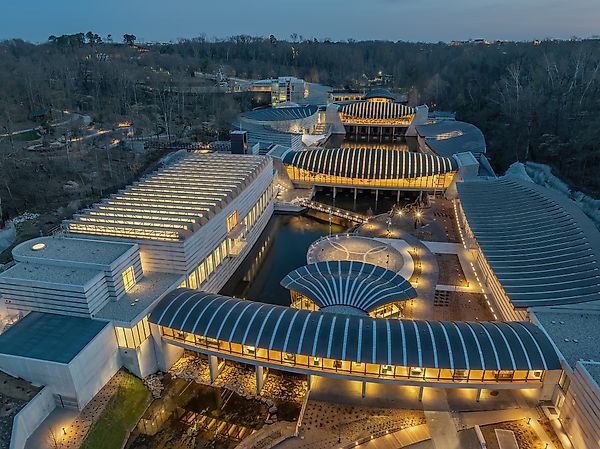
Crystal Bridges Museum of American Art may have opened its 200,000-square-foot facility in Bentonville, Arkansas just 15 years ago, but it is already ready for its first major addition. At the museum’s campus last week, founder Alice Walton, heir to the Walmart fortune and, per Bloomberg, the world’s richest woman at $143 billion, explained that she and architect Moshe Safdie had drawn up a fifty-year plan for the institution, but given their ages and her insistence that no one but Safdie would touch the building, the two decided they’d better get cracking. The addition is in the same style as the original, defined by curves that echo the surrounding landscape and materials including concrete, cedar, and copper. It opened over the weekend and adds some 114,000 square feet of new galleries, education and programming spaces, including a 14,000-square-foot exhibition space. (That’s nearly as big as the fifth-floor galleries at New York’s Whitney Museum of American Art, which weigh in at 18,000 square feet.) In the airy, high-ceilinged new galleries, the architect installed skylights with an elaborate mechanism that funnels sunlight from different directions to create what he described as a perfect, balanced white light. Walton picked Safdie after a pilgrimage to other institutions he built, such as the Peabody Essex Museum in Massachusetts, the Skirball Cultural Center in Los Angeles, and the National Gallery of Canada in Ottawa. Related Articles Two Rare Keith Haring Art Cars to Be Exhibited in New York This Month Hirshhorn Museum and Art Bridges Team Up to Lend American Artworks to Museums Throughout the US Crystal Bridges didn’t disclose the price tag on the expansion, which ARTnews traveled to see the week before the opening, courtesy of the museum. The new exhibition space hosts “Keith Haring in 3D,” co-curated by Glenn Adamson, which the museum bills as the first show to deal with the artist’s sculpture practice, encompassing masks, totems, skateboards, clothing, boomboxes, and painted found objects ranging from a baby’s crib to a 1963 Buick. Named for a nearby natural spring, Crystal Bridges brings world-class American art to a rural area far from the nation’s art capitals. (Bentonville’s population was about 35,000 in 2011; by last year it had grown to about 63,000.) In many ways they’ve certainly succeeded, building a collection with fine examples of the artists one encounters in Art History 101 and plenty of lesser-known lights. The museum reportedly anticipated about 250,000 annual visitors before opening the original building, which was estimated to cost $50 million. In fact, since its opening in 2011, some 15 million visitors have streamed through the institution’s doors. There’s much discussion of accessibility in the museum field; Crystal Bridges is free to all. The addition describes a figure-eight across two ponds fed by local streams, and adds a new entry to the museum from the north. A tour of the addition for the press pointedly began in the roomy, sunlit community and education spaces that are part of the expansion; the museum proudly notes it has hosted more than half a million schoolchildren on free trips, with transportation and lunch provided. The new addition also includes studios for artists in residence, including a digital art studio and a ceramics studio, and other art-making spaces for students and the public. Also part of the addition is an expansive gallery housing contemporary American art, featuring big attractions like a Yayoi Kusama mirrored “infinity room.” Connecting the two new galleries is a bridge that doubles as space for displaying sculpture, ceramics, and glassware, as well as including a café that provides great views of the surrounding landscape. The collection spans about 4,100 works, deputy director Austen Barron Bailly told ARTnews. Highlights, for my money, include a large Donald Judd “stack” sculpture, an early Joan Mitchell canvas, a large Kerry James Marshall painting, a Norman Rockwell rendition of Rosie the Riveter, a Mark Rothko abstraction, a colorful 1981 Jean-Michel Basquiat canvas, a Frederic Edwin Church landscape, a Gilbert Stuart portrait of George Washington, and Alice Neel portraits, and of course much, much more. The museum is near the site of Alice Walton’s father Sam Walton’s first five-and-dime store, in Alice’s childhood hometown, which is now home to Walmart’s global headquarters (and the small Walmart Museum, complete with a talking hologram of Sam Walton). It’s set on a gorgeous 134-acre campus in the Ozarks, and the extensive grounds host outdoor sculptures by figures like Louise Bourgeois, Dale Chihuly, Mel Edwards, Robert Indiana, Rashid Johnson, Yayoi Kusama, and Nancy Rubins, as well as a house by Frank Lloyd Wright. Nearly every work in the museum was moved and reinstalled as part of the expansion, “as the museum works to tell a new story through American art,” as the institution says in press materials, “revealing the many ways to celebrate the American spirit through art.” The museum’s newest installation of its collection is, in this observer’s eyes, a mixed success. The curators have collected works by canonical artists and placed them in sometimes thoughtful juxtaposition with lesser-known artists. Sometimes, things get a bit heavy-handed, and while there’s certainly room for museums to bear the stamp of their founders, as do the Frick Collection in New York, the Barnes Foundation in Philadelphia, and many others, Alice Walton’s vision sometimes falters in execution. Let’s start with the crystals, as it is, after all, Crystal Bridges. The curators bring nature inside, namely with many displays of crystals and other minerals, often cheek by jowl with the artworks. Most eye-catching is one labeled the Holy Grail, a five-and-a-half-foot-high, 1,500-pound piece of quartz crystal formed near Hot Springs, Arkansas. Placing these lovely objects among the artworks might strike those accustomed to more standard museum practice as hokey. One display shows two Georgia O’Keeffe paintings and a Helen Torr canvas side-by-side with a large septarian nodule (a geological concretion combining mudstone, limestone, and other minerals) that plainly resembles the artworks. It’s not subtle. Elsewhere, two paintings by Steve Locke in the “Homage to the Auction Block” series (2019–present) riff on Josef Albers’ “Homage to the Square” paintings, modifying the innermost square to the shape of a slave auction block. The Locke works are placed directly above and below a small Albers; inches away from each are examples of minerals, in their own display cases, which, jutting out from the wall, distract lamentably from the canvases. “Arkansas is the foremost source of clear quartz crystal in the world, and we have a diamond on our license plate,” said Barron Bailly. “So there’s a very distinctive sense of place that we can create.” She added, “That’s why you’re seeing the azurite next to the Albers and the Steve Locke—because of the pigment. So, there’s even artistic connections.” Take also the example of Rothko’s red abstraction, with his classic floating rectangles. It’s displayed very near other works that sport similar colors, like the Judd “stack” sculpture and the Albers. They’re far too close for my taste, but Bailly says that kind of installation is based on feedback from the public and public-facing staff. “It’s very dense, but that kind of density can make people feel more comfortable,” she said. Isolated masterpieces on large expanses of white wall aren’t so inviting to many who may not understand why they’re meant to sit and stare so long at a Rothko in isolation, she said. The museum works hard to tell the story of a pluralistic America, and even a contested nation, one defined as much by protest as by patriotism. It has recently been working on deepening its collection of work by Indigenous artists, which currently represents just three percent of the collection but is nearly all on view; the museum hired curator Jordan Poorman Cocker in 2023 to focus on that area. Indigenous art and craft objects appear all throughout the galleries as part of the reinstallation. Crystal Bridges is also all about “leveling hierarchies” of every sort, Barron Bailly said, and the museum has made an effort to improve its collection of craft. You will find an abundance of works in mediums like fabric, wood, and glass, and, throughout, a fabulous wealth of ceramic artworks by practitioners like Kathy Butterly, Jun Kaneko, and Betty Woodman; the museum hired Jen Padgett as its curator of craft in 2018. “Ceramics and craft have a huge tradition in Arkansas,” noted Barron Bailly. The museum touts its irreverence, for example placing a portrait of George Washington by untrained artist Howard Finster with one by Gilbert Stuart. A healthy dose of wokeness is also on display: A small equestrian sculpture of US president Andrew Jackson, a maquette for a monument by Clark Mills, appears in front of Titus Kaphar’s large painting The Cost of Removal (2017), an equestrian portrait of Jackson that refers to his ordering the Indian Removal Act, which resulted in the Trail of Tears, the deadly forced displacement of nearly 60,000 people. Speaking of these combinations, Barron Bailly pointed out that “Art history takes a backseat. It is the foundation of what we do, but we do not lead with art historical narratives. We lead with what I like to call writing the future art history of America.” (She was quick to note that she’s an art historian herself.) “The two greatest compliments we’ve received so far on the reinstallation have been from Titus Kaphar and Hank Willis Thomas, who said that this installation is how artists think,” she went on. (For the record, Thomas serves on the board.) “And a lot of people think how artists think, but we’re taught how not to think like that, that we’re supposed to put things in buckets and categories.” On my way back to New York, I had a few minutes to kill at Northwest Arkansas National Airport, just a few hours’ flight from La Guardia, where the museum opened a small satellite gallery last year. On display is the small show “Home and Away,” a suitable theme, about American artists’ treatment of their home country and their travels. It includes prominent artists like Bruce Davidson, Elie Nadelman, and James McNeill Whistler, and seems more than an afterthought or a calling card. I may not be crazy about everything the museum does. But maybe more institutions, if they want to meet people where they are and speak to a broader public, can do more like this. The expansion comes as the country observes the 250th anniversary of its founding. As many other institutions have done, the museum has mounted an exhibition, “America 250: Common Threads,” exploring that history. While the curators do present a contested America, the museum also has something to say about patriotism, says Barron Bailly. It tries, she said, “to create a sense of unity through the American story, through the mission of trying to celebrate the American spirit.” She added, “We want to be able to acknowledge the truth and complexity of the American story, but in a way that doesn’t promote a kind of downtrodden pessimism. We believe in Alice’s vision: providing access to inspiration, to imagination, and to creativity can unleash and unlock a sense of possibility. We also can show resilience as an American people. We can recognize our faults, our failures, our shortcomings, but how do we see a way forward?”