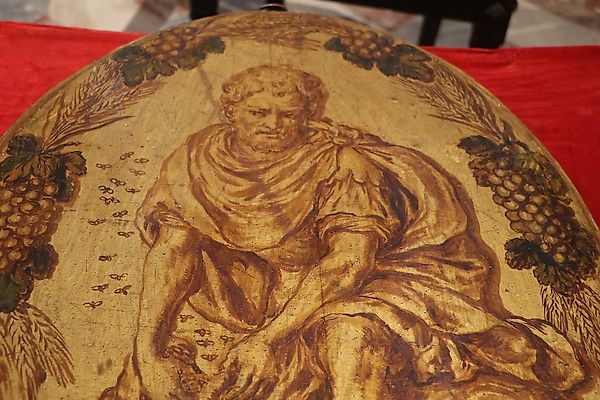
Spanish police have recovered two 17th-century paintings by the Sevillian artist Lucas Valdés that disappeared nearly a century ago after the 1929 Ibero-American Exposition in Seville, according to authorities. The works surfaced earlier this year when they were consigned for auction, prompting an investigation by Spain’s National Police and the country’s culture ministry. The two oval-shaped oil paintings on pine panel once belonged to the Hospital of the Venerable Priests in Seville, where they formed part of the decoration for the church’s main altarpiece. The paintings were loaned out for the 1929 exposition and never returned. Their whereabouts remained unknown for decades. Related Articles Catalonia Sues Aragón for €791,000 for Repayment Over Restitution of 56 Artworks London's Wellcome Collection to Transfer 2,000 Manuscripts to Jain Community, But They Will Stay in UK According to El País, the investigation began in September 2025 after Spain’s Culture Ministry, alerted by the Archdiocese of Seville, notified police that two works scheduled to go up for auction appeared to match the long-missing Valdés paintings. Authorities intervened before the sale could proceed, effectively freezing the transaction while investigators confirmed the works’ identities. Police ultimately contacted the paintings’ owners to explain the works’ legal and patrimonial status. Following negotiations involving the Archdiocese of Seville, the paintings were returned last week to the Hospital of the Venerable Priests. The recovery lands at a moment when questions around ownership, restitution, and cultural patrimony have become increasingly politicized in Spain’s art world. In recent months, Spanish museums and regional governments have been pulled into a series of highly public disputes over contested artworks, missing inventory, and the legacy of pieces displaced during the Spanish Civil War. An order from Spain’s Supreme Court requiring Barcelona’s National Art Museum of Catalonia (MNAC) to return contested medieval murals to the Sijena Monastery in Aragón remained unresolved, as of last month, nearly a year after the ruling, with the museum arguing the fragile works could be damaged during transport. The murals, often described as the “Sistine Chapel of Romanesque art,” were removed from the monastery after it was set ablaze during the Civil War and have remained in Barcelona since the 1960s. That same dispute has escalated into a financial and political brawl between regional governments. Earlier this month, Catalonia formally demanded €791,000 from Aragón to cover conservation and maintenance costs tied to 56 artworks that courts ordered returned from Catalan museums. Meanwhile, Madrid’s Museo Nacional Centro de Arte Reina Sofía has come under mounting pressure from lawmakers over gaps in its inventory records and questions surrounding missing or improperly catalogued works. Spain’s parliament recently passed a resolution demanding a full audit of the museum’s holdings and threatened consequences for museum leadership if the institution fails to comply by the end of the year. Together, the disputes have exposed how deeply questions of art ownership in Spain remain entangled with regional politics, Civil War history, museum bureaucracy, and competing ideas about where cultural heritage belongs.