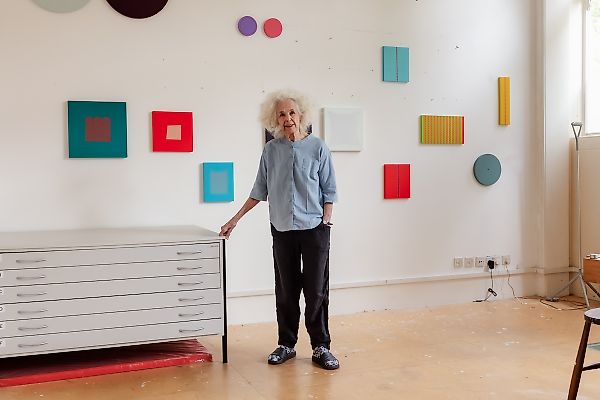
Tess Jaray, a British painter whose understated abstractions explored patterns that recur throughout the world, died on Sunday, according to an obituary posted to the artist’s official Instagram account. She was 88. Jaray specialized in paintings of grids, cubes, and undulating zigzags, all of them set atop palely colored backgrounds. She began making them during the 1960s, at a time when Minimalism reigned supreme across the pond, in the US. But her works exerted a quieter presence, without much of the drama that accompanied that movement. Related Articles Muriel Hasbun, Artist Whose Work Poignantly Recounted the Salvadoran Diaspora and the Fraughtness of Memory, Dies at 64 Valie Export, Groundbreaking Feminist Artist Who Questioned the Nature of Art, Dies at 85 She described a desire to reach something embedded deep within the human condition using these abstractions. In 2019, she told Studio International that she wanted “to make sense of the obsessive searching for patterns and repetition in nature and in art that have been so important … They may be seen as a meeting point, a coming together of the head and the heart and the external and the internal.” While Jaray may lack the name recognition had by some of the most famous artists of her era, she was influential, with her work looked at by artists of many generations—some of whom studied with her at London’s Slade School of Fine Art, where she became the first female teacher in 1968. The celebrated artist Rana Begum, for example, once served as Jaray’s assistant and would later call her a friend; Begum went on to hang a painting by Jaray in her home. Jaray was born in 1937 in Vienna. Her Jewish parents fled the Austrian capital the year after she was born, fearing the rise of the Nazi regime, and re-established themselves in Worcestershire, England. Many of the rest of Jaray’s family members were killed in the concentration camps. She spent much of her childhood drawing landscapes, and she went on to attend art school, first at Saint Martin’s School of Art and Design, then at Slade. In 1960, the same year that she graduated Slade, she visited Italy, which she described as being akin to “entering another world.” Having observed centuries-old buildings by Filippo Brunelleschi and Renaissance-era paintings by Piero della Francesca, she emerged with a new will to make art. “I drew a line across the canvas, a horizontal line in the middle, and then I drew two lines going in at a slight angle,” she told the Art Newspaper, of her return to her studio. “And I thought: ‘Oh, my God, I’m making space.’ Suddenly, I realised that’s what I wanted; I wanted to make space, to make something that you could disappear into. That wouldn’t have happened without Italy.” Jaray later befriended thinkers such as W. G. Sebald and George Steiner. Her art also grew larger, occupying monumental proportions for commissions done in the 1980s and ’90s. Starting in the mid-’90s, she began devoting more energy to her writing, at one point even penning a book alongside Sebald. Recognition came slowly for Jaray, who did not have a survey in her hometown of Vienna until 2021, when Secession mounted one. That same year, her work appeared at Paris’s Centre Pompidou, in a show of female abstractionists. She continued to speak plainly of her work, leaving it mostly to her viewers’ interpretation. In 2013, when the White Review asked her to describe her art, she responded, “I would say that my work is what’s left when everything else is taken away.”