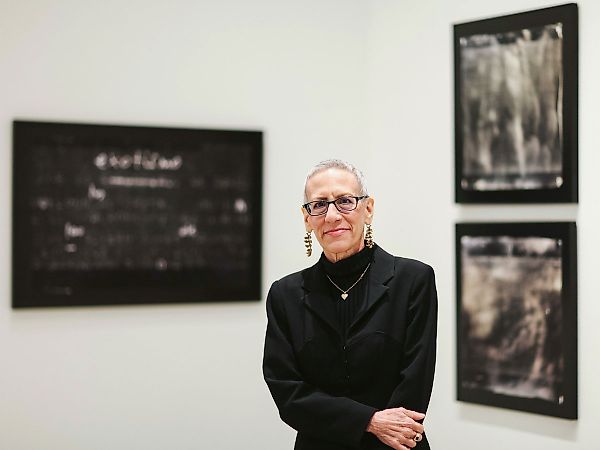
Muriel Hasbun, a multidisciplinary artist whose practice poignantly recounted the effects of El Salvador’s civil war and the migration and exile of its diaspora, died on May 13 from ovarian cancer in Silver Springs, Maryland. She was 64 years old. The news was confirmed by art historian Tatiana Flores. “A beloved member of the DC art scene and a leading advocate for Salvadoran and Central American artists in the diaspora, Muriel’s loss cuts deeply across many communities,” Flores, who curated an exhibition of Hasbun’s at Rutgers University, told ARTnews in an email. “I mourn the passing of a dear friend, her unrealized projects, and the memories that die with her. We left much work unfinished.” Related Articles Valie Export, Groundbreaking Feminist Artist Who Questioned the Nature of Art, Dies at 85 Mary Lovelace O'Neal, Abstract Painter Who Refused to Conform, Dies at 84 Working across photography, video, and installation, Hasbun often looked at themes of memory and migration, loss and exile with a poetic sensitivity that recounted her familial and personal history. She was born in 1961 in El Salvador to Antonio Hasbun Zamora, who was of Salvadoran and Palestinian Christian descent, and Jeannette (Janine) Janowski, who was the daughter of Polish and French Jews. Antonio would give a young Muriel her first camera when she was 15. She left El Salvador in 1979 at the start of the country’s civil war, settling in Washington, D.C. by 1980. Among her earliest mature works is Je me souviens, c. 1945 (1986), a photograph taken from an oblique angle showing her maternal grandmother holding a framed family photograph taken after France was liberated from Nazi occupation. Her grandmother’s red floral dress reflects onto the frame’s glass in such a way that slightly obscures the black-and-white image of a mother and her two children. The haze of memory and how photography could serve as a fertile medium in which to explore that theme would become central to Hasbun’s practice in the decades to come. That thinking was best exemplified by her series “Santos y sombras / Saints and Shadows” (1990–97) in which she combines archival family photos with new images of her own making, collapsing time and place in the process. The veil of past and present, for example, takes an abstract turn in Altar I, while Todos los santos (Para subir al Cielo) shows a cemetery with various cross-shaped tombstones, with a ladder leaning on a wall spectrally overlaid on the image. One image equally tinged with anguish and hope is Palestina llega a El Salvador/Palestine Arrives in El Salvador, showing two palm trees on a clear day in El Salvador, over which Hasbun has superimposed the page from her ancestor’s arrival document: a thumbprint of their “pulgar derecho” (right thumb). Through it all, one can sense a deep sense of longing and the pain of loss for the homeland she once knew. In a 2021 interview with art historian Claudia Pretelin, Hasbun recalled that her favorite part of growing up in El Salvador were weekly visits to the nearby black sand beaches, her terruño, a Spanish word that can equally mean the earth’s soil or the homeland. “As an artist, this ‘terruño’ became the conceptual arena where the forces of creation would play out,” she told Pretelin. “I always felt that making work was about embracing the questions, mysteries and unsolvable paradoxes of being human, what I would later call ‘the irreconcilable.’ Eventually I realized that this ‘terruño,’ while it contained all the complexities and vulnerabilities of identity, also held unbound potential for becoming and for connection. And that I might be able to answer some of these questions by walking this path of possibilities.” Hasbun’s 2023 survey at the International Center of Photography in New York took the title “Tracing Terruño,” which the introductory wall text framed “as an act of mapping, layering the diverse ways Hasbun has reflected on her sense of home, geography, borders, and place,” especially “[i]n a moment when environmental and political crises are causing a rise in mass migration.” On Instagram, the ICP described Hasbun as “an incredible artist whose life and work impacted many of us in the ICP community,” adding, “While working with Muriel, our team had the opportunity to know her as a kind, funny, and insightful person. … Muriel will be remembered as both an artist and an educator who shared deeply personal stories of exile, loss, and migration through her work. Our thoughts are with her husband and son at this time.” The death of Hasbun’s father in 2004 would also prompt the artist to think about her familial legacy in a new way. In El Salvador, Antonio was a dentist, and in 1984, at the height of the civil war, he had been asked to identify the body of her cousin, Janet, who had been a member of the People’s Revolutionary Army (ERP). He ultimately wasn’t able to, but “this memory resonated with Hasbun as a unique intersection of her family’s story and El Salvador’s history,” a wall label from “Tracing Terruño” reads. In going through her father’s belongings, Hasbun came across his archive of dental X-rays, which was often the only way for families to identify the bodies of their loved ones who had been disappeared during the civil war (as could have been the case with Janet). For the 2009–13 series “X post facto (équis anónimo),” Hasbun printed dozens of these radiographs, cropping and blowing them up so as to abstract them. The fuzziness of these images, in their undulating shades of gray and black, recall the “Santos y sombras” series but take that impulse to a more formal end. The teeth rooted in their gums in some images look like bullets buried in the landscape, from a war that ended years ago but whose after effects are still intimately felt by its people. At the core of Hasbun’s practice was how essential memory is to the human experience—and how fraught it can actually be. “Memory is elusive,” Hasbun said in the 2021 interview. “It changes with time and it’s different for each person who experienced a particular event. Nonetheless, its power is unquestionable. We’re not able to construct our sense of self without our memories. Perhaps the greatest challenge is to maintain a sense of authenticity while trying to find a language that may be able to translate and arrest those complex and fleeting memories into something, a narrative of sorts, and that may also connect with others who either have or have not had the same experience as you.” In addition to her artistic career, Hasbun was also an educator, teaching at the Corcoran College of the Arts and Design from 1995 until its closure in 2014, serving as chair of the photography department from 2011 to 2014. The Corcoran would ultimately merge with George Washington University, where Hasbun would work until 2016, when she was named professor emerita. Similarly, Hasbun was equally concerned with the preservation of archives, which she saw as an extension of her practice. As with her father’s death, when her mother died, Hasbun found a new avenue in which to explore this thinking. From 1977 to 2001, Janine Janowski ran galería el laberinto in El Salvador, an experimental art space in a country with no art museum. “Janowski was tenacious, demanding, and intelligent,” Hasbun wrote about the space. “She encouraged artists to seek new visual languages and vocabularies, challenging the existing art paradigms. She believed that the gallery should function on the currency of ideas and tirelessly worked to cultivate a heightened value of art and artists in society. Through her pioneering efforts, Janowski nurtured the work of contemporary Salvadoran artists who had nowhere else to show their artwork.” When her mother died in 2012, Hasbun inherited the gallery’s archives and began combing through them. But she also wanted to carry on that legacy and relaunched the project as laberinto projects, “an arts, culture and education platform that fosters art practices, arts education, legacy preservation, social inclusion and dialogue in El Salvador, Central America and its diaspora,” according to its website. Its programming includes a list of important artworks from the region, artist interviews, educator and artist workshops, and exhibitions. Around this time, Hasbun also begun collaborating with art historian Erina Duganne, who was working on an exhibition and book project on Lucy Lippard’s “Artists Call Against US Intervention in Central America” (1983–84). The two saw an affinity in those archives and that of galería el laberinto, and they soon came to develop a project of their own called “Art for the Future: Building Transnational Activism Through the Archive.” As with Hasbun’s artistic practice, a major emphasis of it is to highlight the contributions of Central American artists. “Salvadorans are the third largest Latinx population in the United States,” Hasbun told Pretelin in 2021. “Latinx artists are barely represented in U.S. museums, and Central Americans are often omitted from Latin American and Latinx art historical narratives. We need an openness to the diversity of who we are, an acceptance that we are an essential part of this country, that we are artists and producers of culture, and that our art is necessary in telling a more inclusive and accurate history of the United States.” In an email, Duganne reflected on her collaborations with Hasbun, writing, “Muriel Hasbun was never one to be reined in by boundaries or categories. What made her multifaceted work—centering exile, diaspora, loss, healing, and eventually illness—so significant is how it resisted totalizing ways of thinking. She was a fierce advocate, ally, teacher, mentor, and interlocutor, who lived life with absolute kindness and grace and never stopped creating and giving to others even after her cancer diagnosis in 2023. She has left a gaping hole in the world and in my heart. I hope she has found peace in her beloved terruño.”