Mary Lovelace O’Neal, Author of Uncategorizable Abstractions, Dies at 84
70May 16, 2026
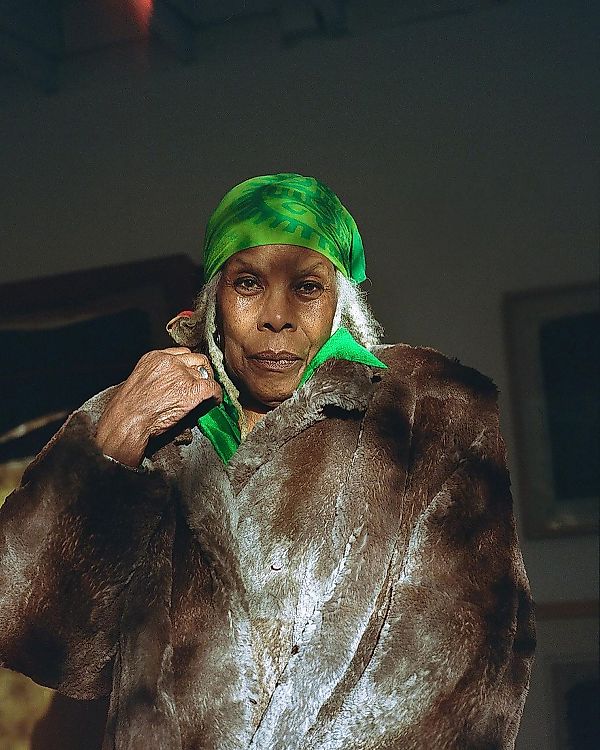
Activist, educator and artist Mary Lovelace O’Neal, whose monumental, richly hued lampblack paintings expanded abstraction’s possibilities, died on May 10 in Mérida, Mexico. She was eighty-four. Despite a fruitful career spanning six decades, Lovelace O’Neal was known primarily as an “artist’s artist” until recent years, when she began to achieve international acclaim. Informed by flatness, abstraction, Minimalism, and social critique, her uniquely visceral works defied description. “I don’t categorize my work. I don’t give it a new name,” she toldVoguein 2024. “I just hope that in the future people see and know that this was a life’s work.”
Mary Lovelace was born on February 10, 1942, in Jackson, Mississippi. Encourage by her father, a choir director and college music professor, to pursue a career in the arts, she earned a BFA from Howard University, where she studied under artist David Driskell and was active in the civil rights movement, helping to found the school’s Non-Violent Action Group and traveling with traveling to Mississippi with classmate Stokely Carmichael to support voter registration drives and labor protests.
In 1963, the summer before she graduated with a BFA from Howard, she attended the prestigious Skowhegan School of Painting and Sculpture in Maine, where she discovered the lampblack pigment that would be a trademark of her practice. In 1965, she married playwright John O’Neal, and the couple moved to New York, where she attended Columbia University and began using lampblack in earnest, applying the powder to unstretched canvas with a chalkboard eraser or her hands, and striating its velvety, matte surface with streaks of vividly hued acrylics, pastels, or oils.
“The black pigment paintings were as black as they could be,” she told the New York Times in 2020. “They can also be seen as my response to my friends in the Black Arts Movement,” among them Amiri Baraka, who criticized her for not directly engaging activist narratives, even as her professors at Columbia urged her to abandon gestural abstraction for Minimalism. Graduating from Columbia in 1969 as the only African American student in the school’s MFA program, she continued apace with her “Lampblack” series, exemplified by works such as The Four Cardinal Works Are Three: North and South, ca. 1970s.
Lovelace O’Neal moved to the Bay Area in the 1970s, where she began her “Whales Fucking” series. “It ain’t deep,” she told Interview magazine in 2024, describing the inspiration behind the works. “A friend and I were walking on one of the city beaches in San Francisco. [We saw] whales coming up and bringing up all of this water with them, so it was like diamonds being thrown out across the sea.” Lovelace O’Neal was transfixed by the idea of how much water the massive creatures would displace when engaging in intercourse. The series, characterized by sweeping gestures, lyrical forms, and fields of mixed-media ornamentation, would be one of her best-known, along with “Panthers in My Father’s Palace.” Begun after a 1984 visit to Morocco, the series amplified the artist’s bold, expressive forms and were themed around her relationship with her father and what she called “the biblical presence of North Africa, and a palace in Asilah, Morocco—the mosaics and moonlight that smeared the ocean.”
Lovelace O’Neal finally began receiving the attention she deserved in recent years, beginning with a 2020 mini retrospective at New York’s Mnuchin Gallery. The subject of major exhibitions at New York’s Marianne Boesky Gallery and the San Francisco Museum of Modern Art in 2024, she participated in the Whitney Biennial that same year, and in the 2025 group show “Paris Noir” at the Centre Pompidou, Paris. Still, she refused to be categorized.
“I call myself a painter,” she told the Times. “What I can do is paint and make things that are powerful. Galleries want to codify you. Every time you move away from the doctrine, you get questioned. Being unruly is my nature. As for doctrinaire, I had to blow it up.”
Concurrent with Lovelace O’Neal’s artistic practice was her teaching career. In 1985 she became the first Black woman to receive tenure in the art department of the University of California, Berkeley, where she had taught since 1979. She became its chair in 1995, retiring as professor emeritus in 2006.
Lovelace O’Neal is survived by her second husband, Chilean American artist Patricio Moreno Toro, whom she met in Morocco. Her work is held in the collections of major institutions around the world including the de Young Museum and the San Francisco Museum of Modern Art, both in San Francisco; the Art Institute of Chicago; the Brooklyn Museum; the Baltimore Museum of Art; the National Gallery of Art and the Smithsonian Institution, both in Washington, DC; the Virginia Museum of Fine Arts, Richmond; and the National Museum of Fine Arts, Santiago, Chile. An exhibition of her work, “Blacker Than a Hundred Midnights Down in a Cypress Swamp,” its title taken from a poem by James Weldon Johnson, author of the Black national anthem “Lift Ev’ry Voice and Sing,” is on view at the Virginia Museum of Fine Arts through August 6.