VALIE EXPORT, Icon of Feminist Art, Dead at 85
72May 15, 2026
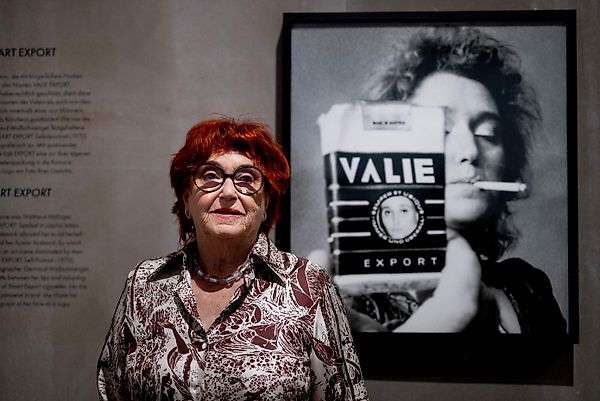
Radical performance artist, filmmaker, and sculptorVALIE EXPORT, arguably the most significant feminist artist of the postwar era, died in Vienna on May 14, just three days shy of her birthday. She was eighty-five. Her death was confirmed by the gallery Thaddaeus Ropac, which represents her. Deploying the body in novel and provocative ways, EXPORT shocked viewers with what she called “acts of protest” against a conservative society, whose mores she challenged through such now-canonical, humor-inflected works that centered the female body and female sexual agency. Though her efforts garnered her hate mail, death threats, and court charges of indecency, EXPORT remained undeterred.
“VALIE was one of the most visionary feminist artists to emerge in Europe in the second half of the 20th century,” said Thaddaeus Ropac in a statement. “Her passing marks the loss of a singular perspective in contemporary art, one that influenced artists across generations. Her pioneering work continues to be of such great urgency.”
“We don’t have witches now, we live in a modern time, but if we want witches, we must take Valie Export and burn her!” trumpeted an Austrian newspaper following a performance of her renowned Tapp und Tastkino (Tap and Touch Cinema), 1968, in which she framed her naked breasts with a miniature cardboard theater and allowed passersby to grope them. “She lets people touch her breasts and she says, celluloid you can burn but Valie Export you can’t.”
Born Waltraud Lehner in Linz, Austria, on May 17, 1940, the artist was raised by a single mother in a country shattered by war and struggling with its Nazi past. EXPORT was educated at a convent school, and would later cite the rituals and ceremonies of the Catholic Church as an artistic influence. The artist determined early on that men had it better than women—“In the beginning was the word and the word was a man,” she wrote at age thirteen—and subsequently began experimenting with gender roles. Early explorations of the theme included self-portraits EXPORT made in male drag, as well as forays in poetry and theoretical feminist texts.
Briefly married, she became a mother by the age of twenty, but temporarily left the child with her sister and decamped for Vienna in the 1960s, changing her name to VALIE EXPORT. In assuming the all-caps moniker (a combination of a childhood nickname and a popular cigarette brand), she pushed against the traditional notion that a woman’s name be that of a father or husband. EXPORT quickly fell in with the Viennese Actionists, but set herself apart from the all-male cohort, whose often aggressive avant-garde performances subjected the body to various extremes, as a self-described “Feminist Actionist,” using her own body to comment on and explode patriarchal norms.
A proponent of expanded cinema, which operates outside the traditional film and video format to include multimedia, live, or immersive components, EXPORT in 1968 cofounded the Austrian Filmmakers Collective alongside a group of artists including Kurt Kren, Hans Scheugl, and Peter Weibel. Among her best-known film and video works are Abstract Film No. 1, 1967–68, which forewent film altogether, instead projecting light through running water onto a mirror, and Finger Poem, 1968, in which the artist spelled with her hands words that were only apprehensible once revealed in text onscreen at the video’s end. Her 1971 video Facing a Family showed a middle-class family eating supper. Broadcast on Austrian public television at dinnertime, the work held a mirror up to viewers who tuned in as they ate, forming a kind of continuous feedback loop.
EXPORT created some of her most notorious performance works around this time, too, starting with Tap and Touch Cinema. Pointing up the cinematic objectification of women, the work transformed the female body from a passive, sexualized object to an active participant in a public action in which players were forced to reckon with the roles assigned them by a patriarchal society. For Aktionshose:Genitalpanik (Action Pants: Genital Panic), she strode through a Munich cinema in crotchless trousers (the work was documented by photographer Peter Hassmann a year later in Vienna), while Aus der Mappe der Hundigkeit (From the Portfolio of Doggedness), 1968, saw her lead Weibel, leashed and on all fours, through the streets of Berlin.
The next decade saw the production of EXPORT’s landmark photographic series “Körperkonfigurationen” (Body Configurations) 1972–82, in which she posed awkwardly in urban settings, revealing the tension between the human form and the built environment. In 1980, EXPORT and Maria Lassnig became the first women to represent Austria at the Venice Biennale. EXPORT’s contribution was Geburtenbett (Birth Bed), comprising a spread set of mannequin legs lying on the floor, strips of glowing red neon issuing from between them. A television set playing a Catholic mass served as the figure’s head.
Though she moved on from the type of incendiary performances that characterized her early practice—“Now that my thinking is changing, my life is changing, I cannot make performances with the same content,” she told Gary Indiana in a 1982 BOMB magazine interview—she continued to work over the ensuing decades. “[EXPORT is] an artist who has never tired of questioning power and the ways in which it is exerted, who recognizes no boundaries between the physical body and other media,” wrote Brigitte Huck in a 2012 issue of Artforum.
EXPORT was professor of multimedia and performance at the Academy of Media Arts in Cologne from 1995 to 2005. In 2015, the VALIE EXPORT Center Linz was inaugurated in a former tobacco factory in her hometown to foster engagement with media and performance art. She was awarded the Roswitha Haftmann Prize, Europe’s largest art honor, in 2019. EXPORT was the subject of major retrospectives at Albertina, Vienna, in 2023 and C/O Berlin in 2024. Her work is held in the collections of major institutions around the world, including the Museum of Modern Art, New York; Tate London; the Centre Pompidou, Paris, and the Museo Nacional Centro de Arte Reina Sofía, Madrid.